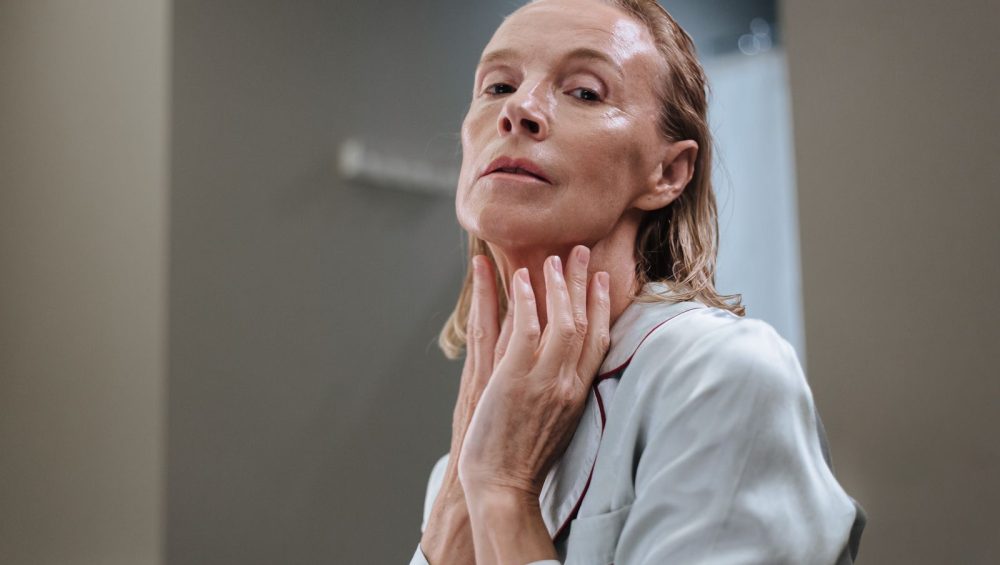

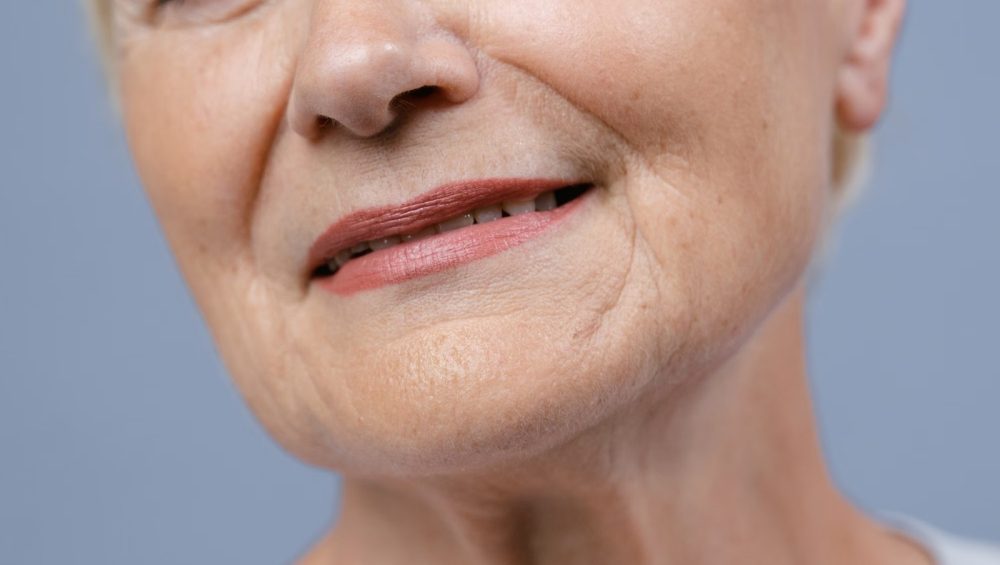
Close-up of a mature woman's lower face and neck showing natural skin textureCategoriesEsente Skincare

Why Skin Thins After 60, and What Genuinely Helps

Short answer: Skin after 60 thins on two levels at once. The outer layer renews more slowly and holds less water, and the junction between the outer and deeper layers flattens out, which removes much of the mechanical grip holding the two together. That flattening is why older skin tears, bruises and shears so easily — it is a structural change, not fragility in the abstract. The deeper layer loses volume in parallel. For many people with mature, dry or increasingly fragile skin, supporting the skin barrier is an important foundation before introducing stronger active ingredients: gentler cleansing, restored surface pH, and consistent lipid replacement. Actives come after that, introduced gradually and according to the directions for the particular product, because they tend to be poorly tolerated on a barrier that has not been supported first.

Almost every routine written for this age group has the order backwards.

Two thinnings, not one

The outer layer. The epidermis thins modestly with age while its renewal cycle lengthens — measurably slower in the seventies than in the twenties, though the exact figures vary between studies and measurement methods, so treat any precise number you see with suspicion. Dead cells stay in place longer, which is why older skin can look dull and rough while also being dry.

The junction between the layers. This is the change that explains the symptoms. In young skin the boundary between the epidermis and the layer below is corrugated — interlocking ridges that grip like a dovetail joint. With age that interface flattens: less surface area for exchange, and far less mechanical resistance to shear. Flattening of the dermo-epidermal junction is a standard description of aged skin in the histology literature (Wulf et al., Micron, 2004;35(3):185–91).

That flattening is why an older forearm can tear from a knock that would not have marked it at 40, and why adhesive dressings can lift skin off. Not weakness as a metaphor — a specific, well-described histological change with specific consequences.

The deeper layer. Volume declines, structural protein content falls, and the elastic fiber network degrades, accelerated hard by cumulative UV exposure. Histological work reports declining thickness through later life; the figures vary enough between studies that the direction is more useful than any single percentage.

What else changes, and why it matters more than you would think

Surface pH rises. Healthy skin sits acidic. That acidity is not incidental — the enzymes that build barrier lipids and the skin’s own antimicrobial defenses work within a narrow pH band. Stratum corneum acidification has been shown to be impaired in moderately aged skin, with barrier defects linked to the resulting rise in pH (Choi et al., Journal of Investigative Dermatology, 2007;127(12):2847–56; the mechanistic work in that paper was done in mice). It is a good reason to consider a pH-balancing toner or antioxidant spray after every cleanse, and that step is part of the Esenté skincare regimen — offered as a recommendation rather than as a physiological requirement for everyone.

Sebum production falls further. It has already dropped through menopause. It keeps dropping. Skin has less of its own occlusive layer and loses water faster.

Blood vessels become more fragile. Purple bruising on the forearms and backs of the hands that appears after minimal trauma is common past 60 and is a recognized presentation. It is not a sign of poor skincare and cannot be prevented with a cream. Anticoagulants and antiplatelet drugs make it more pronounced.

Immune surveillance in the skin declines. Langerhans cell numbers fall with age, and the remaining cells have fewer dendrites and reduced antigen-trapping capacity (Wulf et al., 2004). Healing slows, and infections in broken skin are less well contained.

Vitamin D synthesis in the skin declines. Older skin produces less vitamin D from the same sun exposure because the epidermal concentration of the precursor 7-dehydrocholesterol falls; skin from subjects in their late seventies and eighties produced less than half the previtamin D3 of skin from children and adolescents (MacLaughlin and Holick, Journal of Clinical Investigation, 1985;76(4):1536–8). This is a reason to discuss supplementation with a physician, not a reason to skip sunscreen — the trade there is not close.

The causes nobody mentions

Three drivers of thin skin are not aging at all, and they are worth ruling out before spending money on products.

Topical and oral corticosteroids. Long-term corticosteroid use causes dermal atrophy. This is established, dose-dependent and not controversial. Anyone on chronic inhaled, oral or potent topical steroids who has noticed their skin thinning should raise it with their prescriber rather than treat it as inevitable.

Sun exposure. The photodamaged forearm of a 70-year-old and the sun-protected skin of their upper inner arm belong to the same person and the same genetics. Compare them. The difference is exposure.

Smoking and inadequate protein intake. Smoking is well described as an independent contributor to skin aging, and protein adequacy matters to the tissue the skin has to build. Neither is a skincare problem, and neither is fixed by a product.

Barrier first. Actives second. In that order.

The instinct at 60 is to reach for stronger products, on the reasoning that there is more damage to address. It often backfires, producing skin that is simultaneously thin, dry, irritated and over-treated.

Here is the order Esenté recommends.

1. Look at the cleanser before you change anything else

This is the step people are most likely to treat as low-stakes, and where a lot of avoidable damage happens. Harsh or inappropriate cleansing can compromise skin that is already dry or fragile and no longer has the oil production to recover quickly. Price is not a reliable guide either way — what matters is whether the cleanser is gentle and appropriate for the skin using it.

Esenté’s approach is to cleanse at night, reserving a morning cleanser for genuinely oily skin, on the basis that a properly completed evening routine leaves little to remove; warm water suits most people in the morning. We recommend an aesthetic facial sponge or gauze pad rather than the fingers, and leaving facial scrubbing brushes out — on thin skin, abrasion tends to cause the irritation it was bought to correct. Warm water, not hot.

2. Restore surface pH immediately after every cleanse

A toner or antioxidant spray, morning and night, after every cleanse. Given the age-related rise in surface pH described above, we think it is one of the most under-rated steps for this age group.

3. Replace the lipids the skin no longer makes

Ceramides for the barrier lipids. Humectants such as hyaluronic acid and glycerin to hold water. An occlusive layer over the top to slow its loss — humectants alone in dry indoor air can make skin feel worse rather than better.

Applied twice daily. This is not a luxury step. A cluster randomized trial across 14 Western Australian aged-care facilities found twice-daily application of a pH-neutral, perfume-free moisturizer to residents’ extremities cut skin tears from 10.57 to 5.76 per 1,000 occupied bed days over six months — close to half (Carville et al., International Wound Journal, 2014;11(4):446–53). Those were aged-care residents, so the effect size should not be read across to every healthy adult over 60. It does suggest moisturizer is doing more than cosmetic work.

4. Sunscreen, still, at 60 and at 80

Broad-spectrum SPF 30 or higher, every morning. Photoaging is cumulative and ongoing; the damage does not stop accruing because the birthday count is high. Trials of topical retinoids in photodamaged skin have recruited participants well into their seventies and eighties and reported measurable change in that group, so age is not a reason to assume treatment is wasted — and none of it holds against continued unprotected exposure.

5. Then actives, introduced one at a time

There is no single regimen that suits everyone at this age, and this is not the place for one. The general principle is that active ingredients should be introduced gradually, one at a time, according to individual skin tolerance and the directions for the specific product — and that skin which is thin and easily irritated usually does better with a slower introduction than a faster one. If you are under the care of a dermatologist or another provider, their directions come first.

Niacinamide is a reasonable starting point. Barrier support, tone, redness, and better tolerated on thin skin than almost anything else.

A retinoid is the most evidenced category for texture and fine lines, and the one that most rewards patience. Follow the directions supplied with the product you have chosen; slower conversion in over-the-counter retinol is an advantage on thinning skin rather than a compromise. More on the approach in starting retinol without wrecking your barrier.

Peptides are a reasonable option for skin that does not tolerate a retinoid — well tolerated, with a thinner independent evidence base and a published literature that is substantially manufacturer-funded. See what peptides actually do.

Vitamin C in the morning, if tolerated.

6. Exfoliate less than you did

Slower cell turnover is a genuine argument for some exfoliation. Thin, fragile skin is a stronger argument against overdoing it. Keep it infrequent, chemical rather than physical, and stop if the skin reacts.

What honest expectations look like

What improves: hydration, comfort, texture, tone, tolerance of products, resilience to minor damage, and the appearance of fine lines. These are real and visible, though how quickly they appear varies considerably between individuals and formulations.

What does not: the structural volume already lost, the flattened junction between layers, and the degraded elastic network. Topical products act on the epidermis and the visible surface. They do not rebuild anatomical structure below it — and a cosmetic that claims to should be read carefully, because claims about changing the structure of the body are drug claims rather than cosmetic ones.

What is a separate conversation: professional treatments performed in a clinic by an appropriately qualified and licensed professional where required. They act differently and more aggressively than anything sold retail and need a practitioner who has examined your skin — particularly at an age where healing is slower and medications may be relevant.

None of this competes with a filler or a facelift, and none of it is trying to. Injectables add volume. Surgery repositions tissue. Topical care changes the quality of the skin itself, which neither of the other two addresses. The honest version of that promise is better skin, not a different face.

The routine, in order

Morning. Warm water, or a gentle cleanser if your skin is oily. Toner or antioxidant spray. Vitamin C serum if tolerated. Moisturizer with ceramides. Broad-spectrum SPF 30 or higher, extended to the neck and chest.

Evening. Gentle cleanse with a sponge or gauze pad. Toner or antioxidant spray. Retinoid on the nights your product’s directions allow, hydrating serum on the others. A richer night moisturizer.

Weekly. Gentle exfoliation, kept infrequent.

For placement within those steps: a gentle cleanser such as Esenté Orchid Reviving Cleanser, followed by Octet Herbal Toner or Hydro-Mist, then a serum suited to your skin and a hydrating night creme. Esenté formulations are developed collaboratively by Victoria Nash with Esenté’s professional formulation and manufacturing partners. The Elite line ships in Miron violet glass rather than plastic; taking product out with a cosmetic spatula rather than fingers is good hygiene practice.

Frequently asked questions

Why does skin get thin and fragile after 60?

Two changes together. The outer layer renews more slowly and holds less water, and the junction between the outer and deeper layers flattens, removing much of the mechanical grip that held them together. The deeper layer also loses volume and elasticity. The flattened junction is the reason older skin tears and shears from minor knocks.

Can thin skin be thickened again?

Not by a topical product. Products act on the epidermis and the visible surface, where they improve hydration, texture, tone and the appearance of fine lines. They do not restore lost structural volume. Slowing further loss is achievable, and daily sun protection is the most effective way to do it.

Why do I bruise so easily on my arms now?

Blood vessels become more fragile with age and the supporting tissue around them thins, so minor knocks produce visible bruising on the forearms and hands. Anticoagulants, antiplatelet drugs and long-term corticosteroids make it more pronounced. If it has appeared suddenly or worsened, raise it with your physician rather than a skincare brand.

Is it too late to start a skincare routine at 70?

No. Trials of topical treatment for photodamaged skin have included participants in their seventies and eighties and reported measurable change, and barrier support improves comfort and appearance at any age. The gains are real; they build more slowly.

Should I use stronger products because my skin has more damage?

Often the opposite. Thin, barrier-compromised skin tends to tolerate less, and over-treatment is a common problem in this age group. Look at the cleanser, restore surface pH, replace the barrier lipids, then introduce one active at a time, gradually and according to the directions for that product.

Could my medication be thinning my skin?

It might be. Long-term topical, inhaled or oral corticosteroids cause dermal atrophy, and the effect is dose-dependent and well documented. Do not stop a prescribed medication over this — raise it with the doctor who prescribed it.

Related reading

About the author. Victoria Nash, founder of Esenté Skincare and Younger You Clinique, has been a licensed aesthetician since 2004 and is an experienced skincare educator.

Reviewed by Victoria Nash, licensed aesthetician and founder of Esenté Skincare & Younger You Clinique. This article is educational and is not medical advice. Discuss medications, bruising, and any change in your skin with your physician.


Mature woman applying skincare to her neck and decolleteCategoriesEsente Skincare

Crepey Skin on the Neck and Décolleté: Why It Starts There, and What Genuinely Helps

Short answer: The neck and chest crepe before the face because the skin there is thinner, folds constantly, and gets a fraction of the sun protection and product the face receives. Crepey skin commonly reflects a combination of factors including dermal thinning, changes in elastin and loss of hydration — and those factors respond to different things. Hydration and barrier support tend to give the fastest visible return. Texture work with a retinoid, used more sparingly than on the face, produces slower change over months. Neither addresses laxity, which is tissue descent: a topical cosmetic cannot physically reposition it, though it can improve the appearance of firmness and skin quality. And none of it holds if the area keeps getting daily unprotected sun, which for most people it does.

The area that ages first is the one almost nobody treats.

What crepey actually means

Crepey is not the same as wrinkled and it is not the same as loose. It describes fine, closely spaced lines across a broad area, with a texture like crushed tissue paper, and several changes commonly contribute to it at once.

The dermis thins. Less structural protein, less volume beneath the surface, so the surface no longer sits taut over anything.

Elastin changes. The part that gets least attention and matters most. Elastin gives skin its snap-back. Turnover of the elastic fiber network in adult skin is very slow, and the network you have is largely the one built by early adulthood. UV exposure degrades it and is associated with the accumulation of disorganized elastotic material — solar elastosis under a microscope. Topical skincare cannot recreate the elastic architecture of young skin.

The skin is often dehydrated. The neck and chest hold less water than facial skin and receive less moisturizer. Dehydrated skin exaggerates every fine line it has. Hydration is also the factor that responds fastest, which is why moisturizing produces such a quick visible improvement — and why that improvement fades when it stops.

Why it starts here and not on your face

The skin is thinner. Facial skin is thicker and better supported than the skin over the anterior neck and upper chest. Less to lose means the loss shows sooner.

It never stops moving. Every head turn, every nod, every hour looking down at a phone folds the same tissue along the same lines. The face does this too, with more structural support and less range.

It sleeps in a fold. Side and stomach sleeping compress the chest into vertical creases held for hours at a time. Sleep wrinkles are described in the aesthetic literature as a pattern distinct from expression lines, produced by compression and shear rather than muscle movement (Anson, Kane and Lambros, Aesthetic Surgery Journal, 2016;36(8):931–40). That paper is a review of the mechanism, not a trial of changing position — so treat sleep position as worth knowing about rather than as a proven intervention.

It gets a fraction of the sun protection. People apply sunscreen to their face and stop at the jaw. The chest then takes direct overhead sun through open collars for decades.

It gets a fraction of the product. Whatever is left on the fingers, some of the time.

The sun evidence you can see on your own body

Two pieces of visual evidence make the UV case better than any statistic.

Poikiloderma of Civatte. The reddish-brown mottling with fine visible vessels that appears on the sides of the neck in middle age — and which characteristically spares the shaded triangle under the chin. That sparing is worth noticing, because within one person the exposed and shaded skin are the same age and the same genetics, and they do not look the same. Be careful how far you push it, though: the dermatology literature describes this pattern as multifactorial, with chronic UV exposure alongside hormonal change, contact sensitization to fragrances and preservatives, and a probable genetic predisposition (Katoulis et al., Dermatology, 2007;214(2):177–82; Khunkhet and Wattanakrai, Case Reports in Dermatology, 2014;6(3):258–63). Sun is the biggest lever you control. It is not the only variable.

Unilateral photoaging in drivers. A 2012 New England Journal of Medicine clinical image, widely reproduced since, showed a 69-year-old man who had driven a truck for 28 years with dramatic photoaging on the side of his face nearest the window and comparatively little on the other (Gordon and Brieva, N Engl J Med 2012;366(16):e25). It is one striking case rather than a study, and it should be read that way. The measured part is the glass: windshields are laminated and block nearly all UV-A, side windows are tempered and block far less. A survey of 29 vehicles found windshields averaging 96% UV-A blockage against 71% for side windows, with side windows ranging from 44% to 96% (Boxer Wachler, JAMA Ophthalmology, 2016;134(7):772–5). The neck and shoulder sit directly in that path.

The commonly quoted figure attributes up to 80% of visible facial aging to sun exposure — received wisdom in the dermatology literature more often than a measured result, so read it as an estimate of scale rather than a measured split. The sparing under your own chin makes the point without a number at all.

What produces visible change, ranked honestly

1. Sunscreen, applied down to the chest, every morning. Broad-spectrum SPF 30 or higher, taken to the collarbone and beyond, not stopped at the jawline. This is prevention rather than correction, which makes it unsatisfying advice and the highest-return line in this article regardless.

2. Hydration and barrier support. The fastest visible result available. Humectants such as hyaluronic acid draw water in; ceramides and an occlusive layer slow its escape. This can improve the appearance of dryness and fine crepey texture relatively quickly, though results vary by skin and formulation — and the effect is cosmetic and reversible, not structural. Say that plainly, because the before-and-afters circulating online are almost all this effect photographed at its peak.

3. Niacinamide. Barrier support, redness reduction, tone improvement, and well tolerated on thin skin that rejects most actives.

4. A retinoid, used more cautiously here than on the face. The most evidenced topical category for texture and fine lines, and the one most likely to be abandoned here because people apply their facial dose to skin that is thinner and more reactive. Introduce it cautiously, according to individual tolerance and the directions for the particular product. More in starting retinol without wrecking your barrier.

5. Gentle exfoliation, kept infrequent. Dead cell buildup exaggerates crepey texture. Aggressive exfoliation on thin, already-compromised skin creates micro-damage you will spend a month recovering from.

6. Peptides. Reasonable supporting players, well tolerated on reactive skin. The independent evidence base is thinner than for retinoids and much of the published work is manufacturer-funded. See what peptides actually do.

Where the claims outrun what a topical can do

“Lifting.” Laxity along the jaw and under the chin is tissue descent — fat pad shift, muscle and structural change beneath the skin. A topical cosmetic cannot physically reposition that tissue or reproduce what a surgical procedure does. What it can legitimately do is improve the appearance of firmness, contour, smoothness and elasticity — a real and worthwhile cosmetic benefit, and a narrower one than the word “lift” tends to suggest. Read a firming claim as a claim about appearance, because that is what it is.

Judging a neck product by the word on the label. A neck-specific product deserves to be evaluated on the quality of its formulation, its ingredients and its intended benefits rather than on the words “neck cream.” What also gets overlooked is applying enough of whatever you use, and extending it to the collarbone.

Scrubbing. Esenté’s preferred approach leaves facial scrubbing brushes out of the routine, and the neck is a particularly poor place for one: abrasion on thin skin with limited capacity to recover tends to produce the inflammation the brush was bought to correct. Aesthetic facial sponges or gauze pads are the gentler option.

Anything promising reversal. Topical skincare does not recreate the elastic architecture of young skin. Improvement in appearance is achievable and worth having. Reversal is not on offer from anyone selling it.

Professional treatments performed in a clinic by an appropriately qualified and licensed professional where required — microneedling, fractional laser, radiofrequency — work differently and more aggressively than anything sold retail. They are a separate decision, made with a practitioner who has examined the area.

The routine, and the habits that matter more than it

Morning. Esenté’s approach is warm water for most people, reserving a morning cleanser for genuinely oily skin, on the basis that a properly completed evening routine leaves little to remove. Follow with a toner or antioxidant spray after every cleanse, on the neck as much as the face. Then a hydrating serum, a moisturizer, and broad-spectrum SPF 30 or higher taken to the collarbone.

Evening. Gentle cleanse with a sponge or gauze pad, toner or antioxidant spray, then your treatment step — retinoid on the nights your product’s directions allow, hydrating serum on the others — and a richer moisturizer over the top. Everything you apply to your face, extend downward. It costs a slightly larger pump and nothing else.

Weekly. Gentle exfoliation, kept infrequent, extended to the neck with a lighter hand than you use on your face. Reapply sunscreen if you drive with the window down, and wear a collar in strong sun.

For placement within those steps: a gentle cleanser such as Esenté Orchid Reviving Cleanser, then Octet Herbal Toner or Hydro-Mist, a serum suited to your skin, and a hydrating night creme. For the neck and décolleté specifically, Esenté makes Nek-Tyme Firming Crème. Esenté’s formulations are developed collaboratively by Victoria Nash with Esenté’s professional formulation and manufacturing partners, and the Elite line ships in Miron violet glass jars rather than plastic. Removing product from a jar with a cosmetic spatula rather than fingers is good hygiene practice in a container you will open daily for months.

Frequently asked questions

What causes crepey skin on the neck and chest?

Crepey skin commonly reflects a combination of factors: thinning of the layer beneath the surface, changes in the elastic fiber network — to which UV exposure contributes heavily — and loss of hydration. Constant folding from head movement and sleep position concentrates it into visible lines, and the area receives less sunscreen and less product than the face for decades.

Can crepey skin be reversed?

The hydration component improves quickly and visibly with consistent moisturizing, and that improvement is real. The structural component is another matter: turnover of the elastic fiber network in adult skin is very slow, and topical skincare cannot recreate the elastic architecture of young skin. Products that improve texture, tone and the appearance of fine lines are worth using. Products promising reversal are describing something no topical can do.

At what age does the neck start to age?

Often in the forties, and earlier than the face for the same person. The skin is thinner, it moves constantly, and it has usually had far less sun protection. Many people notice it first in photographs rather than the mirror, because the mirror is met head-on and the neck is not.

Should I use a special neck cream?

Judge it the way you would judge any product: on the quality of its formulation, its ingredients and its intended benefits rather than simply on the words “neck cream” on the label. Products developed for the neck and décolleté can be formulated with the demands of that skin in mind. Whatever you choose, applying enough of it and extending it to the collarbone daily matters as much as which tube it came from.

Can I use retinol on my neck?

Generally yes, but with more caution than on the face. The skin here is thinner and more reactive, and the most common reason people abandon a retinoid on the neck is starting at their facial dose. Introduce it gradually according to your own tolerance and the directions for the particular product.

Does sunscreen help crepey skin that already exists?

Its value is in limiting further damage, which is the larger part of the battle. UV degrades the elastic network you have left, so daily broad-spectrum SPF 30 or higher taken down to the chest helps protect the structure that is still intact. It is prevention rather than correction, and it remains the highest-return step available.

Why does the skin under my chin look better than the skin on the sides of my neck?

Largely because it is shaded. That contrast — mottled, vessel-marked skin on the sides of the neck sparing the triangle beneath the chin — is a recognized pattern called poikiloderma of Civatte. Cumulative sun exposure is considered its main driver, and the sparing under your own jaw is a vivid demonstration of what shade is worth. The literature also implicates hormonal change, contact sensitization to fragrances and preservatives, and a likely genetic predisposition, so it is not a single-cause pattern.

Related reading

About the author. Victoria Nash, founder of Esenté Skincare and Younger You Clinique, has been a licensed aesthetician since 2004 and is an experienced skincare educator.

Reviewed by Victoria Nash, licensed aesthetician and founder of Esenté Skincare & Younger You Clinique. This article is educational and is not medical advice. Discuss any skin condition, in-office procedure or medical treatment with a qualified practitioner.

Woman in her fifties in natural light, relaxed and unretouchedCategoriesEsente Skincare

Menopause and Skin: What Changes, and in What Order

Short answer: Skin changes associated with the menopausal transition emerge gradually, though timing, sequence and severity vary considerably from person to person. Oiliness and reactivity commonly shift first, during perimenopause, while estrogen is still fluctuating — often with adult breakouts and a new intolerance to products you used for years. Increasing dryness follows, and for many women it persists. The steepest structural change is generally placed in roughly the first five years after the final period, which is when firmness and bounce tend to go — an estimate drawn from cross-sectional work rather than a measured trajectory, and one we unpack below. Laxity, crepiness and consolidated pigment follow more slowly over the decade after that. The pattern is worth knowing because each stage responds to something different, and the routine that suits perimenopausal skin is close to the opposite of the one that suits skin five years post-menopause.

Most advice treats menopause as a single event. Your skin experiences it as a timeline.

Why the pattern exists

Estrogen receptors are present throughout human skin — in keratinocytes, fibroblasts, sebaceous glands and hair follicles. That is why a hormonal transition shows up on your face at all, and why it produces a cluster of changes rather than one.

The transition is long. Perimenopause commonly begins in the mid-to-late forties and runs several years. Menopause is defined retrospectively: twelve consecutive months without a period, commonly cited at a US median age of about 51, though SWAN’s longitudinal analysis put the median at 52.5 (Gold et al., American Journal of Epidemiology, 2013). The symptoms do not stop at the finish line — among the SWAN women who reported frequent hot flashes or night sweats, meaning six or more days in the previous fortnight, the median total duration was 7.4 years, and among those with an observable final period it persisted a median of 4.5 years beyond it (Avis et al., JAMA Internal Medicine, 2015). Those figures describe women with frequent symptoms, not every woman.

The window in which skin is being reorganized is closer to a decade than a year.

Stage one: perimenopause, and the confusing years

This is the stage that catches people out, because the complaints do not sound like aging.

Oil behavior becomes erratic. Estrogen and androgens shift relative to one another, and sebaceous glands respond to that ratio rather than to either hormone alone. Skin predictable for twenty years starts producing more oil some weeks and less in others.

Adult breakouts appear or return. Jawline and chin, often cyclical, often in women who had clear skin since their twenties. A common complaint in this age group, and routinely misread as a reaction to a new product.

Reactivity increases. Products tolerated for a decade start to sting. Fragrance that never registered starts to register.

Sleep disruption shows on the face. Night sweats and broken sleep are not a skin problem, but under-eye shadowing, dullness and slower recovery from irritation follow from them.

The mistake at this stage is to escalate. Erratic oil and breakouts push people toward stripping cleansers, acids and scrubs at the moment their barrier is becoming less resilient. The result is skin that is oily, congested and damaged at once.

What actually helps here: stabilize rather than attack. A gentle cleanser at night, a toner or antioxidant spray after every cleanse, niacinamide for barrier support and redness, and a light moisturizer. Esenté’s preferred approach is to cleanse with an aesthetic facial sponge or gauze pad rather than the fingers, and to leave facial scrubbing brushes out altogether. Morning cleanser is generally reserved for genuinely oily skin.

Stage two: the final year and the twelve months after it

This is the compressed one, and it is why women describe their skin as changing overnight.

Circulating estrogen falls substantially across the transition, and for many women the change around the final period feels comparatively rapid — though the endocrine picture differs from woman to woman. Fibroblast activity, structural protein synthesis, skin thickness and water-holding capacity are all influenced by estrogen and tend to decline together. The subjective experience is that skin stops bouncing back — a crease that used to be gone by mid-morning is still there at lunch.

You will see a figure attached to this: roughly 30% of skin collagen lost within five years of menopause, then about 2% a year afterwards. It is worth knowing what that rests on, because it is thinner than its ubiquity suggests.

The primary measurements are Brincat and colleagues’ 1987 work, which found skin collagen content, skin thickness and bone measures declining together at between 1% and 2% per year after menopause (Brincat et al., Obstetrics & Gynecology, 1987;70(6):840–5). Those studies were cross-sectional — different women compared at different distances from menopause, rather than the same women followed over time — and the slope was fitted by regression. The “30% in the first five years” half of the figure does not appear in that paper. It circulates through later review articles, which cite one another rather than reproducing the measurement (see, for example, Duarte et al., Cutis, 2016;97(3):E16–23, and the reviews citing it).

So: the direction is well supported and the mechanism is real. The specific numbers are a re-cited estimate of scale, not a measured trajectory, and no longitudinal study has replaced them.

The other change in this window is sebum. Production tends to fall, and unlike the perimenopausal fluctuation this shift is not usually followed by a swing back. Skin that was oily for decades often becomes noticeably drier and stays that way — which is why a cleanser that was correct in your forties is frequently wrong a year or two later. We cover the structural side in collagen loss after 50.

Stage three: years one to five after your final period

The changes here are consolidation rather than new events.

Dryness tends to become the baseline. For many women it is no longer seasonal. The barrier holds less water and the skin makes less oil to slow its escape.

The barrier becomes the limiting factor. Actives sting, moisturizers absorb unevenly, and the routine that worked in your forties starts producing reactions. Barrier support stops being a supporting step and becomes the foundation everything else sits on.

Wound healing slows. Blemishes, scratches and post-treatment redness take longer to clear. Estrogen’s role in cutaneous wound healing is well described, and the practical effect is that anything irritating your skin now costs more days than it used to.

Facial hair changes. As the androgen-to-estrogen ratio shifts, terminal hairs appear on the chin and upper lip while hair elsewhere thins. Common, rarely discussed, not a sign anything has gone wrong.

What actually helps here: ceramides, hyaluronic acid, and a richer night moisturizer than you think you need. This is also the stage where a retinoid earns its place — introduced gradually according to individual tolerance and the directions for the particular product, because reactive post-menopausal skin rarely takes well to a nightly start. More on the approach in starting retinol without wrecking your barrier.

Stage four: years five to twenty

Slow, cumulative, and dominated by what your skin was exposed to rather than by hormones.

Laxity along the jaw and neck. This is tissue descent, and it is the change topical products address least. A topical cosmetic cannot physically reposition descended tissue or reproduce a surgical lift. It can improve the appearance of firmness, contour and smoothness — a different and more modest promise.

Crepiness on the neck, chest and under the eyes. Fine, closely spaced wrinkling from thinner skin and lost elasticity. It responds to hydration and texture work more than most people expect, and to nothing at all if the area is still getting daily unprotected sun. See crepey skin on the neck and décolleté.

Pigment consolidates. Decades of sun damage surface as fixed lentigines rather than the summer freckling of your thirties.

Skin thins and bruises more easily. Covered in why skin thins after 60.

By this stage the hormonal driver is largely spent and the dominant variable is photodamage. The commonly quoted figure attributes up to 80% of visible facial aging to sun exposure — received wisdom in the dermatology literature more often than a measured result, so read it as an estimate of scale. It points the same way regardless: what you did in the sun before 40 shows up here, and daily protection now changes the next decade.

The three things that get blamed on menopause and are not menopause

Photodamage. Deep wrinkles, mottled pigment, broken capillaries and leathery texture are sun history. The timing coincides with menopause because both surface in your fifties.

Weight change. Facial fat pads shift and shrink with age and with weight loss. That reads as hollowing and sagging, and it is independent of estrogen.

Over-treatment. A familiar version of “my skin got worse at 52” is skin that has had four new actives, an acid and a cleansing device added to it inside three months. Skin in transition tolerates less, not more.

What we are not going to tell you

Systemic hormone therapy affects skin. The same 1987 group reported that the decline in skin collagen was smaller in postmenopausal women receiving estrogen than in untreated women (Brincat et al., British Journal of Obstetrics and Gynaecology, 1987;94(2):126–9). That is an observation about skin, and it is not a reason to start or stop anything. Skin is not an indication for hormone therapy, a skincare brand is not the right source on that question, and this article makes no recommendation on it in either direction. Take it to your physician, who can weigh it against your full medical history.

Second: nothing topical replaces structure that has already gone. Products work on the epidermis and the visible surface, improving texture, hydration, tone and the appearance of fine lines. They do not restore dermal volume, and any brand telling you otherwise is describing a drug it has not registered.

Third: professional treatments performed in a clinic by an appropriately qualified and licensed professional where required — microneedling, laser resurfacing — operate on a different level and are a separate decision from anything you buy on a website.

A routine that matches the stage you are in

Perimenopause. Gentle night cleanser, toner or antioxidant spray after every cleanse, niacinamide, light moisturizer, daily broad-spectrum SPF 30 or higher. Hold off on aggressive actives while oil is fluctuating.

Post-menopause, years 0–5. The same foundation, plus ceramides, hyaluronic acid, a richer night moisturizer, a morning antioxidant, and a retinoid introduced gradually according to individual tolerance and the directions for the particular product.

Post-menopause, five years on. Everything above, with more attention to the neck and chest than the face, and gentle exfoliation kept infrequent.

Esenté’s preferred approach leaves scrubbing brushes out at every stage. For placement within those steps: a gentle cleanser such as Esenté Orchid Reviving Cleanser, then Octet Herbal Toner or Hydro-Mist, a serum suited to your skin, and a hydrating night creme. Esenté formulations are developed collaboratively by Victoria Nash with Esenté’s professional formulation and manufacturing partners, and the Elite line ships in Miron violet glass rather than plastic.

Frequently asked questions

At what age do menopausal skin changes start?

Usually in the mid-to-late forties, during perimenopause, before periods stop. The first signs are erratic oil production, adult breakouts and new sensitivity rather than wrinkles. The structural change concentrates later, around and after the final period — commonly cited at a US median age of about 51, with SWAN’s longitudinal analysis reporting 52.5.

Why did I suddenly get acne in my forties?

Perimenopausal hormone fluctuation shifts the balance between estrogen and androgens, and sebaceous glands respond to that ratio. Jawline and chin breakouts in the forties are common and are frequently mistaken for a reaction to a new product. Treating them with the stripping routine you would have used at twenty tends to make things worse, because barrier resilience is falling at the same time.

How long do menopausal skin changes last?

The steepest phase is concentrated in roughly the first five years after your final period. Slower change continues for a decade or more after that, but by then photodamage is the dominant driver rather than hormones. The transition as a whole spans closer to a decade than a year.

Can skincare reverse menopausal skin changes?

No topical product replaces structure that has already been lost. Products work on the epidermis and the visible surface — texture, hydration, tone, the appearance of fine lines — and consistent use produces real, visible improvement in those. Slowing further loss is achievable, and daily sun protection is the most effective way to do it.

Should I take hormone therapy for my skin?

That is not a question this article can answer, and not one a skincare brand should be answering. What the research describes is narrower than the question: estrogen receptors are present throughout human skin, and studies of women receiving systemic hormone therapy have reported less structural decline than in women who were not. Those are observations about skin. The decision is a prescription decision that belongs to you and your physician, resting on symptoms, cardiovascular and breast history, age, time since your final period and personal risk tolerance — factors that sit well outside anything skin can inform. Take it to a clinician who knows your history.

Does everyone experience this the same way?

No. Timing, sequence, severity and which changes dominate vary considerably with genetics, skin type, Fitzpatrick phototype, accumulated sun exposure, smoking history, sleep and weight change. The stages above are a framework for understanding what is happening, not an order every woman should expect to follow.

Related reading

About the author. Victoria Nash, founder of Esenté Skincare and Younger You Clinique, has been a licensed aesthetician since 2004 and is an experienced skincare educator.

Reviewed by Victoria Nash, licensed aesthetician and founder of Esenté Skincare & Younger You Clinique. This article is educational and is not medical advice. Discuss hormone therapy, menopausal symptoms and any medical treatment with your physician.

Woman gently applying skincare serum to her faceCategoriesEsente Skincare

Starting Retinol Without Wrecking Your Barrier

Short answer: Start at the lowest concentration available to you, apply it to dry skin (buffering over a layer of moisturizer is one option where the product’s directions allow it), and build up gradually, according to individual tolerance and the directions for the particular product — raising the frequency rather than the strength. People often abandon a retinoid not because it failed but because they moved to nightly use immediately, irritated the skin barrier, and spent the following weeks red and flaking. Visible change generally takes months rather than weeks, and peeling is better read as a sign the skin is being pushed harder than it can take than as evidence the product is working. Skin that has been irritated is not in a good position to make use of the active you paid for.

The slow version gets there faster. That is the whole argument.

The mistake almost everyone makes

A new retinol arrives. It gets used every night. Inside a fortnight the skin around the nose is flaking, the cheeks sting under moisturizer, and a patch on the jaw has gone tight. The bottle goes in a drawer.

The application that produces steady improvement over many months and the one that leaves a barrier irritated within a fortnight are often not different concentrations at all. They are the same concentration applied at different frequencies. Stated as an argument rather than a finding: the controlled literature shows irritation is dose- and frequency-related and that benefits accrue over months. Who ends up still using a retinoid a year later has not been tracked in a way that would let anyone quote a number.

What a retinoid actually is, and why the form matters more than the number

Retinoid is the family name. Everything in the family has to reach the same endpoint to do anything: retinoic acid.

Prescription tretinoin is retinoic acid applied as retinoic acid. It needs no conversion, which is why it works faster and irritates more. Over-the-counter retinol is two conversion steps away — retinol to retinaldehyde to retinoic acid — and each step loses material. Retinyl esters such as retinyl palmitate sit a step further back and are the weakest common form on the shelf. Adapalene, approved for over-the-counter sale in the US in July 2016, binds retinoic acid receptors directly and is generally better tolerated than tretinoin.

Those conversion steps are why a 1% retinol is not “1% tretinoin,” and why cross-brand percentage comparisons collapse on inspection.

Retinoic acid binds nuclear receptors in skin cells, and the tretinoin literature describes effects on fibroblast activity and on the enzymes that break structural proteins down. That research describes a prescription drug and a well-studied ingredient class. It does not describe what any retail cosmetic does.

The percentage question is the wrong question

Ask most people how strong their retinol is and they read a number off the box. That number tells you less than they think.

Over-the-counter retinol spans roughly 0.01% to 2%, and the high end is not confined to expensive brands — The Ordinary, CeraVe and Olay all ship products in the 0.5% to 1% range at drugstore prices. One in-vivo comparison found 0.3% and 1% retinol comparably effective on biopsy endpoints — keratinocyte proliferation and fibrillin-rich microfibril deposition, not wrinkle scores — with 0.3% better tolerated in the separate in-use arm (Mellody et al., International Journal of Cosmetic Science, 2022). Read that with its limits attached: the biopsy arm ran on five volunteers, and several authors work for No7 Beauty Company, Walgreens Boots Alliance, which sells retinol. It is one study, industry-affiliated, and it points away from the “more is better” instinct rather than settling the question.

Two things matter more than the headline percentage:

Disclosure. Does the brand publish the concentration and the exact form? Where both are published you have something you can compare against another product. Where they are not, you have less to work with. Concentrations can form part of proprietary formulation information, and a decision not to publish one is not by itself evidence about the formula.

Stability. Retinol degrades on exposure to light, air and heat. A retinol in clear packaging on a warm bathroom shelf is a different product in month three than it was in week one.

Build frequency, not strength

Hold the concentration where it started and let frequency be the variable you adjust. That is the entire structure, and it is the part that generalizes.

There is no universal schedule here, and this article is not going to invent one. Products differ in concentration, form, vehicle and directions, and skin differs more than products do. Introduce a retinoid gradually, according to individual tolerance and the directions for the particular product. Where a physician, dermatologist or licensed professional has given you a plan, theirs governs.

Within that, the principle is simple. Begin at the lowest frequency the product’s directions allow and increase only once the skin has been consistently comfortable — no persistent redness, no tightness, no flaking the following morning. If a step up produces any of those, step back down and let the skin settle. That is titration behaving as a feedback loop rather than a countdown.

Hold at whatever frequency your skin tolerates without complaint. Plenty of people never reach nightly use and still see change. Nightly use is not the goal; consistent use is.

Buffering, and the technique details that decide the outcome

Apply to dry skin. Damp skin increases absorption and increases irritation with it. Let the skin dry after cleansing.

Buffering with moisturizer is an option, not a rule. Moisturizer first, let it settle, retinoid over the top. This is a common approach for reactive skin and is generally understood to blunt initial irritation without eliminating the effect. Product-specific directions — particularly those supplied with a staged system such as Esenté’s Retinol Progressive 60-Day Renewal System — take precedence over it. For skin already reacting, short-contact use — applying the retinoid, leaving it briefly, then removing it and moisturizing — is an approach dermatologists have used with patients who do not tolerate longer exposure. How brief is a question for the product’s directions or for the professional who suggested it, not for an article.

Use the amount the product directs. Application amounts are approximate guides and vary by the individual and the formulation. Over-application may increase irritation, and the product-specific directions should control.

Stay off the thin skin. Skip the eyelids and the corners of the nose and mouth early on. Irritation tends to start there and last longest there.

Sunscreen every morning. Retinoids increase sun sensitivity, and the damage you are treating is largely sun damage. Broad-spectrum SPF 30 or higher, daily. Skip it and you are running the treatment and the cause at once.

What to stop doing while you titrate

One new active at a time. Start a retinoid and an acid together and you will never learn which one your skin objected to.

Ease off other exfoliation while the skin adapts. Scrubs, acids and enzyme masks all make a demand on the same barrier. Reintroduce one gentle exfoliation once the retinoid has settled.

Esenté’s preferred cleansing approach leaves facial scrubbing brushes out, during this period and generally. We consider them too harsh for facial skin, and the irritation they can provoke is exactly what you are trying to avoid here. Cleanse with an aesthetic facial sponge or a gauze pad rather than with your hands.

Do not treat the cleanser as the step that does not matter. A harsh or poorly matched cleanser can compromise the barrier before the retinoid has touched the skin, whatever it cost.

Esenté’s cleanser for this step is Orchid Reviving Cleanser, developed collaboratively by Victoria Nash with Esenté’s professional formulation and manufacturing partners.

Follow every cleanse with a toner or antioxidant spray, morning and night. Esenté treats this as its recommended preparatory step after cleansing, part of the routine rather than an extra — particularly while skin is adapting to a retinoid. Esenté’s approach to the morning is warm water for most skin, with a morning cleanser reserved for oily skin. For placement within that step: Octet Herbal Toner or Hydro-Mist.

Think about benzoyl peroxide separately, and know which retinoid you have. In a laboratory stability test, commercial tretinoin gel mixed with a benzoyl peroxide lotion and exposed to light lost more than half its tretinoin in about two hours; adapalene in the same test was stable (Martin et al., British Journal of Dermatology, 1998). That was glassware rather than skin, and it is specific to tretinoin — it is not a general rule about all retinoids. If you use both and want to remove the question, put one in the morning and one at night.

Irritation is not progress

“Purging” carries more weight than the evidence behind it. Retinoids do accelerate epidermal turnover, and some people see existing congestion surface in the early weeks. That is plausible. It is also the explanation reached for whenever any product causes a reaction, which makes it unfalsifiable in the way marketing language tends to be.

A usable line: congestion appearing where you normally break out, and settling as the skin adapts, is worth waiting out. Redness, stinging, tightness or flaking on areas that never break out is more likely to be barrier irritation, and pushing through that tends to make it worse.

Compromised skin absorbs unevenly and takes time to recover. Every week spent recovering is a week not spent making progress.

Who should ask a physician first

Anyone pregnant, trying to conceive or breastfeeding. Oral isotretinoin is a known teratogen; topical exposure is a different situation, but the standard advice is to avoid topical retinoids in pregnancy, and that conversation belongs with your doctor. Also: anyone with rosacea, eczema or a diagnosed barrier condition, anyone already on prescription acne treatment, and anyone with a recent resurfacing procedure, filler or facial surgery.

Where Esenté sits on this

Esenté’s approach follows the logic above: start low, build gradually, and support the skin’s moisture barrier throughout. Esenté’s Retinol Progressive 60-Day Renewal System is sold as a staged system and carries its own directions for gradual introduction. The suggested amount in those directions is a guide, and each stage is intended to last approximately 20 days; the progression from one stage to the next, and the time spent at each, matters more than any fixed drop count. Follow those directions rather than any schedule found in a general article, including this one.

The supporting steps matter as much as the retinoid itself: a gentle cleanser, a toner or antioxidant spray after every cleanse, and a hydrating night creme.

Esenté’s products for those steps are Orchid Reviving Cleanser, Octet Herbal Toner or Hydro-Mist, and Hydra-Plus night creme, all developed collaboratively by Victoria Nash with Esenté’s professional formulation and manufacturing partners. The Elite line ships in Miron violet glass rather than plastic. Miron’s published transmission data describes the glass as blocking UV-C (200–290 nm) and UV-B (290–320 nm) while filtering other wavelengths selectively. No glass removes the need to keep a retinoid closed, cool and out of direct light. Esenté’s recommendation is to take product out of a jar with a cosmetic spatula rather than with your fingers.

Frequently asked questions

How long does it take for retinol to work?

Longer than most people expect. Visible change in texture and tone generally takes months rather than weeks, and fine lines take longer still. Controlled trials of topical retinoids commonly run 12 weeks or more before reporting results, which is a fair guide to the order of magnitude involved, though individual results vary considerably. Anything promising results in a fortnight is describing surface hydration, not retinoid activity.

Should I start with 0.25%, 0.5% or 1% retinol?

Start with the lowest concentration the brand offers and raise the frequency instead, following the product’s own directions. One industry-affiliated in-vivo comparison found 0.3% and 1% retinol comparably effective on biopsy endpoints, with 0.3% better tolerated (Mellody et al., 2022) — a reason not to assume the higher number is the better buy, though a single study is not the last word. Percentages are also only comparable within one form: a retinol percentage and a retinyl palmitate percentage are not the same measurement.

Can I use retinol and vitamin C together?

Use vitamin C in the morning and the retinoid at night. The common claim that the two “deactivate” each other is overstated, but the practical issue is real: both are potential irritants, and stacking them in one application makes it impossible to identify which one your skin objected to.

Is peeling normal, and what do I do if my skin is already irritated?

Some mild flaking early on is common. Peeling that persists, spreads to areas you do not normally break out on, or arrives with stinging and redness points to an irritated barrier rather than progress. Stop the retinoid. Cleanse gently with a sponge or gauze pad, follow with a toner or antioxidant spray, moisturize, and use sunscreen. Add nothing new. Let the skin settle, then resume less often than before, following your product’s directions or your own provider’s instructions. Anything painful, spreading or persistent belongs with a physician.

Do I need a prescription retinoid to see results?

No. Prescription tretinoin has the strongest evidence base of any topical anti-aging ingredient and the highest irritation rate to match. A prescription strength abandoned in month two is worth less than an over-the-counter retinol still in use in month eight. For thinning or reactive skin, the slower conversion is often an advantage rather than a compromise.

Related reading

About the author. Victoria Nash, founder of Esenté Skincare and Younger You Clinique, has been a licensed aesthetician since 2004 and is an experienced skincare educator.

Reviewed by Victoria Nash, licensed aesthetician and founder of Esenté Skincare & Younger You Clinique. This article is educational and is not medical advice. Discuss any prescription retinoid, pregnancy-related question, or diagnosed skin condition with your physician.

Person reading the ingredient list on a skincare productCategoriesEsente Skincare

How to Read a Skincare Ingredient List

Short answer: Ingredients on a cosmetic sold in the United States are listed in descending order of concentration, but only down to one percent. At or below that threshold the law lets a brand list ingredients without respect to order — and nothing marks where the threshold falls, so a shopper cannot read a dividing line off the label. Understanding that rule is the single most useful thing you can take into a shop. After that, learn what the list cannot tell you: the actual percentage of anything, the purity or grade of the raw material, how fresh it is, and whether an ingredient has been chirally corrected. A label rarely shows any of it, and all of it matters to whether the product works.

The list is a genuine document. It is just a much shorter one than people assume.

What the law actually requires

In the United States, 21 CFR 701.3 governs ingredient declaration on cosmetics. It requires the label to name each ingredient in descending order of predominance, with a specific and consequential alternative in paragraph (f): a brand may instead group them, listing ingredients present at greater than one percent in descending order, then ingredients present at not more than one percent “without respect to order of predominance,” then color additives on the same free-order basis.

Almost everyone uses the alternative, because almost every formula has a long tail under one percent.

Then there is the sentence at the end of that paragraph, which almost no guide mentions: ingredients from the sub-one-percent group may be moved up and listed with the ones above it. The two tiers do not have to be kept apart at all.

Two further provisions sit in the same section. Fragrance and flavor may be declared as “fragrance” or “flavor” without naming the components, which can be dozens of materials behind one word. And where the FDA has accepted a trade secret exemption for an ingredient, the list may end with the phrase “and other ingredients.”

None of this is a scandal. It is the framework, and knowing it changes what you can fairly read into a list.

Worth stating plainly, since it surprises people: cosmetics do not require FDA approval before going on sale, with color additives the exception. The Modernization of Cosmetics Regulation Act, signed on 29 December 2022, added facility registration, product listing, adverse event reporting and safety substantiation requirements, and directed the agency to issue a rule naming fragrance allergens on labels. It did not create pre-market approval.

The one percent rule, and what it cannot tell you

Here is the part most ingredient-list guides get wrong.

The rule is real: above one percent, descending order is genuine information. At one percent or less, the order is free. What does not follow is that a shopper can find the dividing line. The label does not mark it, the regulation does not require it to be marked, the two groups do not even have to be kept separate, and there is no reliable way to work out from an INCI list where the line falls.

Certain ingredients are commonly, though not always, used at low percentages, and seeing one can suggest you are somewhere in the lower part of the list: preservatives such as phenoxyethanol and sodium benzoate, thickeners and gums such as xanthan gum and carbomer, pH adjusters such as citric acid and sodium hydroxide, chelators such as disodium EDTA, and fragrance.

Treat those as possible clues rather than a method. Use levels vary between formulas, several of them can be used above one percent, and spotting a gum tells you nothing precise about what sits above or below it. Anyone who tells you to find the xanthan gum and draw a line has handed you a rule of thumb dressed up as a measurement.

Be fair about the wider point, too. Plenty of ingredients belong below one percent and work perfectly well there: retinol, most peptides, salicylic acid, preservatives. A low position is a question, not a verdict, and the answer is the percentage — which brings us to what the label will not tell you.

The four things the list cannot show you

The actual percentage of anything. Order is not a quantity. A serum whose second ingredient is glycerin might be 20% glycerin or 3% glycerin. The label will not say. Some brands publish the figure; others treat it as proprietary.

Raw material specification and purity. The same molecule can be made to very different specifications: purity parameters, impurity profiles, batch-to-batch consistency, supplier quality systems. All of it sits behind one identical INCI name. Terms such as “pharmaceutical grade” gesture at this, but they are not a standardized cosmetic grading system and the phrase alone establishes nothing.

Freshness. An ingredient list describes what went into the batch, not what survived shipping, warehousing and six weeks on a warm shelf. For photosensitive actives that gap is the whole story, which is why buying vitamin C is mostly a stability problem.

Chirality. This is the one that catches people, and we got it wrong ourselves twice before we went and read the primary source.

Some molecules exist in two mirror-image forms, and the two are not always equivalent in how skin responds. For particular ingredients a formulator may prefer to work with a single isomer; isolating one form costs more than using the mixed material. None of that amounts to a universal rule. The effect of stereochemistry differs by molecule, and chiral correction is not a blanket guarantee that an irritant has been removed.

The label is not a reliable test for it. The published INCI conventions say optical isomers are usually not designated, which is why L-ascorbic acid is normally declared as “Ascorbic Acid.” The word doing the work there is “usually.” Those same conventions record that the committee identifies optical properties where it judges that necessary — d-limonene is their own example — and D-isomer amino acids are named routinely inside peptide names. So the label reads in one direction only. A designator that is present means something; one that is absent means nothing either way, because leaving it out is the default. Scanning for an L- or D- prefix is not a test. What a brand publishes about its formulation approach is the better signal.

INCI, and what the system is for

INCI stands for International Nomenclature of Cosmetic Ingredients. It is a naming standard, maintained so the same ingredient carries the same name in Michigan and in Milan. It is not a quality standard, a safety ranking or a purity specification. It answers one question — what is this substance called — and answers it well. Every other question people put to an ingredient list is one the system was never designed to take.

It also explains why botanical names look alarming and synthetic names look clinical. “Butyrospermum parkii butter” is shea butter. Latin binomials are a requirement of the system, not evidence of anything.

Words on the package with no standardized meaning

All cosmetic labeling is subject to the law, wherever on the package it appears. The difference is narrower: the ingredient declaration has specific requirements attached, while many of the descriptors printed prominently on cartons have no standardized federal definition at all.

  • Hypoallergenic. The FDA states plainly that there are no federal standards or definitions governing this term, and that it “means whatever a particular company wants it to mean.”
  • Non-comedogenic, dermatologist tested. The FDA has never defined either one or set a testing protocol for it, and it maintains no list of approved cosmetic claims at all. Tested by whom, on how many people, measuring what, with what result? The phrase commits to none of it.
  • Clean, natural, chemical-free. No regulatory definition. Water is a chemical.
  • Medical grade, clinical grade, pharmaceutical grade, cosmeceutical. None are regulatory categories, and the FDA has said in terms that “cosmeceutical” has no meaning under the Federal Food, Drug and Cosmetic Act. We use “clinical grade” ourselves and say openly that it is positioning. That does not make a product described this way a poor one; it means the word is not doing the work of proving it.

Claim language is constrained in a way those descriptors are not. Whether a product is regulated as a cosmetic or a drug turns on its intended use and the overall context of its claims rather than on any single phrase — but the phrasing illustrates the line well. “Helps reduce the appearance of fine lines” describes an effect on appearance, which is cosmetic territory. Language asserting that a product changes the structure or function of the skin moves toward a drug claim. The hedge you find slightly annoying is doing real work.

Sunscreen has a different label entirely

Sunscreen sold in the United States is an over-the-counter drug, not a cosmetic, and it carries a Drug Facts panel: active ingredients with their proportions attached, alongside standardized uses, warnings and directions. That makes it the most informative label in the category, and it is why sunscreen claims are narrow and fixed in wording. Every compliant sunscreen must state that it helps prevent sunburn. Only a broad spectrum sunscreen of SPF 15 or higher may add the further monograph claim about decreasing the risk of skin cancer and early skin aging from the sun, when used as directed with other sun protection measures — and a product failing either half of that test has to carry a warning saying so.

The five-step method

  1. Read the whole list, not just the top. The first five ingredients are the bulk of the formula. The rest is where the interesting decisions were made, and where the label stops ranking anything.
  2. Use the ranking that is real. Above one percent, descending order is genuine information. Below it, order tells you nothing, and you cannot see where the change happens.
  3. Check where fragrance falls. High on the list, on a product for skin that is reactive or thinning, is a choice made for the shopper’s nose rather than the wearer’s skin.
  4. Ignore the front of the box for one minute. Then read it again and count how many of its words you now know have no standardized definition.
  5. Read what the brand publishes beyond the label. Which actives it names, what it says about how the finished formula was made and tested, what it publishes about its formulation approach and packaging. Brands vary enormously in how much of this they put in public, and that variation is itself informative.

Esenté publishes the actives it builds around, uses chirally corrected ingredients where the formulation calls for them, and maintains appropriate substantiation for its claims. Esenté products are developed collaboratively by Victoria Nash with Esenté’s professional formulation and manufacturing partners. The Elite line ships in Miron violet glass rather than plastic, with a cosmetic spatula recommended over fingers. Read what we publish. Read what everyone publishes.

Frequently asked questions

Are skincare ingredients listed in order of concentration?

Down to one percent, yes. United States rules require ingredients present at greater than one percent to be declared in descending order of predominance. Ingredients at not more than one percent may be listed without respect to order, as may color additives — and a brand may move sub-one-percent ingredients up into the ranked group if it wants to. Nothing marks where the threshold falls, which is why an ingredient’s position low on a list tells you very little.

How do I find the one percent line on an ingredient list?

You cannot, reliably. The regulation permits ingredients at one percent or less to be listed in any order, but it does not require the label to mark where that threshold falls, and there is no dependable way to locate it by reading the list. Preservatives, gums, chelators and pH adjusters — phenoxyethanol, xanthan gum, carbomer, disodium EDTA, citric acid — are often used at low percentages, so spotting one is a possible clue about roughly where you are in the formula. It is a clue, not a measurement, and use levels vary between products.

Can I tell if an ingredient is chirally corrected from the label?

Not reliably. INCI convention usually leaves optical isomers undesignated, which is why L-ascorbic acid normally appears as “Ascorbic Acid.” The convention has documented exceptions, so a designator that is present does mean something — but one that is absent means nothing either way, because omitting it is the default. There is no prefix test. What a brand publishes about its formulation approach is the better signal.

What does INCI mean?

International Nomenclature of Cosmetic Ingredients, a naming standard so the same substance carries the same name across markets. It is not a safety rating, a quality mark or a purity specification, and it says nothing about how much is present.

Does “hypoallergenic” mean anything?

Not legally. The FDA states there are no federal standards or definitions governing the term, so each brand sets its own meaning. “Non-comedogenic,” “dermatologist tested,” “clean” and “natural” sit in the same position: the FDA has never defined them and maintains no list of approved cosmetic claims. All are governed only by the general requirement that labeling be truthful and not misleading.

Why is fragrance listed as one word?

Regulations allow fragrance and flavor to be declared under those generic terms rather than by naming each component, on trade secret grounds. A single “fragrance” entry can represent dozens of materials. The Modernization of Cosmetics Regulation Act directed the FDA to issue a rule requiring fragrance allergens to be named on the label. That rule has not been issued yet, so for now the single word still stands.

Why does sunscreen have a different kind of label?

Because sunscreen sold in the United States is regulated as an over-the-counter drug, not a cosmetic. Its Drug Facts panel lists active ingredients with their proportions, plus standardized uses, warnings and directions — the most informative label in the category.

About the author. Victoria Nash, founder of Esenté Skincare and Younger You Clinique, has been a licensed aesthetician since 2004 and is an experienced skincare educator.

Reviewed by Victoria Nash, licensed aesthetician and founder of Esenté Skincare & Younger You Clinique. This article is educational and is not medical advice. Ask your dermatologist or licensed skincare professional about ingredients appropriate for your own skin and medical history.

A water droplet falling into water and forming ripplesCategoriesEsente Skincare

Hyaluronic Acid Is Not a Moisturizer

Short answer: Hyaluronic acid is a humectant. It binds water and holds it. A moisturizer is a finished product that usually combines three different things: a humectant to attract water, an emollient to smooth the surface, and an occlusive to slow evaporation. Hyaluronic acid does one of those three jobs. Applied to dry skin in dry air with nothing layered over it, it can leave skin feeling tighter than before you started, which is why so many people conclude the serum “did nothing” or “made it worse.” It is an excellent ingredient used correctly and a disappointing one used alone.

Water that nothing is holding down goes back into the air. That is the entire problem.

Humectant, emollient, occlusive

Three words worth learning, because they explain most of the disappointment in this category.

A humectant attracts and binds water. Hyaluronic acid, glycerin, urea and sodium PCA all do this.

An emollient fills the gaps between surface cells so skin feels smooth. Fatty alcohols, esters and squalane sit here.

An occlusive forms a physical layer that slows how fast water leaves the skin. Petrolatum is the strongest example. Waxes and certain silicones do a gentler version.

A good moisturizer contains all three, in a ratio suited to the skin using it. A hyaluronic acid serum contains one, plus water, plus a preservative system, plus whatever else the brand added. Buying it as a moisturizer is buying a third of a product and expecting the whole thing.

What hyaluronic acid actually is

It is a glycosaminoglycan, a long sugar chain that occurs naturally throughout the body and holds water in tissue. On an ingredient list you will more often see sodium hyaluronate, its salt form, which is more stable in a formula and easier to work with. You will also read that sodium hyaluronate is the smaller of the two. That is a marketing simplification: molecular size is a property of the grade a formulator buys, not of the salt form, and both are sold across a wide range of sizes. For practical purposes the two are used interchangeably in conversation, and sodium hyaluronate is what is usually in the bottle.

You will read everywhere that it holds a thousand times its own weight in water. That figure describes how the molecule behaves in solution. It is not a measurement of what a serum does on your face, and it has been repeated so many times that it now functions as a slogan. Treat it as a description of the molecule’s character, not as a performance claim.

Molecular weight, and what it changes

Hyaluronic acid is sold in a range of molecular sizes, and the size decides where it goes and what it does.

Essendoubi and colleagues tested this directly. Publishing in Skin Research and Technology in 2016, they applied three grades of hyaluronic acid to excised human skin, then cut the samples into thin cross-sections and used Raman imaging to find where each one had ended up. The high molecular weight grade, 1,000 to 1,400 kilodaltons, did not cross the stratum corneum at all. The middle grade reached the layer just beneath it. Only the smallest, in the region of 20 to 50 kilodaltons, travelled the full depth of the epidermis. For every grade including that one, most of the material stayed in the stratum corneum.

Three things follow, and the third is the one usually left out.

First, a serum built entirely from high molecular weight hyaluronic acid stays on the surface. That is a real function, and it is also the function most easily defeated by dry air and a missing moisturizer.

Second, “multi-weight” and “multi-molecular” formulas are not purely a marketing invention. Combining sizes is a defensible formulation choice with a published rationale behind it. Whether a specific product does it well is a different question, and the label will not answer it.

Third, this study measured location and nothing else. It did not measure hydration, and it did not measure water loss. You will find the widespread claim that high molecular weight hyaluronic acid forms a film that slows water loss footnoted to this paper; the footnote does not hold, and the claim itself is thinner than it sounds. The best-controlled human trial to test it — thirty-six older adults with dry skin, each acting as their own control against a vehicle — found no significant difference in water loss between any of the groups. Treat “it seals in moisture” as a plausible story rather than a demonstrated one. Two further caveats worth knowing: the 2016 work was done on excised skin rather than living skin, and one of its authors worked for the company supplying the three test materials.

Everything above concerns the stratum corneum and the epidermis. No hyaluronic acid in that study was found below the epidermis. Injectable hyaluronic acid fillers are a medical procedure performed by a licensed practitioner and sit in an entirely different category. No topical serum reproduces what an injector does, and any product marketed as if it does is making a claim it cannot support.

Why it can make skin feel worse

Here is the argument you will find in most articles: in dry air a humectant cannot pull enough water from the atmosphere, so it takes water from the skin itself and leaves you drier.

That is a mechanistic argument, and it gets repeated as though it were a measured finding. We have not found a controlled study establishing it as a general effect at the concentrations used in cosmetics, and we would rather say so than pass along a confident number we cannot stand behind.

What can be said with more confidence is simpler, and it describes the same experience. A humectant holds water at the surface. Without an appropriate moisturizer layered over it, the hydration benefit may be short-lived, particularly in dry conditions, and some users may experience a feeling of tightness. You applied a serum, it felt lovely for ten minutes, and then your face felt tight. Nothing exotic happened.

Two conditions make it worse and both are common: low indoor humidity in winter, and applying the serum to skin that is already bone dry, so there is nothing for the humectant to bind in the first place.

The four rules that fix it

Apply to damp skin. This is the single change that resolves most complaints. The Esenté approach in the morning is a warm-water rinse rather than a second cleanse, on the reasoning that cleanser belongs to the evening routine and morning cleansing suits oilier skin; your own skin type, climate and routine may point elsewhere. Follow with toner or an antioxidant spray, a step Esenté recommends keeping rather than skipping, then apply the hyaluronic acid while the skin is still damp. You have just given the humectant something to hold.

Seal it. Layer a moisturizer over the top, particularly in a dry climate. The serum attracts the water; the cream helps keep it there.

Do not treat it as a treatment. Hyaluronic acid is a hydration step. It is not an active in the way that a retinoid, a well-formulated peptide or niacinamide at a studied concentration is an active. Hydration improves how skin looks and feels within days and stops the moment you stop. Structural concerns need different ingredients and a longer horizon.

Match the product to your climate. For some skin in some climates, a well-formulated glycerin-and-ceramide moisturizer does more than a hyaluronic acid serum used on its own. Judge a hydration product on the quality of its formulation and how it suits your skin and your air, rather than on which ingredient is currently fashionable.

What to look for when buying one

  • A named form and, ideally, a stated molecular weight range. “Sodium hyaluronate” tells you more than “hyaluronic acid complex.”
  • Where it sits on the ingredient list. Ingredients above one percent appear in descending order of concentration; ingredients at one percent or less may be listed in any order. Hyaluronic acid is used at low percentages by design, so its position tells you less than usual, which makes the rest of the formula more important, not less. The reading method is here.
  • A short, sensible ingredient list. A hydration serum has no reason to be complicated.
  • No fragrance high on the list. Added fragrance is a common irritant and contributes nothing to hydration.
  • Sensible packaging. Hyaluronic acid itself is not especially photosensitive, but whatever else is in the bottle may be, and a preservative system in an open container has a harder job. Removing product from any jar with a cosmetic spatula rather than fingers is good hygiene practice, and worth doing whatever else the format does well.

Esenté’s hydration formulations, including the Hyaluronic Hydration Creme, are developed collaboratively by Victoria Nash with Esenté’s professional formulation and manufacturing partners. The Elite line ships in Miron violet glass rather than plastic. If you want a recommendation, tell us your climate before you tell us your skin type. The rest of what “clinical grade” should mean follows the same principle: judge the things you can check.

Frequently asked questions

Is hyaluronic acid a moisturizer?

No. It is a humectant, which is one of the three components a moisturizer normally contains. It attracts and binds water but does nothing to slow evaporation. Without an appropriate moisturizer layered over it, the hydration benefit may be short-lived, particularly in dry conditions, and some users may experience a feeling of tightness.

Why does hyaluronic acid make my skin feel dry?

Usually because there is nothing over it. A humectant holds water at the surface, and without an occlusive layer above it the hydration benefit may be short-lived, particularly in dry air. Apply it to damp skin and follow with a moisturizer. Applying it to completely dry skin in a dry room is the least forgiving version of the same mistake.

What molecular weight of hyaluronic acid is best?

Different sizes end up in different places. Raman imaging of excised human skin found that high molecular weight hyaluronic acid, around 1,000 to 1,400 kilodaltons, did not cross the outermost layer, while the smallest grade tested travelled the full depth of the epidermis — and that most of every grade stayed in the outermost layer regardless. That study measured location, not hydration, so it does not establish that one size moisturizes better than another. Formulas combining sizes have a defensible rationale, though the label rarely tells you which sizes are in there.

Hyaluronic acid or sodium hyaluronate: which should I buy?

Sodium hyaluronate is the salt form. It is more stable in a formula and more common on ingredient lists, and it is what most products described as hyaluronic acid actually contain. The claim that it is intrinsically the smaller molecule is a simplification — size depends on the grade a formulator buys, not on the salt form. This is not a decision worth agonizing over.

Can you use hyaluronic acid every day?

Yes, morning and night. It is one of the gentlest ingredients in common use and it layers comfortably with almost everything, including retinoids, niacinamide and vitamin C. Apply it to damp skin and follow with a moisturizer.

Does topical hyaluronic acid do the same thing as filler?

No. Injectable hyaluronic acid fillers are a medical procedure carried out by a licensed practitioner. A topical serum works on the epidermis and the skin’s surface layers and does not reproduce what an injection does. Any product suggesting otherwise is overselling itself.

When should I apply hyaluronic acid in my routine?

After cleansing and toning, onto skin that is still damp, before moisturizer. In the Esenté morning routine that means after the warm-water rinse and the toner or antioxidant spray.

Victoria Nash, founder of Esenté Skincare
Victoria Nash, founder of Esenté Skincare and Younger You Clinique.

About the author. Victoria Nash, founder of Esenté Skincare and Younger You Clinique, has been a licensed aesthetician since 2004 and is an experienced skincare educator.

Reviewed by Victoria Nash, licensed aesthetician and founder of Esenté Skincare & Younger You Clinique. This article is educational and is not medical advice. Ask your dermatologist or licensed skincare professional about ingredients appropriate for your own skin and medical history.

Dropper and bottle containing vitamin C serumCategoriesEsente Skincare

Buying a Vitamin C Serum That Still Works When It Arrives

Short answer: L-ascorbic acid is the most studied form of topical vitamin C and the least stable ingredient in common use. Pinnell’s 2001 absorption work, carried out on pig skin, established two numbers worth memorizing: L-ascorbic acid requires an appropriately acidic formulation for effective skin penetration, with that research demonstrating optimal penetration at a pH below approximately 3.5, and absorption peaked at 20% with no gain above that in the concentrations tested. Everything else about buying one is a stability problem. Light, oxygen, heat and water all degrade it, which means the packaging, the supply chain and the temperature of the van it arrived in matter as much as the percentage on the front. Buy opaque or light-filtering glass, buy small, and buy from somewhere that does not leave it on a loading dock in July.

The serum you are judging may have stopped being the serum you paid for before you opened it.

The two numbers that decide whether it does anything

Sheldon Pinnell’s group at Duke published percutaneous absorption studies on topical L-ascorbic acid in Dermatologic Surgery in 2001, applying it to pig skin and measuring what reached the tissue. That paper still anchors the field.

Below pH 3.5. L-ascorbic acid requires an appropriately acidic formulation for effective skin penetration, and Pinnell’s work demonstrated optimal penetration at a pH below approximately 3.5. Ascorbic acid is increasingly ionized as pH rises, which is understood to reduce how readily it crosses the skin’s outer layer. This is why a well-made vitamin C serum is genuinely acidic and why it can tingle or sting on skin that reacts easily. Discomfort is not evidence that a product is working, and anyone whose skin objects consistently should stop and consider a derivative instead. It is also why a “gentle, pH-balanced vitamin C serum” is often a contradiction, unless it uses a derivative.

Twenty percent, and not more. Absorption rose with concentration up to 20% and did not improve beyond it in that research. There is no published basis for expecting a 25% or 30% serum to deliver more, and higher concentrations of a low-pH formula are more likely to be uncomfortable on skin that reacts easily.

Two further findings from the same work rarely get quoted and both are useful. Tissue levels saturated after three daily applications, and the half-life of disappearance from tissue was roughly four days. Practically: you cannot force faster results by applying more, and a few missed days do not reset your progress.

One honest caveat about all of this. The foundational absorption and photoprotection work in this field, Pinnell’s included, was carried out on pig skin — standard practice, still the best evidence available, and not the same thing as a trial on human faces. These are also findings about the specific formulations that were tested, not laws of nature that every vitamin C serum inherits. Anyone quoting these numbers at you, including us, should say so.

Why it dies, and how fast

L-ascorbic acid oxidizes on contact with oxygen, light, heat and water. The formula turns yellow, then amber, then brown. That color change is the visible end of a process that started earlier, so by the time you can see it the potency loss has already happened.

We are not going to give you a countdown in weeks. You will find articles that do, quoting a confident number for how long a serum lasts once opened. Those figures trace back to vendor blogs rather than controlled studies, and we removed one from our own published work after checking it. What is defensible: an aqueous L-ascorbic acid serum stored warm, exposed to daylight and opened daily can lose meaningful potency within weeks, and how many weeks depends on the formula, the packaging and the room.

That uncertainty is the point. It is why the container is not a styling decision.

What the packaging is actually for

Three failure modes, in order of how much money they waste.

Light. Clear glass and clear plastic admit the visible wavelengths that degrade photosensitive actives. Light-filtering glass costs more, photographs less well, and does the job. Miron violet glass is one such option. Its manufacturer publishes transmission data reporting that the glass blocks UV-C (200 to 290 nanometers) and UV-B (290 to 320 nanometers) and filters other wavelengths selectively. Those are Miron’s figures rather than ours, which is how a number like that should always be presented.

Oxygen. Every time the bottle opens, air enters. A pump limits the exchange. A dropper reintroduces air with every use and returns whatever was on the pipette to the bottle. Smaller sizes finish before degradation becomes the dominant story, which is why buying the value-size vitamin C is usually a false economy.

Heat. This is the one nobody controls for. A serum that spent three days in a delivery van in July has already had a hard life. Buy from sellers with reasonable stock turnover, and if the bottle arrives warm to the touch, that is worth knowing.

Plastic, jars, and the thing people get backwards

The packaging argument in most skincare content is aimed at the wrong target.

Jars are not the problem people assume. Each format has genuine advantages, and which one suits a given product depends on the formulation, the packaging material, light transmission, oxygen exposure and how the product is used. An airless pump excludes air well, and airless pumps have no glass option — they are PET, HDPE or polypropylene. Light-filtering glass performs well on light protection and long-term chemical inertness, and a wide-mouth jar makes a thicker formula usable. For a formula whose main vulnerability is light, that protection carries real weight. Neither format is universally superior.

Good hygiene matters with any open container, because fingers carry bacteria and oil into the product and leave them there. Use a clean spatula for jars, including a violet glass jar. For liquids in bottles the question disappears, since a non-airless pump already prevents finger contact.

Derivatives: the honest trade

If a low-pH serum stings your skin, or you have tried three L-ascorbic acid serums and browned all three, derivatives are a legitimate route. So, for reactive skin, is stepping sideways to niacinamide in the 2% to 5% range, which is far gentler and has its own published support for tone and blotchiness.

Sodium ascorbyl phosphate, magnesium ascorbyl phosphate, ascorbyl glucoside and tetrahexyldecyl ascorbate are all more stable than free ascorbic acid, and several work at a skin-friendly pH. Tetrahexyldecyl ascorbate is oil-soluble, which changes how it behaves in a formula entirely.

The trade should be stated plainly: a derivative has to convert to ascorbic acid in the skin to do the job, and the published data on how efficiently each one converts is thinner and more variable than the data on L-ascorbic acid itself. You are exchanging a known active with a stability problem for a stable ingredient with a conversion question. For sensitive skin that is often the right exchange. It is still an exchange.

The friends it keeps

Lin and colleagues published a finding in the Journal of Investigative Dermatology in 2005 that changed how these serums are built. Adding 0.5% ferulic acid to a solution of 15% L-ascorbic acid and 1% alpha-tocopherol improved the chemical stability of both vitamins and doubled photoprotection against solar-simulated irradiation, from roughly fourfold to roughly eightfold, measured by erythema and sunburn cell formation. That work was done on pig skin, from the same Duke group as the absorption studies.

That is why so many serums now list vitamin C, vitamin E and ferulic acid together. It is one of the few ingredient combinations in cosmetics with a specific published rationale rather than a marketing one. Be precise about what that rationale covers, though: the result belongs to that formulation at those three concentrations, not to the three names appearing anywhere on a label in any amount. Seeing the trio is a reason to look further, not a reason to assume you have bought the study.

None of it replaces sunscreen. Antioxidants reduce damage from radiation that gets through; sunscreen reduces how much gets through. They are different jobs and the second one matters more.

The buying checklist

  1. Form and percentage, both stated. L-ascorbic acid at 10% to 20%, or a named derivative. Twenty percent is where Pinnell’s absorption curve stopped improving; the ten percent floor is a practical convention rather than a finding. No number on the box means no claim you can check.
  2. A published pH for an L-ascorbic acid formula. The foundational research points to a pH below approximately 3.5 for effective penetration, so a brand that publishes the number has given you something you can weigh.
  3. Opaque or light-filtering packaging. Thoughtful packaging can help protect a photosensitive active from unnecessary exposure to light, air and heat.
  4. A pump or a small opening, and a size you will finish in a season.
  5. Ingredient-list context, not concentration. Above one percent, ingredients appear in descending order of concentration; at one percent or less they may be listed in any order, so position alone will not tell you how much is present. The full method is here.
  6. See what the brand publishes about stability. A brand that describes how its formula was tested, and in what packaging, is on firmer ground than one whose evidence is a shelf of awards.

Esenté ships the Elite line in Miron violet glass rather than plastic because, for our formulations, protecting the contents from light and oxygen over the life of the container is the trade we prefer. Esenté products are developed collaboratively by Victoria Nash with Esenté’s professional formulation and manufacturing partners, and Esenté recommends removing product from a jar with a cosmetic spatula rather than fingers. We would rather explain that than sell you a bigger bottle. The rest of what “clinical grade” should mean is on the same principle: judge the checkable things.

Frequently asked questions

What is the best vitamin C serum?

There is no single answer, but there is a checkable specification. For most skin, L-ascorbic acid between 10% and 20%, formulated at a low pH — the foundational research points to below approximately 3.5 — in light-filtering or opaque packaging with a pump, in a size you will finish within a few months. For skin that stings at low pH, a named derivative at a higher pH is the better trade.

What percentage of vitamin C should I use?

Pinnell’s 2001 absorption work, done on pig skin, found absorption peaked at 20% with no benefit above it in the concentrations tested. That is where the upper bound comes from; the ten percent floor is a practical convention rather than a published finding. Ten to twenty percent is the sensible range, and we could find no published basis for expecting a higher number to deliver more.

How do I know if my vitamin C serum has gone bad?

Color is the signal. Clear or pale straw is fine; yellow, amber or brown means oxidation has been underway for some time. Smell can also change. Because you only see the change after it has happened, storage and packaging matter more than inspection does.

Does vitamin C serum need to be refrigerated?

It does not require refrigeration. Heat accelerates degradation, so follow the manufacturer’s storage instructions and, in general, keep it in a cool, dry place away from direct light and excessive heat — a dark cupboard is better than a bathroom shelf. Never store it on a sunny windowsill or in a car.

Can I use vitamin C and retinol together?

Yes, though many people find alternating them more comfortable: vitamin C in the morning, retinoid at night. That also suits their chemistry, since the antioxidant is most useful during daylight hours. If you are still building retinoid tolerance, separating them reduces the irritation load.

Is vitamin C serum worth it if I wear sunscreen?

They do different jobs. Sunscreen reduces how much ultraviolet radiation reaches the skin. A topical antioxidant addresses some of the damage from what gets through, and the Lin 2005 work found that adding 0.5% ferulic acid to one particular 15% vitamin C and 1% vitamin E solution roughly doubled its photoprotection on pig skin. That result belongs to that formulation rather than to the ingredient trio in general. Sunscreen first, always. The serum is an addition, not a substitute.

Should I apply vitamin C before or after moisturizer?

After cleansing and toning, before moisturizer. Serum first, cream over it.

About the author. Victoria Nash, founder of Esenté Skincare and Younger You Clinique, has been a licensed aesthetician since 2004 and is an experienced skincare educator.

Reviewed by Victoria Nash, licensed aesthetician and founder of Esenté Skincare & Younger You Clinique. This article is educational and is not medical advice. Ask your dermatologist or licensed skincare professional about ingredients appropriate for your own skin and medical history.

Skincare formulation being prepared in a laboratoryCategoriesEsente Skincare

Niacinamide: The Percentage That Matters and the One That Irritates

Short answer: The controlled trials that made niacinamide famous ran at 2%, 4% and 5%. Bissett’s 2005 split-face study used 5% and reported reductions in the appearance of fine lines, hyperpigmented spots, red blotchiness and sallowness over twelve weeks. Shalita’s 1995 trial used 4% and performed comparably to 1% clindamycin gel on inflammatory acne. Draelos used 2% for sebum. Nothing above 5% has a comparable body of evidence behind it, and we could not find a published head-to-head trial showing that the 10% and 12% serums crowding the shelf beat 5% on the endpoints people buy them for. If your skin is reactive, the higher number is the one to avoid.

More is not the same as better. On this ingredient it may be the opposite.

What niacinamide is, and why it ended up in everything

Niacinamide is the amide form of vitamin B3. Chemists also call it nicotinamide, which is why the older dermatology literature files it under a different name. It is water-soluble, stable across a wide pH range, cheap, and compatible with almost every other ingredient in a formulator’s cabinet.

That combination is unusual. Most actives are difficult: vitamin C wants a low pH and dies in light, retinoids want darkness and a slow introduction. Niacinamide is easy to work with, which explains why it appears in serums, moisturizers, cleansers and sunscreens with equal enthusiasm. Being easy to formulate with is not evidence of efficacy, though. It is a manufacturing convenience, and the two get conflated constantly.

The three percentages with real trials behind them

Here is what the primary literature actually supports, with the study attached, because a figure without a source is a rumor.

5% for the appearance of photoaging. Bissett, Oblong and Berge published a twelve-week, double-blind, left-right randomized study in Dermatologic Surgery in 2005. Fifty women with clinical signs of facial photoaging applied 5% niacinamide to one half of the face and the vehicle to the other, twice daily. The niacinamide side showed significant improvement in fine lines and wrinkles, hyperpigmented spots, red blotchiness and skin sallowness.

Read the design carefully, because the design is the strength here. Split-face means every subject was her own control. Vehicle-controlled means the comparison was against the same base formula minus the active. That is a good study. It is also fifty subjects, all white, over twelve weeks, and it was run by Procter & Gamble, which sells niacinamide products — all three of which are real limits on how far you can carry it.

4% for inflammatory acne. Shalita and colleagues, International Journal of Dermatology, 1995. Seventy-six patients randomized to two arms of thirty-eight, double-blind, 4% nicotinamide gel against 1% clindamycin gel, twice daily for eight weeks. At eight weeks, 82% of the nicotinamide group and 68% of the clindamycin group were rated improved on physician global evaluation.

Read that carefully too, because the numbers invite a stronger reading than they support. None of the differences between the two treatments reached statistical significance — not the global evaluation, not the reduction in papules and pustules, not the severity rating. With thirty-eight patients per arm, “no significant difference” is not the same as “proved equivalent.” What the trial supports is that 4% nicotinamide performed comparably to a topical antibiotic over eight weeks, which is the conclusion the authors themselves drew: since clindamycin drives antibiotic resistance and nicotinamide does not, comparable efficacy makes it a desirable alternative. That is a genuinely useful finding and it is thirty years old.

2% for oil. Draelos, Matsubara and Smiles, Journal of Cosmetic and Laser Therapy, 2006. Two separate trials. In one hundred Japanese subjects, 2% niacinamide significantly reduced sebum excretion rate against placebo at two and four weeks. In thirty white subjects over six weeks, casual sebum levels fell significantly but sebum excretion rate did not.

Note the split result. The authors reported it plainly rather than burying it, and the honest reading is that the effect on oil is real but not uniform across populations or measures. Most articles quoting this study drop the second half.

So what happened at 10%?

No head-to-head trial against 5%, as far as we can establish.

That sentence needs its qualifier said out loud: an absence of trials is not proof that 10% does nothing extra. It is proof that nobody has demonstrated that it does. Given how cheap the raw material is and how much of the market has moved to double-digit percentages, the silence is worth noticing. Brands that could fund a study showing their 10% beats a 5% competitor have not published one.

Meanwhile the reports going the other way are consistent. Higher-concentration niacinamide is where the stinging, flushing and redness complaints cluster. That evidence is anecdotal rather than trial-derived, and anecdote is weak, but the pattern is broad enough to take seriously when the upside is undocumented.

There is a purity hypothesis worth knowing about here, built from two verified halves and one unmeasured join.

First: nicotinic acid — the acid form of the same vitamin — is an established vasodilator when applied to skin, and flushing is exactly what it produces. Second: nicotinic acid is the characteristic residual impurity of niacinamide manufacture. Crude material can carry it at several percent before purification, which is why pharmacopoeial test methods are built to separate the two and why supplier specifications put a ceiling on it.

The join nobody has measured is whether the trace that survives purification is enough to flush a face. It is a coherent explanation for why complaints cluster at higher percentages — the more niacinamide in a formula, the more of any impurity travels with it — and it remains an explanation rather than a finding. It is also one of the reasons raw material quality matters as much as the number on the front.

What niacinamide is genuinely good at

Set aside the percentage argument and the case for the ingredient stands on its own.

It tends to suit skin that reacts easily. At the studied concentrations it is among the better-tolerated actives, and the Bissett study specifically recorded improvement in red blotchiness. Individual tolerance still varies, and anyone managing a diagnosed skin condition should take direction from their own physician or dermatologist.

It supports the moisture barrier. This is a body of work rather than one landmark trial, and the effect sizes are modest. The clearest single piece of it is a study of twenty-eight patients with dry atopic skin, published in the International Journal of Dermatology in 2005, which compared 2% nicotinamide cream on one forearm against white petrolatum on the other: the nicotinamide side showed a significant reduction in water loss through the skin, and the petrolatum side did not. Laboratory work published in the British Journal of Dermatology in 2000 reported that nicotinamide increased ceramide production in cultured skin cells, which is a plausible explanation rather than a demonstrated one. This is where niacinamide earns its place for skin that has become thin, dry and easily irritated.

It works alongside almost everything. Retinoids, peptides, acids, sunscreen. Among the common actives, it is one of the least demanding members of a routine.

It is one of the few actives comfortable in a cleanser or a toner, which matters, because those are steps Esenté recommends keeping. Toner or an antioxidant spray after every cleanse, morning and night, is Esenté’s recommended preparatory step, part of the Esenté approach.

The vitamin C question, addressed directly

You will read that niacinamide and vitamin C cancel each other out. Two ingredients, one bathroom, allegedly incompatible. The usual rebuttal — that the story rests on nothing — overstates it in the other direction, so here is what the chemistry actually says.

The original finding is real and it is sixty years old. Guttman and Brooke, publishing in the Journal of Pharmaceutical Sciences in 1963, showed that niacinamide and ascorbic acid form a one-to-one complex in aqueous solution, that the association is pH-dependent and peaks near pH 3.8, and that the solution turns yellow as it happens. Note the pH: that is squarely in the range of a low-pH L-ascorbic acid serum. There is also more recent work reporting that niacinamide roughly doubles the rate at which ascorbic acid photodegrades under ultraviolet light, in solution and in creams.

What none of that shows is the thing the internet claims it shows. It does not demonstrate that either ingredient stops working, and no controlled human study has ever found that topical niacinamide and topical vitamin C deactivate one another in normal use. What it describes is a problem for chemists — a formulation and packaging problem, dealt with in the laboratory and in the bottle — rather than a problem on your face. Nor is there evidence running the other way: no published work shows the pairing is affirmatively better than either alone.

Where the caution is fair: if you personally flush or sting when you layer the two, stop layering them. Use vitamin C in the morning and niacinamide at night. That costs you nothing and it settles the argument for your own skin, which is the only skin the answer has to be right about. If low-pH vitamin C stings you regardless of what it is layered with, the buying guide covers the derivatives worth trying.

How to buy it

  • Look for a published percentage. Brands that publish the number have given you something you can check against the trials. In the 2% to 5% range you are inside the evidence.
  • Read the ingredient list for context, not for concentration. Ingredients at one percent or less may be listed in any order under United States labeling rules, so position alone will not tell you how much of anything is in the bottle. Reading the list properly takes about a minute.
  • Do not buy on concentration alone. A well-formulated product at an evidence-supported concentration may be a better choice than simply selecting the product displaying the highest percentage.
  • Introduce one active at a time. If you add niacinamide, retinol and an acid in the same week and your face reacts, you have no idea which one to blame.

Esenté incorporates niacinamide into selected formulations as part of a broader approach that emphasizes purposeful ingredient selection, formulation quality and skin compatibility. Esenté products are developed collaboratively by Victoria Nash with Esenté’s professional formulation and manufacturing partners. The Elite line ships in Miron violet glass rather than plastic.

Frequently asked questions

What percentage of niacinamide is best?

The concentrations with published controlled trials behind them are 2% for sebum, 4% for inflammatory acne, and 5% for the appearance of photoaging. Somewhere in that 2% to 5% band is where the evidence sits. Higher percentages are common on the shelf, and we could not find a published trial showing they outperform 5% on the endpoints people buy them for.

Is 10% niacinamide too strong?

For many people it causes no problem at all. For skin that reacts easily, or skin that has become thin and fragile, it is the concentration most associated with reports of stinging and flushing, and we could not find published evidence that it delivers more than 5% does. If your skin reacts easily, there is little reason to pay the irritation cost for an undocumented benefit.

What does niacinamide do for your skin?

In the studied range it has published support for reducing the appearance of hyperpigmented spots, fine lines, red blotchiness and sallowness, for reducing sebum, and for performing comparably to a topical antibiotic on inflammatory acne over eight weeks. It also has a body of work behind its support of the skin’s moisture barrier.

Can you use niacinamide and vitamin C together?

Yes, for most people. The incompatibility story rests on real solution chemistry — the two form a complex in acidic water, and niacinamide speeds the photodegradation of vitamin C under ultraviolet light — but that is a formulation and storage problem rather than a skin problem, and no controlled human study has shown the two deactivate each other in normal use. If you personally sting or flush when you layer them, split them: vitamin C in the morning, niacinamide at night.

How long does niacinamide take to work?

The oil and barrier effects were measured at two to six weeks in the published trials. The appearance-of-photoaging results came at twelve weeks. Judge it at twelve weeks of consistent use, not at two.

Can niacinamide cause breakouts?

Niacinamide itself has evidence for improving inflammatory acne, so the ingredient is an unlikely culprit. A reaction after starting a new product may be attributable to other ingredients in the formulation, or to changes elsewhere in the skincare routine.

Should niacinamide go before or after moisturizer?

Before. Cleanse, tone, apply the niacinamide serum, then moisturizer.

Victoria Nash, founder of Esenté Skincare
Victoria Nash, founder of Esenté Skincare and Younger You Clinique.

About the author. Victoria Nash, founder of Esenté Skincare and Younger You Clinique, has been a licensed aesthetician since 2004 and is an experienced skincare educator.

Reviewed by Victoria Nash, licensed aesthetician and founder of Esenté Skincare & Younger You Clinique. This article is educational and is not medical advice. Ask your dermatologist or licensed skincare professional about ingredients appropriate for your own skin and medical history.

Colorful molecular model of a chain of linked atomsCategoriesEsente Skincare

What Peptides Actually Do (And the Three Things They Cannot)

Short answer: Peptides are short chains of amino acids used in skincare as chemical signals rather than as building material. The best-studied of them have published human trial evidence for improving the appearance of fine lines and texture over a period of months, and they are among the gentlest actives available, which matters more than the marketing admits. Three things they cannot do: replace structure the skin has already lost, guarantee that the molecule arrives intact where the laboratory research says it acts, or mean anything useful as a word on a label. “Peptides” names hundreds of unrelated molecules with wildly different levels of evidence behind them.

The named sequence is the claim. The category is not.

What a peptide is, without the diagram

Amino acids link into chains. A short chain, conventionally between two and fifty units, is a peptide. A long one is a protein. Collagen, elastin and keratin are all proteins, which means they are all spelled with the same alphabet as the peptides in a serum.

That shared alphabet is where the whole idea comes from. When collagen in the skin breaks down, it releases fragments. Several of the peptides used in cosmetics are copies of those fragments. The reasoning runs like this: present the fragment, and the cell reads it as evidence that damage has occurred, and responds by building.

It is an elegant theory with real laboratory support. It is also worth saying plainly that laboratory support and a demonstrated change on your face after twelve weeks are two different claims, and most peptide marketing merges them without telling you.

The four jobs peptides get hired for

Lumping them together is the first mistake. Cosmetic peptides fall into roughly four functional groups, and they have almost nothing to do with each other.

Signal peptides. These are the collagen-fragment mimics. Palmitoyl pentapeptide-4 is the most studied example. Its main human trial ran for twelve weeks in 93 women, double-blind, vehicle-controlled and split-face, and found a significant reduction in fine lines and wrinkles against the same moisturizer without the peptide. Two details rarely travel with that result: the concentration tested was three parts per million, and the study was run by Procter & Gamble, which sells the ingredient. It did not show improved elasticity. Read this literature with the funding disclosures open; a meaningful share of it comes from the companies that sell the molecule.

Carrier peptides. Copper peptides are the well-known case. They bind a trace element and hold it in a form the skin can use. The tripeptide behind them was isolated from human plasma in 1973 as a growth-modulating factor, and its wound-repair applications were worked out over the following fifteen years. That is a longer and more independent scientific history than most cosmetic ingredients can claim.

Neurotransmitter-inhibiting peptides. Acetyl hexapeptide-8 is the headline act, and it is the source of every “topical Botox” claim ever printed. The borrowed mechanism — interference with the protein complex that drives neurotransmitter release — was shown in laboratory systems rather than in living human skin, and the paper describing it came from the company that developed the peptide. When FDA scientists measured how much of it crossed human skin from a ten percent emulsion, they recovered a fraction of one percent in the outer layer and none at all below the epidermis. A topical serum and an injection delivered into muscle are not the same intervention, and the gap between them is not a detail. Treat this category with the most skepticism.

Enzyme-inhibiting peptides. Rather than encouraging construction, these aim to slow demolition by inhibiting the enzymes that break matrix proteins down. The concept is sound. The human data is thinner than the concept.

Four mechanisms. One word on the front of the bottle.

Thing one they cannot do: replace what is already gone

This is the honest ceiling, and almost nobody sets it.

A peptide is a signal. A signal only produces an outcome if there is a functioning system left to receive it and act on it. Where structural loss has already happened, no topical formulation puts that structure back. What a well-formulated peptide serum can reasonably contribute is at the level of appearance: smoother-looking texture, a firmer look, softer-looking lines, better hydration.

Anyone selling you a bottle as a substitute for what time and menopause take out of the skin is selling you a story. The realistic framing is slowing, supporting, and improving how the surface looks, and that framing is not a consolation prize. It is what topicals do.

Thing two they cannot do: guarantee they arrive

Here is the part the industry does not put in the brochure.

The stratum corneum, the outermost layer of the epidermis, exists to keep things out. It is very good at it. The most cited generalization in the field is the 500 Dalton rule, argued by Bos and Meinardi in 2000. Their paper is a position piece rather than an experiment: they observed that essentially every common contact allergen, every standard topical dermatological drug and every agent used in transdermal delivery comes in under 500 daltons, and concluded that larger molecules cannot cross the horny layer.

Now weigh the peptides against it. Palmitoyl pentapeptide-4 has a molar mass of about 802. Acetyl hexapeptide-8 sits near 889. Both are comfortably over the threshold.

That does not mean nothing gets through, and it does not mean the ingredients are useless. The 500 Dalton figure is a rule of thumb, not a wall, and formulation chemistry exists precisely to improve absorption into the epidermis: lipid attachment, carrier systems, particle size, the state of the skin at the time of application. The palmitoyl prefix on palmitoyl pentapeptide-4 is a fatty acid bolted on for exactly this reason.

What it does mean is that a great deal of peptide research was done in cell culture, where there is no barrier at all, and results obtained in a dish do not automatically transfer to skin. When a brand quotes a cell-culture study at you, that is the question to ask.

Thing three they cannot do: mean anything as a word

“Peptide complex.” “Peptide blend.” “Advanced peptide technology.” None of these tell you anything.

United States labeling rules require ingredients above one percent to be listed in descending order of concentration. Ingredients at one percent or less may be listed in any order at all. That provision means a headline peptide can appear on a label without the list telling you how much of it is in the bottle. The name sells the jar. The dose does the work, or fails to. There is more on this in how to read a skincare ingredient list.

The fix is simple and it costs you nothing. Look for a specific INCI name. “Palmitoyl tripeptide-1” is something you can search, read about, and form a view on. “Peptide blend” is a phrase.

What the evidence actually supports

Weighed against retinoids, peptides come second and the gap is not close. Retinoids have decades of independent randomized trial data. The peptide evidence base is smaller, younger, and disproportionately funded by manufacturers.

Weighed on tolerability, peptides win outright. They rarely irritate. They sit comfortably alongside almost every other active. Someone with rosacea, eczema, a reactive barrier or a history of quitting retinoids twice is not choosing between a strong option and a weak one. They are choosing between something they will use and something they will abandon in week three, and the ingredient you keep using is the one that does anything at all. The full comparison sits in peptides versus retinol.

Expect eight to twelve weeks before judging — that window is drawn from the published peptide trials, which are typically run over twelve weeks. Hydration and surface smoothness may show sooner. Anything visible in days is temporary surface plumping, and it will wash off.

What separates a peptide serum worth buying

Four checks worth making before you buy.

  1. Named peptides, not a category. A brand that publishes the specific sequence has given you something you can look up. “Peptide blend” has not.
  2. Position on the ingredient list. Ingredient order can provide useful context, but it cannot reliably indicate the concentration of ingredients present at 1% or below. Look for named peptides and transparent formulation information rather than judging effectiveness from position alone.
  3. Packaging that protects the formula. Thoughtful packaging can help protect sensitive ingredients from unnecessary exposure to light, air and environmental conditions that may affect formula stability.
  4. Clear product-development responsibility. What does the brand publish about who develops and formulates its products, and what expertise sits behind that process? A brand that puts that in public has told you more than “our team of experts.”

Esenté formulates on the peptide side of this argument. The Penta Peptide Serum and the Matrix-Cell 3000 Concentrate both name their peptides rather than hiding them behind a blend. Both were developed collaboratively by Victoria Nash with Esenté’s professional formulation and manufacturing partners, and the Elite line ships in Miron violet glass rather than plastic. Ask us which one suits your skin before you buy both. The checkable version of “clinical grade” is the only version worth paying for.

Frequently asked questions

What do peptides do for your skin?

Cosmetic peptides act as signals rather than as raw material. Depending on the specific sequence they are used to support the appearance of firmness, soften the look of fine lines, improve surface texture, or carry trace elements into the upper layers of the skin. Results build over weeks rather than days, and they vary considerably between one named peptide and another.

Do peptides really work, or is it marketing?

Both, depending on the product. Individual peptides such as palmitoyl pentapeptide-4 have published human trial evidence for reducing the appearance of fine lines and wrinkles, though that work is largely funded by the companies selling the ingredient. The word “peptide” on a label has no evidence behind it whatsoever, because it describes a category containing hundreds of unrelated molecules. Judge the named sequence rather than the category.

Are peptides better than retinol?

Not necessarily. Retinoids have substantially stronger and more independent clinical evidence. Peptides are far better tolerated, which makes them the better practical choice for reactive skin, for anyone who has failed to get through retinoid adjustment, and for anyone who needs an active they will actually keep applying.

How long do peptides take to work?

Plan on eight to twelve weeks of consistent daily use before assessing, which is the timescale the published peptide trials themselves run on. Hydration and surface smoothness often improve earlier. Visible change within a few days is surface plumping from the base formula rather than anything the peptide did.

Can you use peptides with vitamin C or acids?

Generally yes, and there is little evidence of real-world deactivation. Copper peptides are the usual exception, often kept apart from strong direct acids and high-concentration vitamin C on formulation-stability grounds. The evidence for meaningful interference is weak, but separating them between morning and night costs nothing.

Are peptides safe in pregnancy?

If you are pregnant or breastfeeding, discuss your skincare products and ingredients with your obstetrician or physician before use. Retinoids are generally recommended to be avoided during pregnancy.

Should peptides go on before or after moisturizer?

Before. A peptide serum is thinner than a cream and goes on after cleansing and toning, with moisturizer layered over it.

About the author. Victoria Nash, founder of Esenté Skincare and Younger You Clinique, has been a licensed aesthetician since 2004 and is an experienced skincare educator.

Reviewed by Victoria Nash, licensed aesthetician and founder of Esenté Skincare & Younger You Clinique. This article is educational and is not medical advice. Ask your dermatologist or licensed skincare professional about ingredients appropriate for your own skin and medical history.

A mature woman applying skincare to her faceCategoriesEsente Skincare

Anti-Aging Skincare After 50: What Is Actually Worth Paying More For?

Short answer: After 50, higher-performing skincare can be well worth the investment — but not because a label says “clinical-grade,” which is a marketing term rather than a regulated category. It is worth the money when the formulation justifies it: appropriate concentrations of ingredients with real evidence behind them, ingredient quality, stability, packaging that protects what is inside, and tolerability on thinning skin. Price does not establish any of that, in either direction. The formula does.

That distinction matters more after 50 than at any other point in your life.

01 — The biology: what actually changes in your skin after 50

Most of the visible aging women notice in their fifties is not vanity. It is biology, and the timeline is steep.

The dermis, the living layer beneath the surface, is roughly 70 to 80 percent collagen by dry weight, and collagen keeps skin firm, plump and quick to bounce back. As estrogen falls during and after menopause, collagen production falls with it. The most-cited estimate puts the loss at up to 30 percent of dermal collagen in the first five years after menopause, then roughly 2 percent per year after that. It is worth knowing exactly where that number comes from, because it is not quite where everyone says. Brincat’s 1987 study — the reference point nearly forty years later — reports a decline of roughly 1 to 2 percent per year. The “30 percent in five years” formulation entered the literature through later reviews citing one another, and it is now repeated almost everywhere. The underlying study was cross-sectional, comparing different women at different stages rather than following the same women over time, and no longitudinal work has replaced it. Treat the figures as the best available estimate rather than a precise schedule for your own face.

If that estimate is anywhere near right, close to a third of the dermis’s structural support can go inside five years. That is why skin that behaved well in your forties can look thinner, drier and more lined seemingly overnight. Oil production slows, the lipid barrier weakens, and fine lines settle into deeper folds.

You deserve the honest boundary before anyone sells you anything. A topical skincare product cannot simply replace the dermal collagen and volume lost over time, and no cream does what a filler or surgical procedure does. Injectables add volume. Surgery repositions tissue. A well-formulated topical routine changes the quality of the skin at the surface: its hydration, its texture, its tone, the strength of its barrier, and how visible those fine lines become. That is a smaller promise than the industry usually makes, and it is the one that holds up.

02 — The definition: what “clinical-grade” really means, and what it doesn’t

“Clinical-grade” and “medical-grade” are marketing terms. The FDA does not regulate or define them, no agency certifies who may use them, and any brand can print the words on a box. That is not the same as nobody policing them — the moment the words imply a product is clinically proven, that implied claim has to be substantiated, and the FTC, the National Advertising Division and state consumer-protection law all provide routes to challenge one. But there is no standard behind the term itself.

Which means the label guarantees nothing about the four things below. They are not properties that come with the phrase. They are characteristics worth investigating in any product, at any price, whatever it calls itself.

01. Appropriate active concentrations. What matters is whether an ingredient is present at a level that does something — and concentration on its own settles very little. It has to be considered alongside the formulation it sits in, the delivery system carrying it, how stable it is in the bottle, and how well your skin tolerates it. Plenty of drugstore retinols run at 0.5 or 1 percent, so “cheap means underdosed” is lazy and often wrong, and a higher number is not automatically a better product. A well-formulated, stabilized 0.3 percent retinol can serve you better than a 1 percent that oxidized in the warehouse or that your skin cannot tolerate often enough to use.

02. Ingredient quality you can ask about. “Pharmaceutical grade” does not mean a vaguely purer version of the same molecule. It means the material was made and tested against a published monograph: a specific identity test, named impurities with numeric ceilings, limits on residual solvents and trace metals, a microbial specification, and documentation for every batch. The purity figures in those monographs are windows rather than floors, and they differ by ingredient — pharmacopeial niacinamide is specified at 98.5 to 101.5 percent, vitamin E at 96 to 102 percent, and lactic acid at 88 to 92 percent by design. “Cosmetic grade” is not a legal category anywhere; it is a supplier’s assurance that a material is fit for use on skin, which sometimes means testing for things a drug monograph ignores entirely. Ask what standard a brand buys to.

03. Stability, so the active is still active when you use it. Most shoppers never think about this, and it wastes more money than anything else in skincare. Retinol, vitamin C and botanical extracts all degrade on contact with light, air and heat. An oxidized active is not a weaker version of the ingredient you paid for. It is a different molecule that no longer does the job. Serious formulators spend real money on the problem: encapsulation, antioxidant pairings that slow oxidation, and light-filtering packaging. A formula can look flawless on paper and lose ground in the jar if nothing protects it between the lab and your face.

04. Evidence behind the claims. Ingredient-level studies are more readily available and more commonly cited. Evidence on the finished formulation is rarer, and where it exists it tells you more about that particular product — though plenty of well-made cosmetics have never had a finished-product trial, so its absence is not a disqualification. And note what an appearance claim like “helps reduce the appearance of fine lines” actually means. It keeps the product on the cosmetic side of the FDA’s line, but it does not excuse the brand from holding evidence: cosmetic claims cannot be false or misleading, and the FTC expects a company to have a reasonable basis for a performance claim before the advertising runs.

None of this requires a doctor’s office. It does require reading past the label.

03 — The counter: what a prestige price does and does not tell you

Prestige counters sell beautiful products. The textures are gorgeous, the packaging is heavy and elegant, and the experience feels like a reward. Some prestige lines invest in research and have decades of science behind a hero product or two.

The catch is that price is not evidence. A high price can reflect formulation and research, and it can equally reflect the packaging, the retail experience and the marketing, and nothing on the box tells you the ratio. That is not a claim about any particular brand’s economics — it is a reason to evaluate the four things above rather than the price, in either direction.

Three traps worth knowing after 50

Plastic, and the fingers that go into it. Two separate problems get confused here. The first is the container material. Airless pumps solve contamination, but there is no such thing as a glass airless bottle or jar — airless packaging is plastic, whether PET, HDPE or PP. How much light protection a container gives depends on the material, its pigmentation, its opacity and how it is built, and clear plastic gives very little. The second problem is your hands. Fingers introduce bacteria into any open container, glass or plastic, and the fix for that is not the container. It is a cosmetic spatula, used every time, with any jar.

Esenté’s Elite collection uses Miron violet glass, selected for its light-filtering properties and its suitability for protecting sophisticated botanical formulations. For liquids in bottles the contamination question largely disappears, since a standard pump already keeps fingers out of the product.

Not sure what light and air do to a botanical ingredient? Cut an apple in half and leave it on a plate in ordinary daylight. The cut faces brown, and keep browning. The chemistry there is enzymatic and is not the same reaction that degrades a serum, but it makes the general point visible: exposure changes things, and inside a poorly packaged bottle you cannot see it happening.

Added fragrance in a formula built for thinning skin. Two things get blurred here that are not the same. Added fragrance is a compound blended into a formula to give it a scent. It contributes nothing to aging skin, and it is a recognized source of sensitivity for some people — which on a thinning, reactive barrier is a risk without a return. A scent arising from botanical ingredients that earn their place in the formula is a different thing, but it is not automatically gentler: naturally occurring fragrant constituents can provoke a reaction too. Esenté’s position is simply that it adds no perfume, and where a product carries a scent it comes from the botanicals in the formula.

“Inspired by” actives in token amounts. A label can name an impressive ingredient that sits low on the list. On its own that is a question rather than an answer — whether an ingredient does anything depends on concentration, formulation and delivery, and some genuinely effective ingredients belong below one percent.

The opposite trap exists too. Some drugstore brands, developed with dermatologists, deliver excellent hydration and barrier support for a fraction of the price. Price does not equal quality in either direction. The question is never “expensive or cheap.” It is what sits in the bottle, and whether there is enough of it to matter.

04 — The actives: the ingredients that move the needle after 50

Remember this short list. These ingredient classes have real evidence behind them for aging skin, and they are what you are actually looking for when you are deciding whether a product is worth its price.

Retinoids (cell turnover). The most studied topical anti-aging ingredient there is. Two topical retinoids carry FDA-approved anti-aging indications — tretinoin as Renova or Refissa, and tazarotene 0.1 percent cream — both as adjunctive agents for the mitigation of fine facial wrinkles and related signs, in people already using comprehensive skin care and sun avoidance. Each of those labels also states that the drug does not eliminate wrinkles, repair sun-damaged skin, or reverse photoaging. In controlled trials the class speeds cell turnover and raises type I procollagen in photodamaged skin. After 50, this is the workhorse. Tolerance is the whole game: concentration matters, and so does building up to it slowly enough that your barrier keeps pace.

Vitamin C (antioxidant). Defends against daily environmental damage, and is a cofactor in the body’s own collagen chemistry. L-ascorbic acid is the best-documented form and needs an acidic formula, below about pH 3.5, to get through the skin’s surface. The vitamin E and ferulic acid pairing is the best-documented formulation approach rather than a proven winner over every alternative — other derivatives and delivery systems exist, and nobody has run the trial that would settle it. It is also the least stable active on this list: light, air, heat and trace metals all degrade it, and how quickly depends on the formulation, the packaging and where you keep it. Colour is a poor guide, since some formulas start out gold or amber and the first breakdown products are colorless. A deep brown shift in something that started clear is a fair reason to replace it.

Peptides (signaling). Short amino-acid chains, some of which act as messengers in the skin. Palmitoyl pentapeptide-4 has the best evidence of the group: a 12-week, 93-person placebo-controlled split-face trial found modest improvement in the appearance of fine lines, run by the company selling the ingredient. Generally well tolerated, and a reasonable fit for thinning, reactive skin that cannot handle aggressive actives nightly — though tolerability depends on the whole formulation, not the peptide alone.

Niacinamide (barrier, tone). Strengthens the skin barrier, calms redness and improves tone. After 50, barrier support is foundational rather than optional.

Ceramides and hyaluronic acid (barrier, hydration). Not flashy, but essential. They support the barrier and hold water in skin that has lost much of its natural oil, which makes every other active work better and irritate less.

Sunscreen (prevention). The step with the strongest preventive evidence behind it. In a four-and-a-half-year randomized trial in Queensland, Australia, adults assigned to apply broad-spectrum SPF 15+ every day showed 24 percent less measurable skin aging on the back of the hand than adults left to use it at their own discretion, and no detectable increase across the study period. Sun exposure is the largest driver of visible facial aging you can control; the frequently quoted “up to 80 percent” figure is an estimate from the literature rather than a measured allocation, and twin studies suggest genetics account for a substantial share too. Roll up your sleeve and compare the inside of your forearm to your face — that is an illustration rather than an experiment, since facial skin is built differently, but it is a useful thing to look at. No serum outruns unprotected daylight. Look for broad spectrum on the label, not only an SPF number. Broad spectrum means the product has been tested against UVA as well as UVB, and only a broad spectrum sunscreen of SPF 15 or higher may state that it decreases the risk of skin cancer and early skin aging caused by the sun, when used as directed with other sun protection measures. SPF alone tells you about burning. Broad spectrum tells you about aging. Every morning, and reapplied through the day.

05 — The verdict: so, are clinical-grade products worth it?

For most women over 50, spending more can be well worth it, with one condition: you are paying for the formula, not the label.

A well-built product gives you appropriate active concentrations, ingredient quality you can ask about, and packaging that protects those actives long enough for you to use them. That combination has more to offer skin that is losing structure than a surface-level moisturizer does, however luxurious.

You may also use less. Concentrated formulas can go further per drop, and getting the choice right ends the expensive cycle of buying, abandoning and rebuying — though whether that offsets the price depends on the product and how you use it.

What is not worth it: paying more on the strength of the price tag, the packaging, or the words “clinical-grade” on the box.

A simple, effective routine after 50

You do not need fifteen steps. You need a few real actives, used consistently, in the right order.

Morning. Dermatology guidance is to wash your face morning and night. Esenté’s own approach, drawn from Victoria Nash’s experience with skincare clients, is that if the evening routine was done properly there is little left to remove, so many people do well with warm water and an aesthetic facial sponge or gauze pad in the morning, with a full cleanser reserved for oilier skin. Treat that as a preference worth trying rather than a rule — if your skin feels tight after a morning wash, a gentler cleanser is the more sensible fix. Follow with a high-quality antioxidant spray or a toner; Esenté treats this as a standing step rather than an optional one. Then a serum suited to your skin type, a light daytime moisturizer with ceramides or peptides, and always finish with a broad spectrum SPF 30 or higher. The sunscreen is not negotiable.

Evening. Cleanse and tone. If you wore waterproof eye makeup or lipstick, use a quality oil-based makeup remover on those areas only, then cleanse the face, neck and décolleté with a gentle cleanser. Follow with a toner or antioxidant spray. Then a serum for your specific needs, and a hydrating night creme.

How you cleanse, not only what you cleanse with. Esenté’s preference is an aesthetic facial sponge or gauze pad rather than fingers or a facial brush, and the principle behind it is sound: dermatologists generally recommend washing with light pressure, because rubbing irritates skin. Be aware that this is a professional approach rather than a universal finding — independent testing has not shown that a cleansing brush damages the skin barrier more than washing by hand. Take product out of any jar with a cosmetic spatula rather than your hands.

Pace. Add one new active at a time and give it a few weeks before adding another. That is so you know what caused a reaction if one comes, rather than a biological threshold. Thinning, mature skin rewards patience and punishes aggression.

The Esenté difference: what we put the money into

Esenté was built on this philosophy. Botanical, results-driven actives at concentrations that do real work, developed collaboratively by Victoria Nash with our professional formulation and manufacturing partners, rather than to a marketing brief.

Founder Victoria Nash has been a licensed aesthetician since 2004 and is an experienced skincare educator. Esenté formulations are used in the company’s own treatment clinic, Younger You Clinique, where working professionals apply them on real skin.

Four things follow from that:

  • No added perfume. Where an Esenté product carries a scent, it comes from the botanical ingredients in the formula rather than from an added fragrance compound.
  • Chirally corrected ingredients where appropriate. Some molecules exist in two mirror-image forms, and which one is present is usually what decides whether the ingredient does its job — a relationship specific to each compound rather than a general rule. In Esenté’s experience, sourcing and processing the form that does the work costs more in money and yield. Esenté’s ingredient declarations, supplied through its formulation and manufacturing sources, carry the applicable chiral designators.
  • Miron violet glass on the Elite collection. A botanical formula degrading in the bottle is not a bargain at any price.
  • Paraben free, which is a factual characteristic of how the line is formulated, and formulated with mature skin that is also reactive in mind rather than trading comfort against results.

The bottom line

After 50, your skin is working against a steep decline, and the products you choose decide how visible that decline becomes. Neither price, nor prestige, nor the phrase “clinical-grade” establishes that a product works. What does the work is the formulation: appropriate concentrations of ingredients with evidence behind them, ingredient quality, stability, protective packaging, tolerability on thinning skin, and whatever the brand can show you about the finished product.

Read the ingredient list, not the label. Spend on formulation quality, effective actives and packaging that protects them—not prestige for prestige’s sake. Wear broad spectrum sunscreen every single day. Do that, and the right routine will do more for your skin in your fifties than anything you tried in your thirties.

Victoria Nash, founder of Esenté Skincare
Victoria Nash, founder of Esenté Skincare and Younger You Clinique.

About the author. Victoria Nash, founder of Esenté Skincare and Younger You Clinique, has been a licensed aesthetician since 2004 and is an experienced skincare educator.

Reviewed by Victoria Nash, licensed aesthetician and founder of Esenté Skincare & Younger You Clinique. This article is educational and is not medical advice. Ask your dermatologist or licensed skincare professional about your own skin.</em>