

Short answer: The percentage on the front of the bottle matters less than most people think. What matters more is whether the brand gives you useful information about the formula and how to introduce it, whether the packaging is designed to help protect the formula from excessive light and air, and whether the product is built to be introduced slowly. A retinol serum that irritates you into quitting after two weeks does nothing. One you can use for months does a great deal. Choose for tolerance first.
Retinol is one of the few skincare ingredients with decades of real evidence behind it. It is also widely misunderstood, partly because so much attention goes to the percentage on the front. This guide is the plain version.
What retinol is, in one paragraph
Retinol is a form of vitamin A. When you put it on your skin, the skin converts it, step by step, into retinoic acid, which is the form that does the work. Prescription tretinoin is retinoic acid itself, so it skips the conversion and acts faster and harder. Over-the-counter retinol is generally gentler, in part because it has to be converted first. That is the trade: slower, but far easier to live with.
If you want the fuller story, Peptides vs Retinol compares retinol with its main rival, and Starting Retinol Without Wrecking Your Barrier is about the first months.
What the evidence says it does
Here the honesty matters, because retinol has been oversold. The best evidence is for prescription-strength retinoids, and even their FDA-approved labels are modest. The prescription tretinoin creams approved for photoaged skin are described as an addition to a full skin-care and sun-avoidance program, for the mitigation of fine facial wrinkles, and their labels state plainly that they do not eliminate wrinkles, repair sun-damaged skin, or reverse photoaging.
If that is what the prescription version says about itself, an over-the-counter serum should not be promising more. What a well-formulated retinol can do, used steadily, is improve the look of fine lines, skin texture and uneven tone over months. That is a real result, and it is enough.
The percentage question
Everyone asks it, so here is the straight answer: a higher number is not automatically better.
One piece of research worth knowing about compared 0.3% and 1% retinol. It had two separate parts. A six-week tolerability study of 218 people found that the 0.3% product caused fewer and milder reactions. A separate and very small biopsy study, involving only a few participants, found that the two concentrations produced similar changes in the skin. The larger group tells us about tolerance, not about results; the results finding rests on a small sample and should be read with that in mind. The work was funded by a retinol brand, which is also worth knowing. The logic still holds: the stronger product is not the more useful one if the people using it stop sooner.
So instead of chasing the biggest number, look for two things. Does the brand tell you something useful about the formula, what it is for and how to use it? “With retinol” on the front, and nothing else, tells you little; many brands, reasonably, keep the exact concentration of a proprietary formula to themselves, and the absence of a percentage is not a mark against a product. And is the product designed to be introduced gradually? A serum you can build up to is more useful than one you have to survive.
Packaging is not a detail
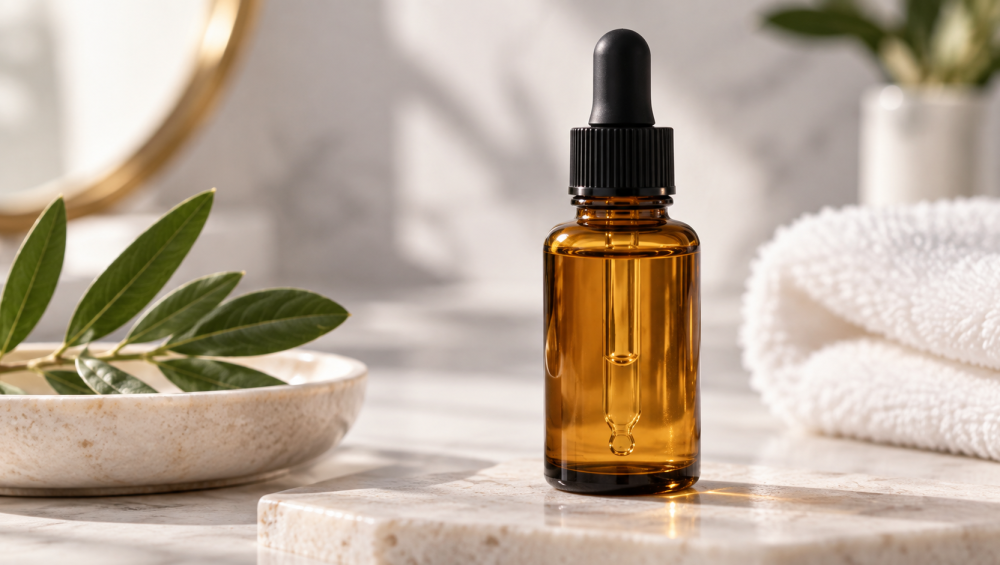
Retinol breaks down when it meets light, air and heat. A retinol serum in a clear bottle is exposed to light every time it sits on the counter. Look for opaque or dark packaging, whether a pump, a dropper or a jar you can close tightly, and a product that has not been sitting in a sunny bathroom window. The Bathroom Is the Worst Place to Store Skincare explains where to keep it instead, and Does Retinol Expire? covers how long it stays good.
Esenté’s Elite line uses Miron violet glass, which the manufacturer describes as a filter rather than a shield: it reduces the wavelengths that drive degradation while letting some light through. It is one reasonable answer to the light problem. Opaque plastic and airless pumps are others.
Retinol and the sun
Retinol is generally used at night. Daily broad-spectrum sunscreen is recommended as part of any retinol routine, and following the directions on your own product is the simplest way to get this right.
What “gentle” retinol products actually do
Some products list retinyl palmitate or other retinol esters instead of retinol. These sit a step further back in the conversion chain, so they are milder and also weaker. They are a reasonable starting point for very sensitive skin and a weak choice for someone who already tolerates retinol well. Encapsulated retinol, where the ingredient is wrapped in a coating intended to release it more slowly, is another approach to the same problem. None of these are gimmicks, but none of them change the basic rule: start low, go slow, and wear sunscreen in the day.
A short checklist
- The brand gives useful information about the formula, its intended benefits and how to introduce it.
- The packaging is designed to help protect the formula from excessive exposure to light and air.
- The product is designed to be introduced gradually, or you are prepared to do that yourself.
- The rest of the formula is calm, with little or no fragrance.
- You are already using sunscreen every morning.
Victoria’s approach
Victoria Nash, founder of Esenté Skincare and Younger You Clinique, has been a licensed aesthetician since 2004 and is an experienced skincare educator. She draws on her professional experience at Younger You Clinique when evaluating skincare products and their performance.
Esenté’s Retinol Progressive 60-Day Renewal System is sold as a staged system and carries its own directions for gradual introduction. Like the rest of the range, it was developed collaboratively by Victoria Nash with Esenté’s professional formulation and manufacturing partners, with Victoria providing product direction, ingredient research, professional-use feedback and performance requirements. If you are unsure whether retinol suits your skin, or you are already using a prescription retinoid, ask your dermatologist first, and the Ask Victoria page is open for product questions.
Frequently asked questions
Lower than you think. A six-week study of 218 people found fewer reactions with 0.3% retinol than with 1%. A separate, much smaller biopsy study suggested the two produced similar changes in the skin, though that finding rests on very few people. The concentration you can use every night for months beats the one you abandon after two weeks. Follow the directions on the product you choose.
Neither is better as a category. Serums are usually lighter and creams usually include more moisturizing ingredients, which some people find easier to tolerate. Choose by how your skin feels and by the packaging, not the word on the label.
Retinol is generally used at night, and the ingredient itself is sensitive to light. Follow the directions on your product, and wear broad-spectrum sunscreen every day either way.
Dryness, flaking and redness are common in the first weeks, especially if the product is strong or used too often. Slowing down, using a moisturizer over it, and giving skin rest nights usually settles it. If it does not settle, stop and ask a professional.
No. Even prescription tretinoin’s label says it does not eliminate wrinkles, repair sun-damaged skin or reverse photoaging. Retinol can improve the appearance of fine lines and texture over months of steady use. That is the honest claim.
You can, with some care. Many people use vitamin C in the morning and retinol at night, and space out exfoliating acids, because layering several strong actives at once can increase irritation for some skin. Follow the directions on each product and introduce one at a time.
About the author. Victoria Nash, founder of Esenté Skincare and Younger You Clinique, has been a licensed aesthetician since 2004 and is an experienced skincare educator.
Reviewed by Victoria Nash, licensed aesthetician and founder of Esenté Skincare & Younger You Clinique. This article is educational and is not medical advice. Ask your dermatologist or licensed skincare professional about products appropriate for your own skin and medical history.