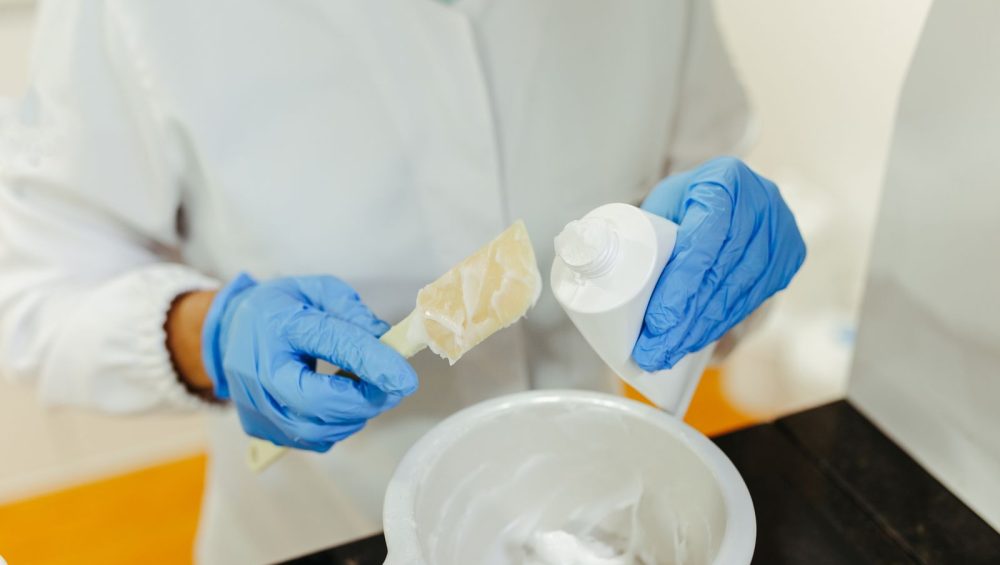

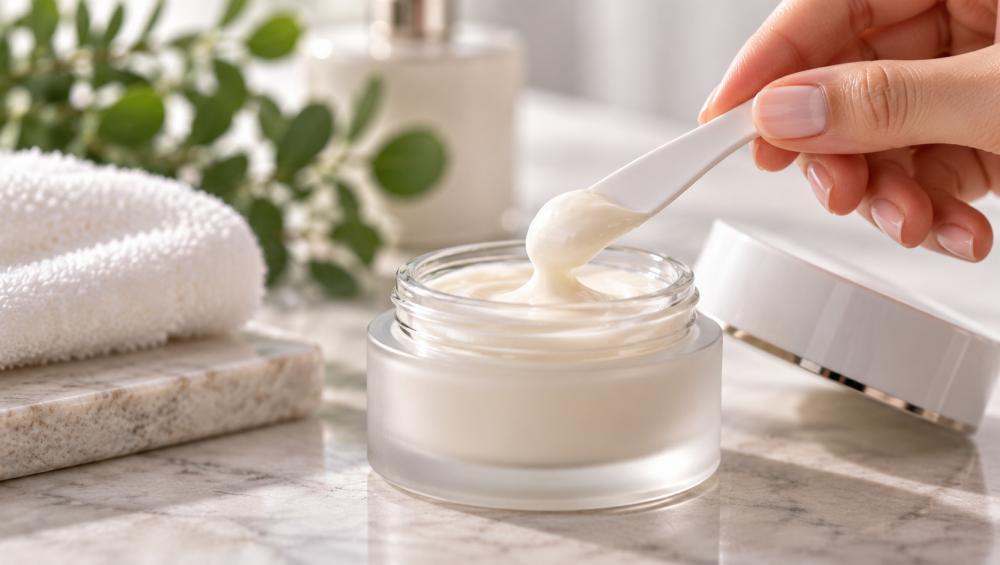
Cosmetic spatula removing cream from a skincare jarCategoriesEsente Skincare

The Spatula Rule: Getting Product Out Without Contaminating It

Short answer: Take product out of every jar with a cosmetic spatula, use what you took, and never return the leftover. Your fingers carry skin oils, bacteria and water into the formula, and minimizing that repeated contamination is good hygiene that can reduce the microbial burden on the product. The container is not the main variable here — a well-made glass jar has real advantages of its own, particularly around light and oxygen. What a spatula addresses is the hand going into it, and a stainless spatula that costs a few dollars addresses it permanently.

One tool. One habit. No downside.

What goes into the jar with your finger

Three things, every time, and none of them are visible.

Skin flora. Human skin carries a resident bacterial population that is entirely normal on you and entirely unwelcome in a jar of cream held at room temperature. Fingers also pick up whatever they last touched — a phone, a door handle, a face already mid-routine.

Sebum and residue. Whatever is on your skin transfers into the product. Over the life of a jar you are slowly blending your own oils, dead surface cells and any earlier product back into the formula.

Water. This is the one people underestimate. A wet finger, a damp bathroom, a jar opened straight out of the shower — free water is what microorganisms need to multiply. A formula that is stable dry is a different proposition once you have introduced water into it repeatedly for eight weeks.

None of this makes a product dangerous overnight. It shortens the window in which the product is what the manufacturer filled.

Preservatives are designed for a defined amount of abuse, not an unlimited amount

Cosmetic preservative systems are not decorative. They are formulated, tested and challenged.

The standard approach across the industry is challenge testing — preservative efficacy testing, in the trade — and it is written down. ISO 11930, Cosmetics — Microbiology — Evaluation of the antimicrobial protection of a cosmetic product, is the cosmetic-specific method; USP General Chapter <51>, Antimicrobial Effectiveness Testing, covers the pharmaceutical and topical side. Both work the same way. The finished formula is deliberately inoculated with a defined panel of organisms — in both methods five of them, spanning bacteria, a yeast and a mold — and the preservative system has to reduce those populations by a specified amount within a specified window and then hold them down across a 28-day observation period. A formula that passes is a formula shown to handle a defined contamination event.

Defined. Not unlimited. Every finger dip introduces another contamination load, and minimizing that repeated contamination is good hygiene that can reduce the microbial burden the preservative system has to handle.

A spatula does not sterilize anything. It reduces the load, which is exactly what a preservative system is designed to cope with.

The jar is not the villain

There is a fashionable argument that jars are inherently bad packaging and airless pumps are inherently good. It is half right, and the half it gets wrong matters.

Airless packaging reduces direct consumer contact with the bulk formulation. Product comes out without a finger going in, and that is a real advantage.

The trade-off is material. Airless pump systems are typically plastic — PET, HDPE or PP. Comparative testing of pharmaceutical containers puts glass ahead of both PET and HDPE as an oxygen barrier, with glass treated as effectively absolute and the polymers ranked below it, PET being the better of the two. Plastic also offers no light filtering of its own unless it is pigmented.

Glass gives you the opposite trade. It is inert, it does not breathe, and violet glass filters part of the spectrum: Miron publishes transmission data for its own glass, which blocks the visible band from blue to red and selectively filters other wavelengths. Which format suits a given product depends on the formulation, its sensitivity to light and oxygen, and how the product is used — there is no single hierarchy that holds across every formula. Esenté ships the Elite collection in Miron violet glass because, for our formulations, protecting the contents from light and oxygen over the life of the jar is the trade we prefer.

That leaves the hand as the gap a jar does not close on its own. The spatula closes it. That is the argument, and it is why we recommend the habit rather than a packaging change.

For liquids in bottles the question disappears altogether. A pump or a dropper already keeps fingers out, so there is no gap to close.

Choosing a spatula

Stainless steel is the default and the one worth buying. It is non-porous, it will not stain or hold odor, it takes hot water and soap indefinitely, and it lasts for years. It is also easy to see when it is clean, which matters more than it sounds.

Single-use plastic spatulas are the right answer in a professional setting, where a fresh one per client removes the question entirely. At home they are wasteful for no gain, since you are the only person using the jar.

Silicone is fine, flexible, and good at scraping the last of a thick cream out of a corner. It is slightly more prone to holding residue than steel and needs a proper wash rather than a rinse.

Wood or bamboo looks appealing and is the hardest option to keep clean. Porous surfaces absorb product and water and cannot be sanitized as thoroughly as steel or silicone, which works against the reason for using a spatula at all.

Size to the jar. A spatula too wide for the opening scrapes product onto the rim, which then dries and works its way under the lid seal.

The method, in five seconds

  1. Wash and dry your hands first. The spatula is not a substitute for clean hands — you still touch the lid, the rim, and your face.
  2. Scoop what you need, in one pass. Judge the amount before you go in rather than making three trips.
  3. Set it down on a clean surface — a small dish, a saucer, the back of a clean hand — and close the jar immediately. Every minute a jar stands open is oxygen exposure and a chance for something to land in it.
  4. Apply. Fingertips to the face are fine at this point; the container is already shut.
  5. Never return what you did not use. Anything that has left the jar has met air, your skin and the dish. It does not go home. Wipe it into the back of your hand or discard it.

That last one is the rule people break, and it undoes everything the first four achieved.

Cleaning, and one spatula per product

Rinse under warm running water after each use and dry it properly. Once a week, wash with soap and hot water. A stainless spatula can also go through the dishwasher if you have somewhere it will not disappear.

Do not leave it sitting in the jar between uses. It becomes a bridge — a damp object holding residue, in permanent contact with the formula, defeating the purpose.

Keep a separate spatula for each jarred product. Cross-transfer between a cleansing balm, a night cream and an exfoliant is not catastrophic, but it is easily avoided, and mixed residue makes it harder to tell whether a product has changed. Color-code the handles or keep each one beside its jar.

Where you store the spatula matters as much as where you store the product. Both belong out of the bathroom if you can manage it — heat and humidity are hard on formulas and on tools. The storage argument is a physics argument rather than a wellness one, and it applies to the whole shelf.

Where else the rule applies

Mask jars and clay masks. Same rule, plus a brush. Spatula onto a dish, load the brush from the dish, and never dip the brush into the container.

Balms and cleansing balms. These are the most-dipped products in most bathrooms and the ones most often used with wet hands in a steamy room. If you change one habit, change this one.

Scoops that come with the product. Use them, wash them, and do not leave them buried in the jar. A supplied scoop is a spatula with a manufacturer’s logo on it.

Sampling in a shop. Never take a tester with your fingers, and be wary of a tester everybody else has.

Professional treatment rooms. Single-use spatula per client, product decanted into a dish, nothing returned to the back bar container. This is basic infection control rather than a preference.

What a spatula does not fix

Honesty about the ceiling: the spatula controls one variable. Three others still apply.

Light degrades photosensitive actives whatever you use to remove them. Heat and other environmental conditions can affect formulation stability, so follow the product-specific storage and use guidance. And oxygen enters every time the lid comes off, which is an argument for closing jars quickly rather than for opening them less.

A spatula also does not extend a period-after-opening figure. Where one is printed — the open-jar symbol with a number of months, which European rules require on qualifying products and United States law does not require at all — follow it alongside the product’s storage and use guidance, and trust your senses as well. A color shift, separation, or a smell that has changed means the formula has turned regardless of what the label allows. On a US-market product with no such marking, your senses and the purchase date are what you have.

Frequently asked questions

Why should you use a spatula instead of your fingers?

Fingers introduce skin oils, bacteria and water into the container. Preservative systems are formulated and challenge-tested against a defined contamination load under ISO 11930 or USP <51>, not an unlimited one, so repeated dipping shortens the window in which the product is what the manufacturer filled.

Are jars bad for skincare?

No. Glass is inert and an effectively absolute barrier to oxygen, and violet glass filters part of the spectrum — Miron publishes transmission data for its own glass, which blocks the visible band from blue to red and selectively filters other wavelengths. The gap a jar leaves open is the finger going into it, and a spatula closes that gap.

Are airless pumps better than jars?

They reduce direct contact with the bulk formulation, since nothing enters the container. They cost you something in return: airless mechanisms are typically plastic, and comparative container testing ranks glass ahead of PET and HDPE as an oxygen barrier. Plastic also offers no light filtering unless pigmented. Neither format wins universally — it depends on the formulation and how it is used. For Esenté’s formulations, the light and oxygen protection of glass combined with a spatula is the trade we prefer.

What kind of cosmetic spatula is best?

Stainless steel for home use — non-porous, easy to sanitize, lasts for years. Single-use plastic in professional settings. Silicone works well for thick creams. Avoid wood and bamboo, which are porous and cannot be properly cleaned.

Can you put unused product back in the jar?

No. Anything that has left the container has met air, a surface and your skin. Returning it reintroduces exactly what the spatula prevented.

How often should you clean a cosmetic spatula?

Rinse and dry after every use; wash with soap and hot water weekly. Do not store it inside the jar, where it sits damp and in constant contact with the formula.

Does a spatula make skincare last longer?

It protects the formula from one specific failure — microbial contamination — which is a real one. It does not stop degradation from light, heat or oxygen, and it does not extend the period-after-opening on the packaging.

A tool is one of the few parts of a skincare routine you can judge without trusting anyone’s marketing, which is the same test that applies to everything else on the label.

About the author. Victoria Nash, founder of Esenté Skincare and Younger You Clinique, has been a licensed aesthetician since 2004 and is an experienced skincare educator.

Reviewed by Victoria Nash, licensed aesthetician and founder of Esenté Skincare & Younger You Clinique. This article is educational and is not medical advice.
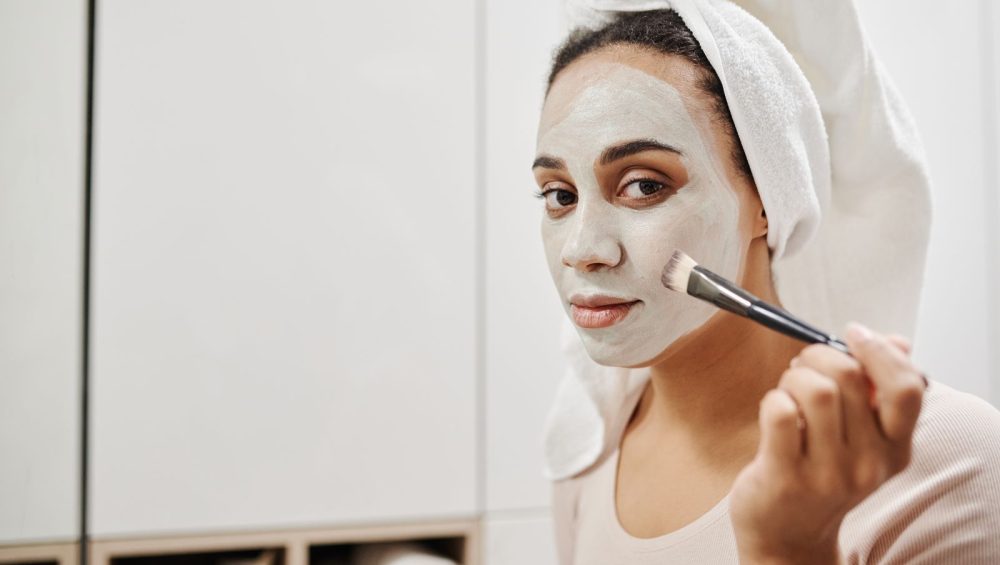
Woman applying a clay face mask with a flat brushCategoriesEsente Skincare

How to Use a Mask Brush (And Why It Beats Your Fingers)

Short answer: Lift the product out of the jar with a cosmetic spatula onto a small dish, load a soft synthetic brush, and lay the mask on in short strokes working from the jaw upward and outward to the forehead, keeping clear of the eyelid and the lip line. The brush earns its place for three reasons: your fingers never enter the container, the layer goes on evenly instead of in patches, and you use less product. Remove the mask with a damp aesthetic facial sponge or gauze pad rather than by rubbing with your hands. Esenté’s preferred approach leaves facial scrubbing brushes out of the routine altogether.

A mask brush applies. It never scrubs. That is the whole distinction.

What a mask brush is, and what it is not

A mask brush is a soft, flat, tapered applicator. It carries product to the skin and spreads it. It does not exfoliate, it does not stimulate, and it does not generate friction. If you can feel the bristles working against your skin rather than gliding across it, the brush is wrong or you are pressing too hard.

It is not a cleansing brush, and the two get confused because both are called face brushes.

Facial scrubbing brushes — the motorized bristle heads sold for cleansing — have no place in an Esenté routine. Our position is that they are too harsh for facial skin, and that the irritation they can cause tends to produce exactly the redness and blotchiness people then try to treat with more product. That is Esenté’s preferred approach rather than a universal rule, but it is a firm one. The skin on your face is not the skin on your heels, and it does not need scouring to be clean.

Application and cleansing are separate jobs done with separate tools. A soft brush for putting product on. An aesthetic facial sponge or a gauze pad for taking it off.

Choosing one

Synthetic bristles. The structural difference is real: animal hair has a keratin cuticle and a porous shaft that takes up liquid, and synthetic filament does not. What follows from that is the practical case rather than a tested one — natural hair holds more of a wet formula inside the fiber, so less of it reaches your face, and it stays damp longer after washing. Synthetic filament picks up product on the surface and gives most of it back. We are not aware of a controlled study comparing contamination rates between the two in home use, so treat this as a sound inference from how the materials behave, not as a proven hygiene result. For anything wet — masks, gels, clay, serums — synthetic is the easier tool to keep clean and the less wasteful one.

Flat and tapered, not round and fluffy. A flat brush lays product down. A domed makeup-style brush stipples it, which is slower and less even. A slight taper at the tip gives you control at the hairline and around the nostrils.

Sized to your face, not to a professional trolley. A brush roughly the width of two or three fingers covers a cheek in a couple of strokes without overshooting onto the eyelid. Very wide brushes are built for treatment rooms and back-bar speed; at home they mostly deposit product where you did not want it.

Silicone applicators are a legitimate alternative for thick clay and cream masks. They are the easiest tool in the category to clean and waste almost nothing, but they do not feather product the way bristles do, so the edge of the layer is blunter. Either is fine. Fingers are the option we would leave out.

Before you load the brush: the spatula step

Do not dip the brush into the jar.

A brush that has touched your face and then goes back into the container carries skin oils, bacteria and moisture into a formula whose preservative system was tested against a defined contamination load, not an open-ended one. The brush is cleaner than a finger. It is not clean.

Use a cosmetic spatula to lift what you need onto a small dish, a saucer, or the back of your hand if the mask is going on immediately. Load the brush from there. Whatever is left on the dish is discarded — it never goes back in the jar. Use a clean spatula for any jar or container where fingers would otherwise enter the product.

Tubes and pumps are the exception, since nothing goes into them. Squeeze straight onto the dish or the brush.

How to apply, in order

Start with clean, dry skin. Cleanse in the evening with an aesthetic facial sponge or gauze pad, then follow with a toner or antioxidant spray — Esenté’s recommended preparatory step after every cleanse, treated as part of the routine rather than an extra. Blot dry before masking so the mask is not diluted on contact.

Then:

1. Load lightly. Draw the brush across the product so both faces of the bristles pick some up. A brush overloaded at the base drops product on your collar.

2. Work upward and outward. Start at the jawline and move up. Chin, jaw, cheeks, nose, then forehead last, because the forehead is the fastest area to cover and the one where product tends to run into the hairline if it has been sitting there for three minutes.

3. Short strokes, light pressure. An inch or so at a time, brush held at an angle rather than upright. The bristles should bend slightly. If they splay flat, ease off.

4. Follow the contour. Move along the shape of the face rather than across it — up the cheek toward the temple, out along the jaw. This is about coverage, not about lymphatic direction or any claim of stimulation. Even coverage is the entire goal.

5. Stop at the borders. Leave a clear margin around the eye socket — roughly a fingertip’s width outside the orbital bone — and stay off the lip line. Eyelid skin is thinner and more reactive than the rest of the face, and most masks are not formulated for it. Do not extend into the hairline or over the eyebrows unless the product instructions specifically say to.

6. Check the edges. Look in the mirror and pick up the misses: the sides of the nose, the crease beside the nostril, the front of the ears, the underside of the jaw. Those are the four places a mask is always thin.

How much is enough

Follow the application instructions for the individual mask — products differ in the layer they call for.

Unnecessary over-application wastes product: a layer thicker than the directions call for takes longer to dry, costs more per use, and makes a mess coming off. If the layer is holding its own shape and standing proud, you have likely gone past what the product needs and the extra is going down the sink.

Do not keep adding until it feels substantial. Check the product’s directions instead.

Timing and removal

Follow the time on the packaging and set a timer rather than guessing. Longer is not stronger. Clay and drying masks in particular become harder to remove and more likely to irritate once they have gone past dry into cracking, and a mask left on well past that point is commonly said to start drawing water back out of the skin’s surface — a plausible explanation rather than one settled by controlled study, and a reason to follow the timing on the packaging either way.

To remove: soften first with warm water, then lift the product off with a damp aesthetic facial sponge or a gauze pad in gentle sweeping passes. Rinse the sponge and repeat. No scrubbing, no circular buffing, and no washcloth used with force.

Then tone. Every removal counts as a cleanse, and in the Esenté routine a toner or antioxidant spray follows every cleanse. Continue into your usual evening steps from there — the full order for layering what comes next does not change because you masked.

Cleaning the brush

Every single use. A brush left with product in it becomes a damp reservoir, and the next application puts that reservoir on your face.

Rinse under lukewarm water, working the bristles between your fingers until the water runs clear. Add a drop of gentle cleanser once a week or after a clay or oil-based mask, lather, rinse thoroughly. Squeeze — do not wring — reshape the head with your fingers, and lay the brush flat on a towel with the bristles overhanging the edge, or hang it head-down.

Never dry a brush upright in a pot. Water runs down into the ferrule, where it sits against the adhesive holding the bristles in place, and repeated soaking of that joint is the common explanation for a head that starts shedding early. We have not found a published test putting a number on how long that takes, and it will depend on the glue and on how wet the brush gets — but the fix costs nothing, so there is no reason to run the experiment on your own brush.

Store it dry, out of the bathroom if you can. Steam and humidity are not kind to tools any more than they are to formulas.

Replace it when you see any of three signals: shedding that continues after a wash, bristles that no longer return to shape, or a ferrule that feels loose or looks stained at the base. There is no universal interval — it depends on how often you use the brush and how well you wash it. A well-treated synthetic brush lasts a long time. One dried upright in a bathroom does not.

Four mistakes worth avoiding

  • Dipping the brush in the jar. The spatula exists for this.
  • Pressing. The brush is a delivery tool. Avoid excessive pressure or unnecessary friction, particularly on sensitive or reactive skin.
  • Masking over an uncleansed face. You are sealing the day onto your skin.
  • Using one brush for everything without washing between. Clay residue in a bristle head contaminates a cream mask, and the reverse.

Frequently asked questions

Do you really need a mask brush?

It is not the reason a mask works, and we would rather say so than oversell a tool. What the brush gives you is an even layer, less product used per application, and — with a spatula — a container your fingers never enter. Those are hygiene and economy arguments rather than efficacy claims, and they are the honest reasons to own one. They are also good enough reasons.

Is a mask brush better than using your fingers?

For applying a mask, yes, on three counts: even coverage, no contamination of the container, and less waste. Fingers are warm, oily and carry bacteria, and they push product into the skin unevenly.

How do you clean a mask brush?

Rinse in lukewarm water after every use until the water runs clear, and use a drop of gentle cleanser weekly or after clay and oil-based masks. Squeeze out the water, reshape the head, and dry it flat or head-down. Never leave it upright in a pot — water in the ferrule loosens the glue and the brush starts shedding.

Should a mask brush be synthetic or natural hair?

Synthetic, for wet products. Animal hair has a cuticle and a porous shaft that takes up liquid; synthetic filament does not, so more of the product reaches your face and the brush dries faster after washing. That is a materials argument rather than a tested comparison of contamination rates, but it points one way and nothing points back.

How thick should a face mask be applied?

Follow the application instructions for the individual mask, since products differ. Applying more than the directions call for wastes product: it slows drying and makes removal harder.

Can you use a cleansing brush instead?

Not for this, and not in an Esenté routine. Facial scrubbing brushes are excluded from our recommended approach — our position is that they are too harsh for facial skin and can cause irritation and blotchiness. Apply with a soft brush; remove with an aesthetic facial sponge or gauze pad.

A tool is one of the few parts of a skincare routine you can judge without trusting anyone’s marketing, which is the same test that applies to everything else on the label.

About the author. Victoria Nash, founder of Esenté Skincare and Younger You Clinique, has been a licensed aesthetician since 2004 and is an experienced skincare educator.

Reviewed by Victoria Nash, licensed aesthetician and founder of Esenté Skincare & Younger You Clinique. This article is educational and is not medical advice.

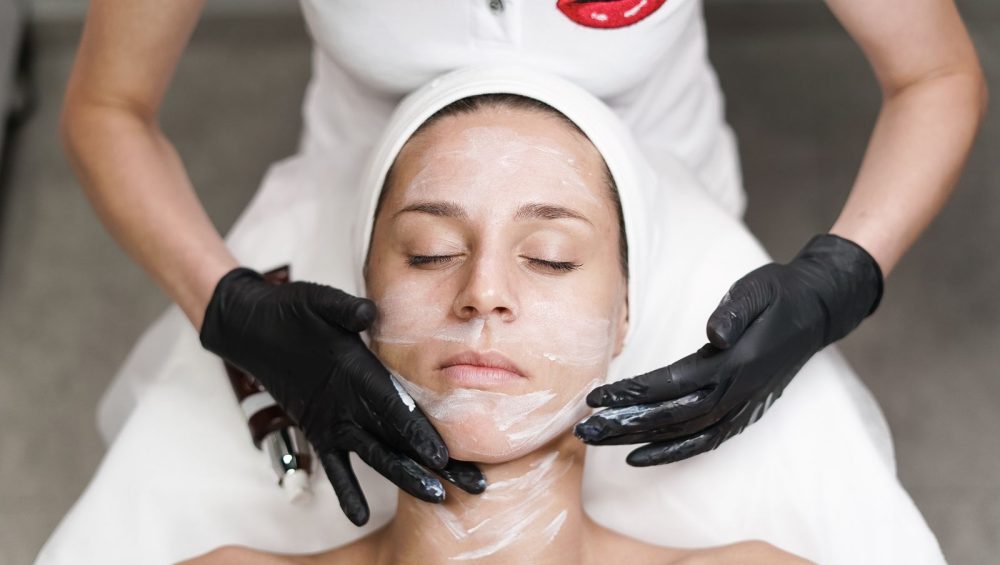
Esthetician performing a facial treatment wearing glovesCategoriesEsente Skincare

What Estheticians Can and Cannot Legally Do

Short answer: Esthetics generally concerns surface-level cosmetic care — cleansing, superficial exfoliation, extractions, masks, hair removal, manual treatment of the skin’s outer layers. Which procedures, depths and devices are permitted under an esthetics license is determined by applicable state law and licensing authorities. Injecting, prescribing, diagnosing or treating disease generally sits outside esthetics and inside medicine or nursing, and everything else varies by state, changes without much announcement, and is decided by your board rather than by a brand, a trainer or an article.

Check your own state board before you buy the device. That sentence is most of this piece.

The distinction most boards start from

State rules differ enormously in their detail and they get rewritten often. What holds across almost all of them is the underlying principle, which is worth learning instead of memorizing a list.

Esthetics is defined, in most enabling statutes, as work on the surface of the skin for beautification and maintenance. The epidermis is the working field, and the stratum corneum — the outermost layer, made of cells that are no longer alive, as FDA itself defines it — is where surface exfoliation does its work.

The moment a treatment breaks the skin, penetrates living tissue, or is intended to treat a disease, it stops being esthetics in the eyes of most boards, whatever the marketing calls it. Laws, regulations and device classifications can change, so verify your state’s current requirements rather than relying on how the categories are drawn today.

Two consequences follow, and both catch practitioners out. Depth is not intensity — a superficial peel that leaves a client flushed for two days may sit inside scope, while a device that punctures the skin painlessly may not. Boards care about the tissue reached, not about how dramatic the treatment felt. And naming a treatment does not classify it: “facial”, “resurfacing treatment” and “medi-facial” have no legal effect. The mechanism decides.

Who actually decides

Not the manufacturer. Not the trainer who sold you the certificate. Not an insurer, and not a peer in a professional forum who practices in another state.

In most states the authority is a board of cosmetology, a board of barbering and cosmetology, or a combined licensing department. In some, a department of health or a medical board also holds jurisdiction over device-based treatments and over anything performed under medical supervision. Two agencies frequently have overlapping interests in the same treatment, which is why a written answer beats a confident one.

Three sources outweigh everything else. The statute and the administrative rules for your license — both, because the statute grants the scope and the rules fill in what it means in practice. Written board guidance, including position statements and declaratory rulings. And your liability carrier: a treatment your policy excludes is a treatment you cannot afford to perform, whatever the board permits.

Certification is not authorization. A manufacturer’s training certificate proves you attended. It does not expand a license, and no private body can.

“Medical esthetician” is a job description, not usually a license

This phrase causes more confusion than any other in the field.

In most states there is no separate “medical esthetician” or “medical aesthetician” license. The term describes where somebody works — a physician’s office, a medical spa, a dermatology practice — and sometimes a private training credential. It does not, on its own, grant a scope the underlying esthetics license does not already contain.

A minority of states do maintain a higher tier, variously called a master, senior or advanced esthetician, requiring additional training hours and carrying a defined additional scope — and at least one state administers it through a dedicated board rather than the cosmetology board. Which states offer such a tier, and what it adds, changes as legislatures act, so treat any list you find online as a prompt to check rather than an answer. Where the tier exists the scope is spelled out in the rules and is worth reading closely, because it is usually narrower than practitioners assume.

Find out whether your state has a tier above the basic license, find out exactly what it adds, and use the correct title. Titles are themselves regulated in many states, and claiming a protected one you do not hold is a violation in its own right.

The treatments that generate most of the confusion

What follows describes the general shape of the argument in each case. None of it is a statement of the rule in any particular state, and the rules move.

Chemical peels. Almost universally permitted at a superficial level and almost universally restricted beyond it. States draw that line differently — by acid concentration, by pH floor, by named agent, by depth of intended injury, or by a combination — and the thresholds differ. Medium and deep peels are commonly reserved for medical practice or for delegated performance under supervision. Know which method your state uses, because a percentage limit and a pH limit are not interchangeable, and “professional strength” on a label is evidence of nothing.

Microneedling. The clearest current example of how boards apply the depth question. A device driving needles into living skin is doing something categorically different from surface exfoliation, and states variously prohibit it under an esthetics license, permit it within a defined depth, or allow it only under medical supervision.

There is a federal layer, and it is worth understanding precisely, because it is routinely misdescribed. FDA’s Regulatory Considerations for Microneedling Products: Guidance for Industry and Food and Drug Administration Staff, issued as final guidance on 10 November 2020, sets out when a microneedling product is a regulated medical device. It is not a rule about how deep a needle may go.

The operative test is intended use. FDA looks at the claims a firm makes for the product, and separately at the product’s design and technological characteristics, and treats both as evidence of whether the product is intended to affect the structure or function of the body. Claims or statements indicating penetration or some effect beyond the stratum corneum into living layers of skin count as evidence of that intent; so does needle penetration beyond the stratum corneum arising from the design itself. Claims about removing the stratum corneum — a layer FDA describes as dead — do not.

The consequence is the part people get backwards. The guidance’s own worked example is a manual product with short, blunt needles that the firm advertises as stimulating collagen production and treating wrinkles: it is a device, because of what was claimed for it. A product that does not penetrate living skin and claims only to exfoliate, improve the appearance of skin, or give skin a smoother look and feel generally would not be. The claim can create the regulated product; short needles do not exempt it.

Note what the guidance does and does not do. It governs the product and its manufacturer, and FDA states that its guidances are non-binding recommendations rather than legally enforceable requirements. It does not grant or limit your scope, which remains your state board’s decision. Be skeptical of any depth claim made only in a sales deck, and read the current version of the guidance alongside your state rules.

Lasers, IPL and other energy devices. The most fragmented area in the field. Some states regulate them under the medical board, some under cosmetology, some under a device registry, and some through a supervision requirement specifying how physically present the supervising practitioner must be. “Available by phone” and “on the premises” are different legal standards.

Dermaplaning. Permitted in many states as surface exfoliation with a blade, restricted or prohibited in others, and sometimes dependent on blade type. The debate turns on whether the procedure removes only stratum corneum and vellus hair or risks reaching living tissue.

Microdermabrasion and hydra-type resurfacing. Generally accepted as superficial. The scope question here tends to attach to whatever active solution the device is infusing rather than to the device.

Injectables. Injecting neuromodulators, fillers, mesotherapy solutions or vitamins generally falls outside an esthetics license and is governed by applicable state medical and nursing laws. Verify your jurisdiction’s requirements, and if you have been told otherwise, get it from your board in writing.

Prescription products. Dispensing, prescribing or adjusting prescription-strength topicals is prescribing. Recommending an over-the-counter product is not.

Body devices, teeth whitening, lash and brow services. Treated inconsistently across states, and several have drawn enforcement action. Verify rather than assume.

Diagnosis is the line people cross without noticing

Device scope gets the attention. Language gets the complaints.

Estheticians do not diagnose. “You have rosacea”, “this is fungal”, “that mole looks fine” and “this will clear your eczema” are clinical assessments, outside scope regardless of how accurate they turn out to be. Nor do estheticians treat disease — a treatment described as curing, healing or resolving a medical condition has been reclassified by its own description.

The workable form is observational and referring. “I’m seeing persistent redness across your cheeks and nose that I’m not comfortable treating without a physician looking at it first.” That sentence is defensible, and it protects the client as much as it protects you.

Document the referral. A note in the client record that you observed something and declined to treat pending medical review is worth more than any waiver.

Supervision does not automatically extend scope

A recurring and expensive misunderstanding: working in a medical practice does not, by itself, enlarge what an esthetics license permits.

Some states allow specific acts to be delegated under defined conditions — a supervising practitioner of a specified type, a documented protocol, a particular level of physical presence, sometimes a good-faith examination first. Those conditions are prescriptive, they are typically set by the medical or nursing board rather than the cosmetology board, and meeting three of four is not compliance.

If your employer’s answer to “am I allowed to do this?” is “we’ve always done it this way”, get the written rule. The license at risk is yours, and it follows you when you leave.

Where the retail shelf and the treatment room diverge

Professional treatments performed by an appropriately qualified and licensed professional where required — needling and laser work carried out in a clinical setting under whatever supervision the state requires — act on tissue in ways no retail product does. Keep that separation explicit in how you talk about both.

A product sold to a consumer for home use is a cosmetic. It works on the epidermis. Describing it as though it did what a device-based professional treatment does creates two problems at once: a claim exposure under federal cosmetic law, and a client who believes a cream substitutes for a procedure. Worth reading alongside this: “medical grade” and “clinical grade” are not regulatory categories, and neither phrase extends anyone’s scope.

How to check, concretely

A protocol that takes an afternoon and settles the question properly.

  1. Find your state board’s site and locate both the practice act and the administrative rules for your license class. Read the definitions section first — that is where scope actually lives.
  2. Search the same site for position statements, declaratory rulings, newsletters and disciplinary summaries. Enforcement history tells you where the board’s attention sits.
  3. For anything contested, submit a written enquiry and keep the reply.
  4. Confirm coverage with your liability carrier before performing the treatment, not after.
  5. Re-check annually, and whenever you add a device or modality. Rules change between renewals.
  6. If two states are involved, verify both. Reciprocity is not universal.

The consequences of getting this wrong can run well past a fine — a license suspension, an uninsured claim, or a client injury you cannot undo.

Frequently asked questions

What is an esthetician’s scope of practice?

In general terms, care of the epidermis for beautification and maintenance: cleansing, superficial exfoliation, extractions, masks, hair removal, makeup and manual treatment of the skin’s surface layers. The specifics — which peels, which devices, which depths — are set by each state’s practice act and administrative rules, and they differ substantially.

Can estheticians perform microneedling?

It depends on the state, and it is one of the most restricted procedures in the field because the device penetrates living tissue rather than acting on the surface. Some states prohibit it under an esthetics license, some permit it within a depth limit, and some allow it only under medical supervision. Check your board before purchasing a device.

Is “medical esthetician” a license?

In most states, no. It describes a work setting or a private training credential rather than a license class. Some states do issue a higher tier such as a master or advanced esthetician license with a defined additional scope. Confirm what exists where you practice, and use the title your license grants.

Can estheticians diagnose skin conditions?

No. Diagnosis is a medical act. Estheticians can describe what they observe, decline to treat, and refer. Naming a condition or promising to treat one falls outside scope regardless of experience.

What chemical peels can estheticians perform?

Superficial peels are within scope in most states; medium and deep peels generally are not. States define the boundary differently — by acid, concentration, pH or intended depth — so the limit in one state tells you nothing about the limit next door.

Can estheticians give injections?

Generally, no. Injectables fall outside an esthetics license and are governed by applicable state medical and nursing laws, so verify your jurisdiction’s requirements before performing any injection.

Does working under a doctor expand what an esthetician can do?

Not automatically. Delegation is permitted in some states under specific conditions set by the medical or nursing board, including who supervises, how present they must be, and what documentation is required. An employer’s practice is not evidence that those conditions are met.

Victoria Nash, founder of Esenté Skincare
Victoria Nash, founder of Esenté Skincare and Younger You Clinique.

About the author. Victoria Nash, founder of Esenté Skincare and Younger You Clinique, has been a licensed aesthetician since 2004 and is an experienced skincare educator.

Reviewed by Victoria Nash, licensed aesthetician and founder of Esenté Skincare & Younger You Clinique. Written for licensed professionals. This article is general educational information and is not legal advice. Scope-of-practice rules are set by each state and change frequently; verify everything here against your own state board’s current statute, administrative rules and published guidance before you rely on it.

Hands writing calculations in a notebook beside a calculatorCategoriesEsente Skincare

Back Bar Economics: What Your Product Cost Should Actually Be

Short answer: No published dataset fixes a correct back bar percentage. The ranges you will be quoted come from trade training material, distributor guidance and spa-software marketing, they run anywhere from single digits to the high teens, and they disagree with each other because they are quietly measuring different things. So cost the treatment yourself: per milliliter, per protocol, disposables included, using what your hands actually dispense rather than what the protocol card says they dispense. A percentage you measured tells you something. A percentage you inherited tells you where somebody else’s numbers landed.

The percentage is arithmetic. The measurement is where the money goes missing.

First, about the benchmark you were given

Somebody has told you a number. It is worth knowing where it came from before you manage to it.

Search for one and you will find several, none of which cite a source. Spa-management training decks have put professional skincare inventory in the mid-single digits as a share of departmental revenue. Distributor and spa-software content routinely quotes double that, sometimes flagging the high teens as the point where margin starts to erode. Neither camp is drawing on an industry census, because as far as we can establish no association or research body publishes one for back bar cost specifically.

They also define the term differently, which is most of why they disagree. One counts only the product consumed in the treatment. Another folds in gauze, gloves and laundry. A third divides last quarter’s professional order — retail testers and expired stock included — by the number of services booked. Three methods, three answers, one label.

That is not an argument for ignoring the ratio. It is an argument for generating your own rather than adopting somebody else’s, and for being suspicious of any figure presented as the industry standard without a dataset behind it.

Back bar cost is narrower than the number most people quote

Back bar cost is the product you consume delivering one treatment. Nothing else.

It is not cost of goods sold, which includes retail inventory. It is not supply cost, which sweeps in laundry, gloves and paper. And it is not last month’s supplier invoice divided by the number of facials you performed, though that is how most rooms arrive at the figure, and it is why the figure is usually wrong.

An order total contains retail stock, samples given away, product that expired on the shelf, and whatever you bought because a rep had a promotion running. Divide that by treatment count and you have folded four separate problems into one number that cannot tell you which of them to fix.

Cost the treatment. Not the month.

Cost per milliliter is the only unit that works

Every professional product has a unit cost hiding behind its case price. Get it out and write it down.

Take what you pay for the container, divide by its volume in milliliters or grams, and you have a unit cost. Do it once per SKU, record it on the shelf label or in a spreadsheet, and everything after that is addition.

An illustration, with round numbers chosen for clarity rather than realism. A 500ml back bar cleanser bought at $60 costs $0.12 per milliliter; a double cleanse using 6ml costs $0.72. A 250g mask bought at $90 costs $0.36 per gram; a 15g application costs $5.40. The mask step costs more than seven times the cleanse step. Nothing on the invoice told you that, because the cleanser bottle was the larger object.

That ratio is the real finding. Back bar cost is almost never spread evenly across a protocol. A small number of steps may account for a disproportionate share of it, and which steps those are is something each professional should determine by measuring their own protocols.

Which is good news, because the lever is short. You do not need to economize across ten products. You need to know which steps decide the number.

Cost the protocol, not the menu

Build a cost card for every protocol you sell. One page each, kept live.

List every product the protocol consumes, in order of use. Beside each, the grams or milliliters actually used and the unit cost. Add the disposables the treatment genuinely consumes: gauze, aesthetic sponges, cotton, applicators, a single-use spatula. Total it.

Two disciplines make that card true rather than decorative.

Weigh what you dispense, once. Put a kitchen scale on the trolley and record the mass of each product across three real treatments — real ones, at the end of a long day, not a demonstration. Actual dispensing can run above what a protocol specifies without anyone noticing, because the protocol was not written while looking at a client’s face at four in the afternoon. Whether that is happening in your room, and by how much, is not something an article can tell you and not something you can estimate from memory. It is the single reason to own a scale.

Count what you discard. Product decanted and unused is consumed cost. Mask mixed and half-thrown-away is consumed cost. If it left the container, it goes on the card.

Divide the total by the service price. That is your back bar percentage, per protocol, and across a normal menu it will vary by a factor of three or more.

What the percentage does not tell you

Even a percentage you measured yourself is a screening tool. It flags treatments worth examining. It decides nothing on its own, and three things break it routinely.

Time is the missing variable. A 90-minute treatment at 10% back bar can be less profitable than a 45-minute treatment at 18%, because the second one bills the room twice. Product percentage measures product. It says nothing about the resource you actually sell, which is a room and a pair of trained hands for a block of time.

Run both. Back bar percentage, and contribution per room-hour: service price, less back bar cost, less direct labor, divided by the hours the room is occupied including turnover and sanitation. The second number is the one that pays rent.

The price sits inside the ratio. A percentage can be pulled down by raising the price or by cutting the product, and the ratio cannot tell you which happened. Look at the numerator and the denominator separately before you change either.

Averages hide the outlier. One protocol running at double the rest can sit inside a healthy menu average while losing money on every booking. Per-protocol cost cards exist to surface exactly that.

Sometimes a high percentage is the right answer

Managing to a borrowed benchmark makes people cut the wrong thing.

A corrective peel or a high-active series carries genuine product cost, and clients book it for the result rather than for the hour. If it converts to a course of treatments, drives retail attachment, and produces the outcome that brings somebody back, a high product percentage can be a sound decision — provided you made it deliberately and priced for it.

The failure mode is not a high percentage. It is a high percentage nobody chose.

Relaxation and maintenance services sit at the other end. Low product cost, sensory value, high repeat frequency. They should run lean, and when they do not, over-dispensing is a more common cause than under-pricing — though the cost card is what tells you which.

The retail side changes the maths, and not always in your favor

Retail is the reason many rooms tolerate a back bar cost they would otherwise refuse. That logic only holds if you measure it.

Track retail attachment per protocol: what share of clients receiving that treatment buy something, and the average value when they do. A product-heavy treatment with strong attachment is a different proposition from the same treatment with nobody buying anything on the way out.

Two traps live here.

Samples are back bar cost wearing a marketing costume. They are worth giving, and they belong on the cost card as a line you chose, with a conversion figure attached. Untracked, they are the fastest route from a healthy protocol to a losing one.

And retail margin does not rescue a mispriced service. Selling a moisturizer at the end recovers part of the loss and disguises the rest. Fix the service.

If you are over, work in this order

The first two cost you nothing.

  1. Dispensing. Pumps and pipettes instead of pouring. Decant what the card specifies rather than what feels generous. This is usually worth more than any purchasing change, and it embeds in a week.
  2. Waste. Mix mask to the amount used. Cap products between steps. Order to throughput rather than to a bracket discount, and check expiry dates against how fast you actually move a SKU.
  3. Format. Back bar sizes for treatment use, retail sizes for retail. Where a line offers only retail sizes for professional work, your cost per milliliter is higher than it needs to be, and the size of that gap is worth calculating before you commit to the line.
  4. Protocol design. Move the expensive step to the tier that can carry it, or reserve it for the corrective service rather than the maintenance one.
  5. Price. Last, and only after the first four. Raising the price to solve a dispensing problem leaves you with a higher price and the same dispensing problem.

Whether the line itself is workable at all is a longer question — terms, education, formulation and margin — and how to evaluate a professional line before committing to it covers that ground. It is also worth knowing that the labels on the box carry no regulatory weight: “medical grade” and “clinical grade” are positioning, not categories, which is why the cost card matters more than the brand story.

Twenty minutes a quarter keeps it honest

Unit costs move. Suppliers raise prices, pack sizes shrink, and a protocol quietly gains a step that nobody logged.

Once a quarter: re-price every unit cost against your most recent invoices, re-weigh two protocols you have not checked lately, re-run the percentages. Twenty minutes. Drift of this kind arrives a fraction at a time and never on a day you would notice, which is the only reason a quarterly check is worth the trouble. Record a strong month and a slow month separately while you are at it — seasonal menus have different economics, and the annual average conceals both.

Victoria Nash, founder of Esenté Skincare and Younger You Clinique, has been a licensed aesthetician since 2004 and is an experienced skincare educator. The point the arithmetic keeps making is not that professional lines are expensive. It is that a well-priced line dispensed with a heavy hand and never weighed will read on a bank statement exactly like an expensive one.

Frequently asked questions

What percentage of service price should back bar cost be?

There is no authoritative answer, and be careful of anyone who gives you one. The figures in circulation come from training material, distributor guidance and software marketing rather than from a published industry dataset, they span a wide range, and they define back bar cost differently from each other. Measure your own per protocol and compare each treatment against the rest of your menu — that comparison is useful in a way the borrowed number is not.

How do you calculate back bar cost per treatment?

Divide each product’s purchase price by its volume to get a unit cost, multiply by the amount actually dispensed, add the disposables the treatment consumes, and total the protocol. Weigh real dispensing rather than trusting the protocol card.

What is the difference between back bar and retail cost of goods?

Back bar is product consumed delivering a service. Retail cost of goods is inventory bought to resell. Combining them produces a number you cannot act on, because it cannot distinguish a dispensing problem from a purchasing problem.

Should disposables be counted in back bar cost?

Count what the treatment consumes: gauze, aesthetic sponges, cotton, applicators, single-use spatulas. Laundry, general room supplies and equipment belong in operating costs rather than on the protocol card.

Is a high back bar percentage always a problem?

No, but it should always be a decision. Corrective and high-active treatments can carry more product cost when they are priced for it and convert to a series or to retail. The problem is a high percentage nobody chose.

How often should back bar costs be reviewed?

Quarterly suits most rooms. Unit costs shift with supplier pricing and pack sizes, and dispensing drifts upward over time, so an annual review usually uncovers a problem that has been running for months.

About the author. Victoria Nash, founder of Esenté Skincare and Younger You Clinique, has been a licensed aesthetician since 2004 and is an experienced skincare educator.

Reviewed by Victoria Nash, licensed aesthetician and founder of Esenté Skincare & Younger You Clinique. Written for licensed professionals. This article is general educational information and is not financial, accounting or tax advice. The dollar figures used are illustrative arithmetic, not market prices. Scope-of-practice and licensing rules vary by state; check your state board.

Water droplets beading on the surface of a leafCategoriesEsente Skincare

Why Your Serum Feels Like It Is Sitting on Your Skin

Short answer: Usually because it is, and usually for one of five reasons: you applied it over something occlusive, you used too much, the preceding skincare step affected how it applied, you stacked too many film-forming layers, or the formulation has a texture that was never going to vanish. Worth knowing first, though: “absorbing” is the wrong test. A serum is not supposed to disappear. Part of it partitions into the outer layers of the skin and the rest — water, humectants, film formers — either evaporates or stays on the surface doing its job there. A product that sinks in instantly is often just full of volatile ingredients.

Fast disappearance is a sensation. It is not evidence.

What “absorbing” actually means

The outermost layer of your skin, the stratum corneum, is a barrier whose entire purpose is to keep things out and water in. Skin scientists model it as brick-and-mortar: flattened, protein-filled cells are the bricks, and a matrix of ceramides, cholesterol and free fatty acids is the mortar. That lipid matrix is generally regarded as the main route topical ingredients take through it, though not the only one — some movement happens through the cells themselves, and some through hair follicles and sweat ducts.

That geometry does most of the deciding. Small, moderately lipid-soluble molecules move into the matrix reasonably well. Large or strongly water-loving molecules do so poorly, and largely stay at the surface. Neither outcome is a failure, because plenty of useful skincare works at the surface by design. A humectant holding water in the outer layers is doing exactly what it is for.

So the honest framing is this: what you feel is the vehicle, not the active. When a formula “sinks in fast,” what disappeared was water, alcohol or a volatile silicone. When one “sits,” what remains is a film former, a thickener or a humectant with nowhere to go. That sensation tells you about texture and almost nothing about whether the product works.

Here is why yours is sitting.

Reason one: order

The most common cause and the easiest fix. Products go on thinnest to thickest, because a thin formula can move through the surface and a thick one is designed to seal it.

Once you have applied a moisturizer, anything you put on top of it is largely staying on top of it. The moisturizer did its job. It is the job.

This includes the near-misses: serum over a rich eye cream, treatment over a night cream, an extra layer of anything after sunscreen in the morning. If a step feels like it beads up or slides around, look at what went on before it.

Sunscreen is the exception that runs the other way. In the morning it goes last regardless of texture, because it needs to form a continuous film across the surface, and putting anything over it disrupts the film you paid for. We covered the full morning and evening sequence in a separate article.

Reason two: too much product

Stated application quantities are approximate guides rather than a measured optimum, and a thin gel and a rich emulsion will not need the same amount — follow the directions for the individual product. The principle behind any stated amount holds regardless. The surface area is finite and the outer layer can only take up so much at once. Everything beyond that point has one destination: the surface, and then your collar.

Doubling the amount does not double the result. It roughly doubles the residue and the cost per month.

Reason three: the preceding skincare step

A serum does not have to be applied to damp skin to work properly. Apply it to clean skin at the appropriate point in your routine, following the directions for the particular product. If you use a toner or facial mist before your serum, choose one appropriate for your skin and use it according to its directions.

Esenté includes a toner or antioxidant mist as part of its routine following cleansing. Hydro Mist and Octet Herbal Toner are two examples from the Esenté range, with different formulations and directions. Follow the directions for whichever product you use before proceeding to the next step.

Reason four: too many layers, and pilling

Pilling is the specific failure where product balls up under your fingers and rolls off. It is a compatibility problem, not an absorption problem.

Three causes account for most of it:

Incompatible film formers. Silicone-based products and water-based gels containing certain thickeners and gums do not always coexist. The usual explanation is that the polymers separate out into visible flakes rather than forming one continuous film. That account is formulator’s experience rather than a settled published finding, but the practical observation — that certain combinations pill and others do not — is easy enough to confirm on your own hand.

Not waiting. Thirty seconds to a minute lets a layer set before the next one goes over it. Applying wet-on-wet is a common way to produce pills. The advice to wait ten or twenty minutes between steps is widely repeated and, as far as we can find, unsupported by any published comparison — and it mostly guarantees people abandon the routine. A minute is usually enough.

Rubbing. Mechanical friction dislodges films that would otherwise have stayed put. Application technique should suit the formulation and its directions.

The broader point: three effective products used every night beat nine used erratically. Each additional layer can interfere with the one underneath it and adds another chance to irritate the barrier.

Reason five: what is already on your face

If the evening cleanse left residue behind, the serum is landing on that rather than on skin.

Esenté’s approach to this step, which is a recommendation rather than a universal rule:

Cleanse at night, properly. A well-formulated, pH-balanced cleanser is a vital step and not the place to economize. A harsh or poorly matched cleanser can compromise the lipid barrier, and the redness and blotchiness that follows often gets blamed on the serum applied afterward. Correcting the cleanse, and following it with a toner, is worth doing before any active is introduced. Anything persistent, spreading or painful belongs with a physician rather than with a change of cleanser.

In the morning, Esenté’s preference is warm water for most skin. If the evening routine was done properly there is little left to remove. A morning cleanser suits particularly oily skin; dry or sensitive skin often does better with water alone.

Esenté’s preferred tool for routine facial cleansing and general makeup removal is a professional facial sponge, used gently with an appropriate cleanser. Clean fingertips are also acceptable. For eye makeup, Victoria uses small sterile, non-impregnated gauze squares with Eye-Onizer Gentle Makeup Remover and discards the gauze after use. Esenté does not recommend automatic bristled facial cleansing devices for routine cleansing because of unknown bristle firmness, pressure and friction, and the potential for unintended repeated mechanical exfoliation

Handle product cleanly in a way appropriate to the package, including a clean spatula for jars where appropriate. Fingers introduce skin flora and moisture into a formula on every use, and a clean spatula is straightforward hygiene practice for a jar.

If surface buildup is genuinely the problem, gentle chemical micro-exfoliation is a better answer than more scrubbing. Follow the directions that came with the product and whatever your own provider has told you, rather than a schedule from an article like this one.

Esenté’s product in that category is a micro-exfoliation crème, Esenté’s Oligo-Peel Exfoliation Crème is one example of a rinse-off exfoliating product from the range; use it according to its directions and individual skin needs.

Two things people try that make it worse

Adding a facial oil to “help everything absorb.” Whatever else an oil does, it is an occlusive layer, and adding an occlusive layer to a surface that already has too much on it does not make the layer underneath it disappear faster. If a serum is sitting, the answer is fewer layers rather than another one. Facial oils are not part of the Esenté routine, and they are not the fix for this particular problem.

Applying more of the serum. See reason two. The saturation point does not move because you are frustrated.

When the product is the problem, not the routine

Two cases where nothing you do at the application step will help.

The formula has degraded. A serum that has thickened, separated, changed color or developed a smell has changed its physical properties as well as its chemistry. It will spread badly and sit. That is a signal to replace it, and it happens faster than most people expect once a bottle is open — particularly if it has been living somewhere warm.

It is a heavy formula and always was. Some serums are rich by design. A gel texture on oily skin and a cream texture on dry skin both behave better than the reverse.

Neither case is your skin “rejecting” a product. Physics and chemistry account for all of it, and both are fixable.

The fix, in order

This is Esenté’s general approach rather than a universal regimen. Product-specific directions and professionally prescribed routines take precedence.

  1. Cleanse at night with an appropriate cleanser, using a professional facial sponge or clean fingertips. A warm-water rinse may be sufficient in the morning for many people after a thorough evening cleanse.
  2. Toner or antioxidant spray after every cleanse. Esenté treats this as part of the routine, not an extra.
  3. Apply serum at the appropriate point in the routine, using the amount and application method specified in the product’s directions.
  4. Apply with a technique appropriate to the formulation and its directions.
  5. Let each layer set briefly before the next one.
  6. Moisturizer after serums, not before. Sunscreen last in the morning.
  7. Cut the routine down until pilling stops, then add products back one at a time rather than all at once, so you can tell which one was responsible.
  8. Handle product cleanly in a way appropriate to the package, with a clean spatula for jars where appropriate.

Give it a little time before concluding a product does not work for you. Most of the time the serum was fine and the sequence was not — which is also the reason packaging and storage sit alongside concentration on the short list of things worth paying for.

None of this is a treatment plan, and it is not meant to displace one. If a dermatologist or another treating provider has given you a specific routine, theirs is the one to follow.

Frequently asked questions

Why does my serum not absorb into my skin?

It may have been applied over a moisturizer or another occlusive layer, too much may have been used, or the combination of products may be leaving a film on the skin. Follow the serum’s directions and apply it at the appropriate point in your routine before heavier creams or other occlusive products.

Is it bad if my serum sits on top of my skin?

Not necessarily. Serums are not designed to vanish, and several useful ingredients work at the surface by holding water there. A visible film is only a problem if it pills, feels uncomfortable, or blocks the next step.

Why does my skincare pill and roll off?

Pilling is usually an incompatibility between film-forming ingredients, made worse by applying layers too quickly and by unnecessary rubbing. Wait thirty to sixty seconds between layers, use fewer products, and apply in the way the product’s directions call for.

Should I apply serum to wet or dry skin?

Follow the directions for the particular serum. A serum does not universally need to be applied to damp skin. Apply it to clean skin at the appropriate point in your routine, after any preceding product has been used according to its directions.

How long should I wait between skincare layers?

Thirty seconds to a minute. Longer waits are commonly recommended and poorly supported, and they mostly cause people to give up on the routine.

Will a facial oil help my serum absorb?

No. An oil is an occlusive layer, and adding one to a surface that is already over-layered does not help the layer underneath it. Facial oils are not part of the Esenté routine. If a serum is sitting, reduce the number of layers rather than adding another.

Does using more serum give better results?

No. The surface can only take up so much at a time, and the excess ends up on your collar. Stated application amounts are an approximate guide; follow the directions for the individual product.

Could the serum itself have gone off?

Yes. A formula that has thickened, separated or changed color has altered physically as well as chemically, and it will spread poorly. Check the period-after-opening symbol and treat a color, texture or smell change as the real expiry.

About the author. Victoria Nash, founder of Esenté Skincare and Younger You Clinique, has been a licensed aesthetician since 2003 and is an experienced skincare educator.

Reviewed by Victoria Nash, licensed aesthetician and founder of Esenté Skincare & Younger You Clinique. This article is educational and is not medical advice. Ask your dermatologist or licensed skincare professional about your own skin.

Steam condensation and water streaks on a glass panelCategoriesEsente Skincare

The Bathroom Is the Worst Room in Your House to Store Skincare

Short answer: A bathroom delivers four things that can degrade skincare — heat, humidity, light and repeated temperature swings — several times a day, every day. Chemical degradation speeds up as temperature rises, so a warm cabinet is running your serum’s degradation reactions faster. Move anything with an active in it to a cool, dark, dry drawer in a bedroom or hallway. That single change costs nothing.

The room you keep it in is part of the formula.

The physics, in one paragraph

Chemical reactions run faster when it is warmer. The long-standing rule of thumb in kinetics is that many reactions roughly double in rate for every 10°C rise in temperature — an approximation rather than a law, and one that holds better for some reactions than others, but close enough to be the working principle behind accelerated stability testing: manufacturers hold products at elevated temperature and humidity for a few months to predict what happens over years at room temperature.

Turn that around and you have the whole argument. If a manufacturer can simulate two years of aging in a few months by adding heat, then your bathroom cabinet is doing a smaller version of the same experiment on the product you paid for. Nobody is collecting the data.

What a bathroom actually does to a bottle

Four mechanisms, all running at once.

Heat. A bathroom is the warmest room in most homes for a large part of the day, and it does not cool immediately. The cabinet sitting above or beside a shower absorbs and holds that heat.

Humidity. During and after a shower, the air approaches saturation. Water is a reactant, not a neutral bystander: it drives hydrolysis, it destabilizes L-ascorbic acid, and it is the medium every contaminating microorganism needs to grow. Moisture also creeps past threads and seals that were never designed to be airtight.

Temperature cycling. This is the mechanism people miss, and it may be the most damaging one. The room heats fast and cools slowly, over and over. Each cycle changes the pressure and the moisture-holding capacity of the air inside the container’s headspace, and each cooling phase can condense water onto the inner surfaces. Condensation inside a jar or a cap is free water sitting on a formula whose preservative system was designed for a controlled water content.

Light. Bathroom windows are frequently frosted, which diffuses light without removing it, and bathroom lighting is often bright and directly overhead. The photoprotection literature is consistent that commercial and automotive glass blocks most UVB, while UVA transmission varies considerably with the type of glass — laminated glass filters most of it, ordinary annealed and tempered glass much less. So a bottle on a windowsill is likely getting more UV than it looks like it is, and how much depends on the window.

Where to put it instead

Rank your options by how stable they are, not by how convenient they are.

Best: a closed drawer in a bedroom or hallway. Dark, dry, stable in temperature, away from exterior walls and radiators. Manufacturer-specific storage instructions take precedence over any general guidance.

Very good: an interior closet or a lidded box on a shelf. Same properties, more accessible.

Acceptable: a bathroom drawer or closed cabinet in a bathroom with a working extractor fan, provided the products are not the fragile ones. Cleansers, body lotion, and mineral sunscreen in daily rotation can live here.

Bad: open shelving in a bathroom, a windowsill, the top of a radiator, a car glove box. The interior of a parked car in the sun climbs well above the outside temperature, and the FDA states that sunscreen labels must carry the instruction “Protect the product in this container from excessive heat and direct sun.” A glove box is the clearest way to ignore it.

The refrigerator, with caveats. Check the storage instructions for the particular product before you move it, because those are written for that formula and override any general rule. Refrigeration is sometimes suggested for water-based vitamin C serums. For emulsions it is less clear-cut — cold can affect emulsion stability, and repeatedly moving a cream between cold and room temperature is its own cycling problem. Never freeze anything. Cool and constant beats cold and intermittent.

Which products actually need this, and which do not

Not everything deserves relocation. Stability depends on the finished formulation, the packaging, the stability testing behind it and the storage conditions, so the examples below are a guide rather than a ranking, and the manufacturer’s storage directions for each product take precedence.

Products often worth moving include water-based vitamin C serums, retinoids, anything built on botanical extracts, which oxidize like any other plant material, and anything in a clear bottle, because it had no light protection to begin with. Peptide serums, antioxidant sprays, eye products and anything with a short period-after-opening figure are also worth considering. Cleansers, bar products, body wash, niacinamide, glycerin-based humectants and mineral-heavy emollients are comparatively stable and tend to get used quickly.

If you only do one thing, move the vitamin C. It is often the most expensive per gram of active and among the least stable ingredients in common use, and it can lose meaningful potency within weeks under exactly the conditions a bathroom provides.

What the container can and cannot fix

Packaging is your second line of defense, and it is worth understanding what each type actually does.

Clear glass and clear plastic offer no light filtering. Visible wavelengths that can degrade a photosensitive active pass straight through. That does not tell you a formula is poorly made — packaging suitability depends on the formulation, its stability data and how the product is used — but it does mean a light-sensitive product in a clear container has one less line of defense, and storing it somewhere dark matters more as a result.

Amber glass is used across the pharmaceutical and food industries specifically because it absorbs most ultraviolet, and that is a genuine protection. It still transmits a significant portion of the visible spectrum, which continues to degrade chlorophyll, volatile aromatic compounds and other light-sensitive plant constituents.

Miron violet glass filters selectively. According to the manufacturer’s published transmission data, it blocks UV-C (200 to 290 nanometers) and UV-B (290 to 320 nanometers) and filters other wavelengths selectively. On the manufacturer’s figures, the highest-energy ultraviolet is filtered, which matters for a botanical formula where chlorophyll, carotenoids and volatile aromatics are all light-sensitive. Packaging narrows the problem. It does not remove it.

Plastic has a problem that has nothing to do with light. Polymers are not absolute barriers to gas. PET, HDPE and polypropylene all have a measurable oxygen transmission rate, and that rate increases with temperature — so the hotter the storage, the faster oxygen arrives through the wall of the container as well as through the opening. Glass is effectively impermeable and stays that way at any temperature you will encounter.

This is the honest limitation of all of it: no packaging fixes heat. Miron glass filters light. It cannot slow down a reaction that temperature is accelerating. A violet glass bottle on a warm bathroom shelf is better off than a clear one, and worse off than either would be in a cool drawer. Storage and packaging are two independent variables and you need both.

Esenté packages the Elite collection in Miron violet glass because botanical ingredients are central to those formulations, and botanicals oxidize. It is also why the packaging costs what it does. Glass is heavier to ship, more expensive per unit, and less forgiving in a warehouse than plastic — which is why it belongs on the short list of things worth paying more for.

Getting product out without undoing the work

Storage protects the formula between uses. The other half is what happens during a use.

Fingers carry skin flora, and they deposit it into the product on every application. Esenté’s recommended practice is clean application appropriate to the individual package, including a clean spatula for jars where appropriate. Wipe the spatula, keep it clean, and use it even when you are in a hurry.

Close things properly and close them fast. Every minute a container stands open is an air exchange, and oxidation does not reverse. A formula that has oxidized also spreads differently, which is one of the quieter reasons a serum can start to feel like it is sitting on the skin.

It is worth saying that this is a hygiene argument rather than a claim about a specific formula. A preservative system is developed and challenge-tested to cope with a realistic contamination load, not an unlimited one, and reducing what goes into the container is the part of that equation you control.

Traveling with skincare

Three rules cover most of it.

Do not check the fragile products. Aircraft holds run cold and pressure changes stress seals. Vitamin C and retinoids belong in the cabin bag.

Do not leave anything in a parked car. Not for an afternoon, not while you are at the beach with the sunscreen sitting on the dashboard.

Hotel bathrooms are bathrooms. Same problem, worse ventilation. Keep the products in the bedroom, in the bag, out of the window’s light.

Frequently asked questions

Why should I not store skincare in the bathroom?

Because a bathroom combines heat, humidity, light and repeated temperature cycling, and all four accelerate the breakdown of active ingredients. A cool, dark, dry drawer elsewhere in the house solves it at no cost.

Where is the best place to store skincare?

A closed drawer in a bedroom or hallway, away from windows, radiators and exterior walls. Cool, dark, dry and stable in temperature is the whole specification.

Should skincare be refrigerated?

Go by the storage instructions on the product first. Refrigeration is sometimes suggested for aqueous vitamin C formulations; most other products do not require it, and repeatedly moving emulsions between cold and warm can affect their stability. A cool, dry place away from direct light and excessive heat is the safer general answer. Never freeze skincare.

Does heat ruin skincare?

It accelerates the degradation reactions running in the formula. As a rough rule of thumb, many chemical reaction rates roughly double for every 10°C rise, which is why manufacturers use heat to simulate long-term aging in stability testing. The rule is an approximation, not a precise conversion.

Is it safe to leave sunscreen in the car?

No. Sunscreen is a regulated drug product and its performance depends on the formula remaining intact. FDA-required labeling tells you to protect the container from excessive heat and direct sun, and the agency advises keeping sunscreen shaded or wrapped rather than exposed. If a product has been through a hot car, or has changed in color, smell or consistency, replace it — that is our recommendation rather than a regulatory instruction.

Does violet glass stop products from going off?

No. On Miron’s published transmission data it blocks UV-C, UV-B and most of the visible spectrum, which slows one specific route of degradation. It does nothing about heat, and nothing about contamination from fingers. Packaging and storage are separate defenses and you need both.

What is the single highest-return storage change?

Move your vitamin C serum out of the bathroom today. It is among the most fragile and often among the most expensive products in a routine, and it is one that suffers from where most people keep it.

About the author. Victoria Nash, founder of Esenté Skincare and Younger You Clinique, has been a licensed aesthetician since 2004 and is an experienced skincare educator.

Reviewed by Victoria Nash, licensed aesthetician and founder of Esenté Skincare & Younger You Clinique. This article is educational and is not medical advice. Ask your dermatologist or licensed skincare professional about your own skin.

Woman holding an open jar of skincare creamCategoriesEsente Skincare

How Long Skincare Actually Lasts After You Open It

Short answer: Two clocks run on every product. Unopened, manufacturers typically quote two to three years from manufacture. Opened, the clock is the period-after-opening figure — the small open-jar symbol printed with a number and an M, so 6M means six months. That number is set by the manufacturer from their own stability and preservative-efficacy testing, not by a regulator. Storage conditions can affect stability, and manufacturer-specific storage directions should be followed. One thing to be clear about: that symbol is an EU labeling requirement, not an American one. U.S. law does not require cosmetics to carry an expiry date or a period-after-opening mark at all. Sunscreen is the exception, because sunscreen is a drug.

Most people throw out the wrong things and keep the wrong things.

Two clocks, and only one of them is printed

Clock one: shelf life unopened. Manufacturers commonly quote two to three years for a sealed cosmetic in normal warehouse conditions. That figure comes from their own stability testing, and it is only as good as the storage the product actually got in transit and in a retail stockroom.

Clock two: period after opening. From the moment air, light and your hands first meet the formula. This is the number that matters, and it is far shorter.

The two do not add up neatly, because opening a product changes the chemistry. Oxygen enters. Photosensitive actives are exposed on every use. Microbes get a route in. A serum with two years of unopened shelf life left might have six months of usable life once the cap comes off.

What the PAO symbol means, and what it does not

The open-jar symbol with “6M,” “12M” or “24M” inside it is a European Union requirement, adopted internationally because manufacturers make one carton for all markets. It is not a U.S. requirement, and no U.S. rule obliges a brand to print it — a product sold only in the States may carry nothing at all. Under Article 19(1)(c) of Regulation (EC) No 1223/2009, a product with a minimum durability of more than 30 months carries the open-jar symbol followed by the period in months or years; a product with a shorter durability carries a date of minimum durability, preceded by an hourglass symbol or the words “best used before the end of,” instead.

Three things about the number are worth understanding.

The manufacturer sets it. No agency reviews it. It is derived from the brand’s own stability testing and preservative challenge testing — most often ISO 11930, the standard written for cosmetics, or USP <51>, the pharmacopeial antimicrobial effectiveness chapter also used for topicals. Both work the same way in outline: the formula is deliberately inoculated with a specified panel of bacteria, yeast and mold, and counts are taken at intervals to confirm the preservative system brings them down. They set different acceptance criteria, so “passes challenge testing” is not one fixed bar. The testing is real and meaningful. It is also self-assessed.

Storage conditions can affect stability. Manufacturer-specific storage directions should be followed. Where you store a product changes its shelf life more than almost anything else you control.

It describes preservation, not potency. A 12M product may sit well inside its preservation window at eleven months while its vitamin C has been degraded for months. The symbol addresses the first question, not the second.

Why the U.S. label is often silent

The FDA states it plainly: there are no U.S. laws or regulations requiring cosmetics to have a specific shelf life or to carry an expiration date on the label. Manufacturers are responsible for determining shelf life and for substantiating that a product is safe, but the printed date itself is voluntary. Neither is the open-jar PAO symbol mandated here. If a U.S.-market product carries either one, the brand chose to.

The exception is over-the-counter drug products, and in skincare that means sunscreen. Under 21 CFR 211.137, nonprescription drugs must carry an expiration date unless the manufacturer’s stability testing shows the product remains stable for at least three years. The FDA’s position for consumers follows from that: a sunscreen with no printed expiry date should be considered expired three years after purchase, and discarded if you do not know how old it is. The FDA also states that sunscreen labels must carry the instruction “Protect the product in this container from excessive heat and direct sun,” and recommends keeping containers shaded or wrapped rather than left in the sun. Beyond that, a change in color, smell or consistency is a sensible reason to replace any product, sunscreen included — that judgment is ours, not the agency’s.

Eye products get their own convention. Industry practice, not regulation, puts mascara at around three months from first use, because the wand shuttles between your lash line and a warm, dark tube on every application; the FDA notes separately that shelf life for eye-area cosmetics is more limited than for other products. That is a contamination clock, not a potency clock.

What degrades: some examples

Not everything in a bottle ages at the same rate. Stability depends on the finished formulation, the packaging and the storage conditions, so the ingredients below are examples rather than a ranking.

L-ascorbic acid. The most studied form of topical vitamin C and one of the least stable ingredients in common use. It reacts with oxygen, degrades under UV and accelerates with heat. It is also pH-sensitive: it is typically formulated below about pH 3.5, both because that is the range the percutaneous absorption work points to and because oxidation to dehydroascorbic acid and onward speeds up markedly as pH rises past roughly 4. It can lose meaningful potency within weeks in a warm, frequently opened, light-exposed container. The yellow-to-brown shift is the reaction product — by the time you can see it, the loss has already happened.

Retinoids. Degrade under UV exposure and with heat and air. Stabilized and encapsulated forms are generally understood to hold up better than free retinol, and where a brand publishes which form it uses, that is useful information to have.

Botanical extracts and volatile aromatic compounds. Plant material oxidizes — cut an apple and watch the surface brown. That reaction runs inside a bottle too, and takes active constituents with it. Unsaturated plant lipids go further and turn rancid, which you smell before you see.

Peptides. Generally robust, but sensitive to pH drift.

Niacinamide, glycerin, hyaluronic acid, mineral filters, emollients. Comparatively stable. A niacinamide serum is not the product to worry about.

The practical consequence: the products most worth replacing on schedule tend to be the ones people hold onto longest, because they are usually the expensive ones.

The three things that shorten the clock

Heat. Chemical reaction rates rise with temperature. The long-standing rule of thumb in chemistry is that many reactions roughly double in rate for every 10°C increase — a rough approximation rather than a law, and the reason accelerated stability testing works at all. A product stored warm is running its degradation reactions faster.

Air. Every opening exchanges the air above the formula. Oxidation is cumulative and irreversible.

Contamination. Fingers carry skin flora, and they carry it into the product every single time. This is the failure mode that turns a preserved formula into an unpreserved one before its stated date.

The container question, answered honestly

There is a real trade-off here and most articles pretend there is not.

Airless pump systems are excellent at one thing: they keep fingers out and reduce the headspace air the formula sits under. That is a genuine advantage and we will not pretend otherwise.

They have a constraint that rarely gets stated. Airless pump mechanisms are plastic — PET, HDPE or polypropylene — because the mechanism cannot be made in glass. Plastic is not an absolute barrier: polymers have a measurable oxygen transmission rate, and it rises with temperature. Glass is effectively impermeable. Plastics also offer no light filtering unless pigmented, and pigmented plastic does not filter selectively.

Glass addresses the permeability problem, since it is effectively impermeable to gas, and violet glass adds a light filter on top of that. According to Miron’s published transmission data, the glass blocks UV-C (200 to 290 nanometers) and UV-B (290 to 320 nanometers) and filters other wavelengths selectively.

Neither format is universally right. Which trade-off suits a product depends on the formulation, its sensitivity to light and oxygen, the material and how the product is used. What glass does not address is contamination, because a container needs an opening.

Esenté’s recommendation is clean application appropriate to the package, including a clean spatula for jars where appropriate. A spatula costs almost nothing, it is good hygiene practice, and it narrows the gap between an open container and a sealed one.

Esenté packages its Elite collection in Miron violet glass for this reason: for our formulations, the light-filtering and barrier properties of the glass are the trade we prefer, and the contamination question has a fifty-cent solution.

Date your own products

The most useful thing you can do takes ten seconds. When you open something, write the date on the base in permanent marker. Not the purchase date — the opening date.

You now know which clock is running and when it started. No guessing at how long that vitamin C has been on the shelf, no discovering a two-year-old retinol behind the moisturizer.

One more consequence worth naming: a degraded formula also behaves differently on the skin. Products that have thickened or separated spread badly and sit on the surface, which is one of the reasons a serum can feel like it is not absorbing.

When to throw it out, regardless of the date

Four signals override any printed number.

  • Color shift. Clear to yellow, yellow to brown, white to cream. The reaction has already run.
  • Separation. An emulsion that has split has lost its structure and will not re-form properly.
  • Smell change. Rancid, sour, sharply different from new. This is the most reliable single signal.
  • Texture change. Thickening, thinning, graininess, a skin forming on the surface.

And the fifth, which is behavioral rather than chemical: if it stings now and did not before, stop using it and do not try to reason your way past it.

There is a familiar version of this — a product described as having “stopped working,” when it in fact finished working some time ago and the bottle is still half full. Packaging that protects a formula is one of the four things worth paying more for, and the one you can check with your eyes before you buy.

Frequently asked questions

Does skincare expire?

Yes, in two ways. The preservative system eventually stops controlling microbial growth, and the active ingredients degrade chemically. The second usually happens first, which is why a product can be perfectly safe and no longer effective.

What does the 12M symbol on skincare mean?

It is the period-after-opening figure: twelve months of usable life from the day you first open the container, as determined by the manufacturer’s own stability and preservative testing. Storage conditions can affect stability, and the manufacturer’s storage directions should be followed. The symbol is an EU labeling requirement under Regulation (EC) No 1223/2009, not a U.S. one — American products carry it by choice.

Is US skincare required to have an expiration date?

No. The FDA states there are no U.S. laws or regulations requiring cosmetics to carry an expiration date, and no U.S. rule requires the period-after-opening symbol either. Over-the-counter drug products including sunscreen are the exception: under 21 CFR 211.137 they must carry a date unless the manufacturer’s stability testing shows the product remains stable for at least three years.

How long does an unopened serum last?

Manufacturers commonly quote two to three years from manufacture for sealed products stored in normal conditions. The date on the carton, where one exists, is the one to go by rather than a general rule.

Which product in my routine goes off fastest?

Often a water-based vitamin C serum. L-ascorbic acid is among the least stable ingredients in common use, and warmth, light and repeated opening all accelerate it.

Does refrigerating skincare make it last longer?

Follow the storage instructions for the particular product first — they are set by the manufacturer for that formula, and they override any general rule. In broad terms, a cool, dry place away from direct light and excessive heat suits most products. Refrigeration is sometimes suggested for aqueous vitamin C formulations, while for emulsions and creams it is less clear-cut, because cold can affect the stability of the emulsion itself. Cool and consistent beats cold and intermittent.

Can I still use a product past its PAO date if it looks fine?

For a body lotion or a simple humectant serum, the risk is modest. For anything used around the eyes, anything with a fragile active, or anything dipped into with fingers, replace it.

About the author. Victoria Nash, founder of Esenté Skincare and Younger You Clinique, has been a licensed aesthetician since 2004 and is an experienced skincare educator.

Reviewed by Victoria Nash, licensed aesthetician and founder of Esenté Skincare & Younger You Clinique. This article is educational and is not medical advice. Ask your dermatologist or licensed skincare professional about your own skin.

Dermatologist examining a patient’s skin with a dermatoscopeCategoriesEsente Skincare

Dermatologist Tested vs Dermatologist Recommended vs Clinically Proven

Short answer: None of the three is a regulated term. “Dermatologist tested” means a dermatologist was involved in some test, with no standard for how it was run or what it found. “Dermatologist recommended” usually rests on a survey, and the meaningful detail — how many were asked, and how the question was worded — lives in fine print if it is disclosed at all. “Clinically proven” sounds like a drug trial, but it can rest on a small in-house study, sometimes measuring nothing but how the participants said their skin felt. Every one of these can sit on a genuinely excellent product. None of them is evidence by itself.

Three phrases that sound regulated. Zero regulators involved.

“Dermatologist tested”

Take the phrase literally, because it is precise about very little.

It says a test happened and a dermatologist had something to do with it. It does not say how many people took part, how long it ran, what was measured, whether there was a control, or — and this is the part that surprises people — what the result was.

The test is usually a safety and tolerance screen rather than a performance study. A patch test on a panel of volunteers checks for irritation and sensitization. Tolerance testing can provide useful information about irritation and sensitization, but it is not efficacy testing. A product can be dermatologist tested, produce no reaction on anyone, and also do nothing whatsoever for wrinkles.

Nor does the phrase promise the dermatologist approved of the outcome. “Dermatologist tested” and “dermatologist approved” are different sentences, and brands that can only support the first are careful to write only the first.

What to look for: whether the brand publishes what was tested, on how many people, over how long, and what the test found. Where those details are published, you can judge them. Where they are not, the badge on its own is not telling you much.

“Dermatologist recommended”

This one is a survey claim, and the survey design is where it lives or dies.

A hypothetical honest version would read: “recommended by dermatologists in a survey of 250 U.S. dermatologists, conducted last year.” That gives you a sample size, a date and a population, and you can judge it. The weak version is a bare badge with an asterisk you have to hunt for on the back panel, or no asterisk at all.

The reason the badge tells you so little is that none of the design is required to be disclosed. Sample size, how the panel was recruited, whether participants were compensated, and — most of all — the exact wording of the question can each move the result, and none of them has to appear on the carton. “Which brand do you recommend to patients with sensitive skin?” and “Which of these five brands have you ever recommended?” would produce very different findings, and the badge would look identical either way. Where a brand publishes the methodology, you can judge it. Where it does not, there is nothing to judge.

The U.S. Federal Trade Commission does police advertising claims. Its Endorsement Guides, at 16 CFR 255.3, say that where an advertisement represents the endorser as an expert, the endorsement “must be supported by an actual exercise of the expertise that the expert is represented as possessing” — an evaluation at least as thorough as someone with that expertise would normally need in order to reach the stated conclusion. Separately, an objective claim requires a reasonable basis before it is made. That enforcement happens after publication, though, on a complaint or an investigation. Nobody vets the badge before the carton goes to print.

What to look for: whether the brand publishes how many dermatologists were surveyed, when, how they were selected, whether they were compensated, and what exactly they were asked.

“Clinically proven”

This is the one that does the most work in a customer’s head, and it is the loosest of the three.

“Clinical” in cosmetics means a study run on human participants. It does not mean a randomized, controlled, blinded trial of the kind a drug goes through. It does not mean the study was published. It does not mean anyone outside the company has seen it.

Cosmetic studies fall into roughly three tiers, and the phrase covers all of them without distinguishing between them:

Consumer perception studies. Participants use the product and answer questionnaires, and the result is reported as a percentage of women who said their skin felt smoother or looked brighter. Self-report, often unblinded, frequently with no control group. It is the weakest form of evidence in the set, and it can support a “clinically proven” claim just as readily as the stronger designs below it. It measures how people felt about a product, which is a real commercial question and not a biological one.

Instrumented measurement studies. These use equipment rather than opinions — capacitance probes for surface hydration, suction devices for skin elasticity, image analysis or profilometry for surface topography and wrinkle depth. Better. The measurement is objective even when the study design around it is thin.

Vehicle-controlled trials. Participants are randomized, half receive the formula and half receive the identical base without the active, and ideally neither the participant nor the assessor knows which. This is the design that can actually tell you the active did something rather than the moisturizer underneath it. It is expensive, and it is rare in cosmetics.

None of the three is fake. They answer different questions, and the phrase “clinically proven” flattens them into one.

How to read a study claim in thirty seconds

When a brand publishes the detail, six things tell you most of what you need.

  1. Is there a control arm, and is it the vehicle? Comparing the finished product to nothing measures the base. Comparing it to the base measures the active.
  2. How many participants, and for how long? Twenty people over four weeks is a pilot. Treat it as a signal, not a proof.
  3. Self-reported or instrumented? “Participants said” and “measured at” are different sentences.
  4. Was it blinded? Unblinded participants rating their own faces tend to find improvement.
  5. Who paid, and who ran it? Manufacturer-funded is normal in this industry and not disqualifying. Undisclosed funding is a different matter.
  6. Is it published, or is it a line on a website? If the study is not publicly available, the consumer cannot independently evaluate the evidence behind the claim.

The FTC’s standard for objective advertising claims is that the advertiser must have a reasonable basis for the claim before it is made. For health and efficacy claims, the agency’s Health Products Compliance Guidance sets that basis at competent and reliable scientific evidence — its definition is tests, analyses, research or studies conducted and evaluated objectively by qualified experts, using procedures generally accepted in the profession to yield accurate and reliable results. That is a real obligation. It is also enforced after the fact, case by case, against a small fraction of the claims in circulation.

The rest of the badge wall

While we are here, four more phrases that carry less than they appear to.

Hypoallergenic. The FDA’s own position is blunt: “There are no Federal standards or definitions that govern the use of the term ‘hypoallergenic.’ The term means whatever a particular company wants it to mean.”

There is a history behind that, and it is worth knowing because it explains why nobody has fixed it. The FDA proposed a rule in February 1974 and finalized it on June 6, 1975, permitting the label only where comparative testing on human subjects showed a significantly lower rate of adverse skin reactions than competing products. Almay and Clinique sued. The district court sided with the FDA; the U.S. Court of Appeals for the D.C. Circuit did not, holding in Almay, Inc. v. Califano (569 F.2d 674, decided December 21, 1977) that the FDA had not shown consumers actually understood the term the way the regulation defined it. The rule was struck down and never replaced. Half a century later the word still means the manufacturer believes the product causes fewer allergic reactions — their belief, by their method.

Non-comedogenic. No standard definition, no required test, no agreed threshold. The historical screening method was the rabbit ear assay, developed in the 1970s, in which a substance is applied to a rabbit’s inner ear and the skin examined for comedone formation. Later work comparing it against a human model found substances that were potent comedogens in rabbits produced little or nothing in people — the model over-predicts, and it was often run at concentrations far above what a finished product contains. Your own pores remain the trial.

Clean, natural, chemical-free. None are defined in U.S. cosmetics law. Every material in a skincare product is a chemical, including water. These words describe a retail aesthetic.

Clinically tested. One word away from “clinically proven,” and it drops the outcome entirely. Same trick as “dermatologist tested.”

The pattern across all of them: a phrase that sounds like it was granted by an outside body, printed by the company that benefits from it. This is the same structure behind “cosmeceutical” and “medical grade” — words with no legal definition doing the work of evidence. We take the first of those apart in a companion article.

What we do about it

Esenté’s position on our own labeling is uncomfortable and deliberate: we use “clinical grade,” and we say plainly that it is positioning rather than a regulatory category. We would rather lose the sale to a brand making a bigger claim than make one we cannot support.

The checkable things sit in the same place they always have — on the label and in what a brand chooses to publish.  Esenté products are developed collaboratively by our management team and our professional formulation and manufacturing partners, and are manufactured exclusively in the USA. The Elite collection ships in Miron violet glass. Those are attributes you can look at rather than badges you have to take on trust, which is the only real point this article has to make.

Frequently asked questions

Does “dermatologist tested” mean a dermatologist approved the product?

No. It means a dermatologist was involved in testing it, most often a safety and tolerance screen. It does not disclose the result, the sample size or whether the dermatologist recommends the product.

Is “clinically proven” a regulated claim?

No. There is no legal definition of “clinical” in cosmetics marketing and no required study design. The claim can rest on a small self-reported consumer study or on a randomized vehicle-controlled trial, and the wording is identical either way.

What is the difference between “dermatologist tested” and “dermatologist recommended”?

Testing refers to a study a dermatologist participated in. Recommendation refers to a survey of practicing dermatologists. Neither term is defined in law, and both rely entirely on the underlying detail, which is optional to publish.

Does “hypoallergenic” mean the product will not cause a reaction?

No. The FDA states there are no federal standards or definitions governing the term, and that it means whatever a particular company wants it to mean. An FDA rule requiring substantiation was struck down by the D.C. Circuit in 1977 and never replaced. If you react to a specific ingredient, only the ingredient list helps you.

Who regulates skincare advertising claims?

In the U.S., the FTC oversees advertising and requires a reasonable basis for objective claims — competent and reliable scientific evidence for health and efficacy claims — while the FDA governs labeling and the cosmetic-versus-drug line. Both act after a product is on the market. Neither approves claims in advance.

Should I ignore these phrases completely?

Treat them as neutral. They do not indicate a bad product, and plenty of excellent products carry them. They simply are not evidence, so weigh ingredient selection, formulation quality, appropriate packaging and whatever a brand publishes about how the finished product was tested instead.

What is more useful than the badge?

What the brand publishes about the product’s development and formulation, and what expertise supports that process. A brand that publishes the design and findings of a study has given you something to evaluate; a badge on a carton has not. Note that this is different from expecting a company to hand over confidential formulation, supplier or technical documentation — having substantiation and distributing it publicly are separate things.

Victoria Nash, founder of Esenté Skincare
Victoria Nash, founder of Esenté Skincare and Younger You Clinique.

About the author. Victoria Nash, founder of Esenté Skincare and Younger You Clinique, has been a licensed aesthetician since 2004 and is an experienced skincare educator.

Reviewed by Victoria Nash, licensed aesthetician and founder of Esenté Skincare & Younger You Clinique. This article is educational and is not medical advice. Ask your dermatologist or licensed skincare professional about your own skin.
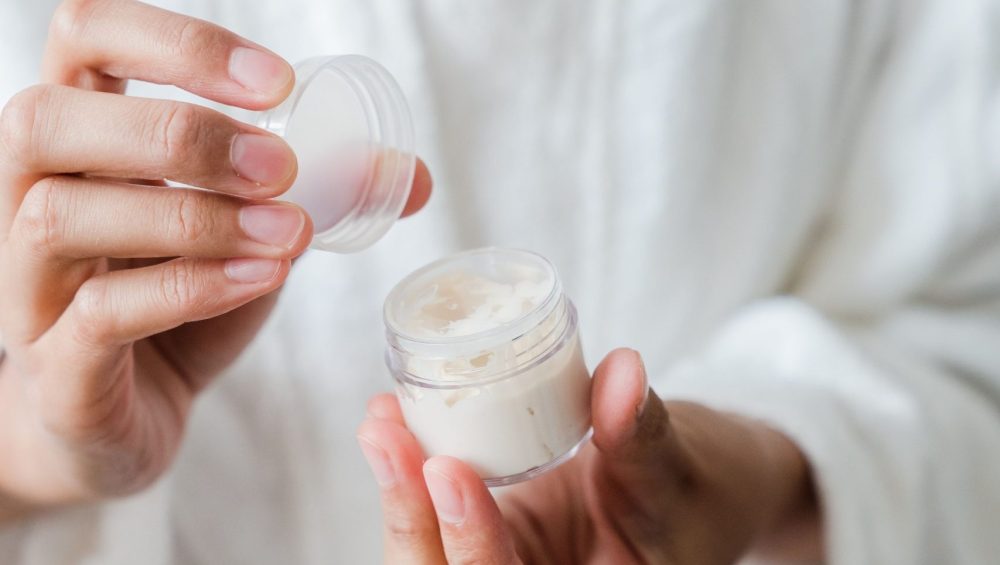
Gloved hands mixing a skincare cream in a laboratoryCategoriesEsente Skincare

“Cosmeceutical”: A Word With No Legal Meaning

Short answer: “Cosmeceutical” is a marketing word, not a regulatory one. The U.S. Food and Drug Administration says so in plain language: “The FD&C Act does not recognize any such category as ‘cosmeceuticals.’ A product can be a drug, a cosmetic, or a combination of both, but the term ‘cosmeceutical’ has no meaning under the law.” There is no third shelf. That does not make every product using the word dishonest — some are very good — it means the word carries no information, and you are back to judging the formula.

The word is free. The formulation is not.

Where the word came from

The credit here is worth getting right, because it is repeated carelessly almost everywhere. The dermatologist Albert Kligman — the University of Pennsylvania researcher behind topical tretinoin’s use in dermatology — introduced the term to the industry in 1984, at a national scientific meeting of the Society of Cosmetic Chemists, and gave it the definition that stuck: a topical preparation sold as a cosmetic but with performance characteristics that suggest pharmaceutical action. That is the version most review articles cite.

It may not be the first use. Several accounts in the cosmetic science literature trace the word further back, to Raymond Reed, a founding member of the U.S. Society of Cosmetic Chemists, around 1961. We could not verify an original Reed document, so treat that earlier date as contested. What is not contested is that Kligman is why the word entered wide circulation, as shorthand for products doing more than a conventional cosmetic while not being prescription drugs.

Whatever it meant among scientists, the marketing departments found it, and it stopped describing anything in particular. Today “cosmeceutical” appears on products ranging from serious, well-evidenced formulas to scented lotion in a heavy jar. Both uses are equally legal, because there is no rule to break.

What the law actually recognizes

Two categories, and they are defined by what the maker intends the product to do.

A cosmetic, in the statute’s words, is an article “intended to be rubbed, poured, sprinkled, or sprayed on, introduced into, or otherwise applied to the human body… for cleansing, beautifying, promoting attractiveness, or altering the appearance” — section 201(i) of the FD&C Act. A drug is an article “intended for use in the diagnosis, cure, mitigation, treatment, or prevention of disease,” or “intended to affect the structure or any function of the body of man or other animals” — section 201(g)(1).

That second half of the drug definition is where skincare gets caught. A product does not have to claim to cure anything; a claim to change how the body works can be enough. To illustrate rather than to state a legal test: saying a cream makes skin look firmer sits comfortably in cosmetic territory, while saying a cream rebuilds the skin’s structural proteins points toward a drug claim. Classification turns on intended use and the overall context of what a company says about its product, not on any single phrase in isolation.

Cosmetics do not go through FDA approval before sale. Color additives are the exception. Everything else reaches the shelf on the manufacturer’s own judgment, and regulators act afterwards if something goes wrong. That is the system. Knowing it changes how you read a label.

Intent decides, not ingredients

The same substance can land in either category depending on what the label says about it.

Toothpaste that cleans teeth is a cosmetic. Add fluoride and a cavity-prevention claim and it becomes a cosmetic and a drug at once. A shampoo that washes hair is a cosmetic. An anti-dandruff shampoo is both. Sunscreens marketed in the United States with sun-protection claims are regulated as over-the-counter drugs, governed by a monograph that dictates the wording permitted on the tube — and the same product may also perform cosmetic functions.

So there is no such thing as a “cosmeceutical ingredient.” There are ingredients, and there are the claims a company makes about them, and it is the claims and the intended use that determine how a product is regulated. This is why two products containing the same active at the same percentage can be treated differently. One brand wrote carefully. The other did not.

It also explains the strange, hedged phrasing on products that genuinely work. “Helps reduce the appearance of fine lines” reads as a cosmetic claim. Drop “appearance of” and the sentence starts pointing at what the product does to the body rather than to how it looks. That is why so much careful copy reads like legal throat-clearing.

What MoCRA changed, and what it left alone

The Modernization of Cosmetics Regulation Act was signed on December 29, 2022, as part of the Consolidated Appropriations Act, 2023. The FDA describes it as the most significant expansion of its authority to regulate cosmetics since the FD&C Act was passed in 1938. It matters, and it is routinely misreported.

In broad terms, it introduced facility registration and product listing with the FDA, a requirement to keep records supporting adequate safety substantiation, reporting of serious adverse events within 15 business days, expanded records access, mandatory recall authority for the FDA for the first time, and rulemaking on fragrance allergen labeling and good manufacturing practice.

The detail matters, and this is where most write-ups go wrong. MoCRA exempts certain small businesses from the GMP, registration and listing requirements — though not for products that regularly contact the mucous membrane of the eye, products that are injected, products intended for internal use, or products intended to alter appearance for more than 24 hours where the consumer does not remove them. Implementation has been phased: enforcement of registration and listing began on July 1, 2024. Several rulemakings are still outstanding. As of August 2026 the FDA has published draft guidance on cosmetic GMP but has not issued a final GMP regulation, and the fragrance allergen labeling rule has not been finalized either; the proposed rule on asbestos testing methods for talc-containing products was withdrawn in November 2025. Regulatory status in this area moves. Anyone relying on it for compliance should check current FDA guidance rather than a blog post.

What it did not do: create pre-market approval for cosmetics. Create a “cosmeceutical” category. Define “medical grade,” “clinical grade,” “pharmaceutical grade” or “physician dispensed.” Require anyone to prove a product works before selling it.

Read that list twice. MoCRA raised the floor on safety and traceability, which is genuinely good. It left efficacy exactly where it was — unverified before sale, and challengeable only afterwards.

The middle category exists — just not here

Here is the part that makes the word feel almost reasonable. The intermediate category people imagine when they hear “cosmeceutical” is real in other markets.

Japan regulates a class of quasi-drugs, sitting between cosmetics and pharmaceuticals, with approved active ingredients and permitted claims — whitening and anti-dandruff products are examples. South Korea has a functional cosmetics designation administered by its Ministry of Food and Drug Safety, covering skin whitening, wrinkle improvement and UV protection among other statutory headings, with a review process attached. In both systems a brand has to apply, submit data and be granted the status.

The European Union, meanwhile, works much as the United States does on this specific point. Regulation (EC) No 1223/2009 recognizes “cosmetic products”; the word “cosmeceutical” appears nowhere in it. The EU does require a safety assessment and a designated responsible person for every product placed on the market, which the United States does not, but that is a safety mechanism rather than an intermediate category.

So the category is not a fantasy. It just does not exist where you are shopping. A brand telling a U.S. customer that its product is “a cosmeceutical” is not describing an approval it obtained. It is describing an aspiration.

So what should you do with the word?

Ignore it, and look at the things the word is standing in for. Every one of these is something you can assess before you buy.

  • Which actives are in it, and what does the ingredient list tell you? Under 21 CFR 701.3, a brand may group its declaration: ingredients above 1% in descending order of predominance, then ingredients at 1% or below in any order, then color additives in any order. That is useful context, but it does not let you locate an exact 1% line by eye, and a low position is a question rather than a verdict — several genuinely effective ingredients belong below 1%.
  • Does the brand publish anything about concentration? Brands that publish their concentrations are telling you something useful. A brand that treats its formulation detail as confidential is not thereby confessing to a weak formula — proprietary formulation information is a normal commercial reality — but published detail is easier for you to evaluate than an unpublished claim.
  • Is the packaging appropriate to the formula? Light, air and heat can affect the stability of some ingredients, and thoughtful packaging is designed with that in mind. Whether a given container suits a given formula depends on the formulation, the material and the stability work behind it.
  • What does the brand say about how the product was developed? The useful question is who is responsible for the product’s development and formulation, and what relevant expertise supports that process. Good products come out of collaboration between brand product developers, cosmetic chemists, manufacturing laboratories and skincare professionals — no single named individual has to have done all of it.
  • Is there any evidence on the finished product? Look at what the brand publishes about how the finished formula was tested, and by whom. Testing on a raw material is not testing on the product you are buying.

This is the same test that applies to “medical grade”, and for the same reason: both phrases are unregulated, and both are sometimes attached to excellent formulas. The phrase is never the evidence. The next article in this series takes apart three more of them — “dermatologist tested,” “dermatologist recommended” and “clinically proven” — which sound even more official and are governed just as loosely.

What we say about our own products

Esenté uses the phrase “clinical grade.” It is positioning rather than a regulatory category, and we would rather say so than let the phrase do work it has not earned — pretending otherwise would be the exact behavior this article is criticizing.

What we will stand behind are the checkable attributes: botanically based formulations, packed in Miron violet glass rather than clear plastic, and developed collaboratively by Victoria Nash with Esenté’s professional formulation and manufacturing partners. Victoria is a licensed aesthetician with long professional experience, and that experience informs the product direction, ingredient research and performance requirements she brings to that collaboration.

Apply the questions above to us. Apply them to every brand you buy from.

Frequently asked questions

What is a cosmeceutical?

It is an informal marketing term for a cosmetic product positioned as having drug-like benefits. The FDA states that the FD&C Act “does not recognize any such category as ‘cosmeceuticals’” and that the term “has no meaning under the law.” Legally, the product is a cosmetic, a drug, or both.

Are cosmeceuticals FDA approved?

No. The FDA does not approve cosmetics before they go on sale, and it does not recognize “cosmeceutical” as a category to approve. Color additives require approval, and over-the-counter drug products such as sunscreens are subject to their own regulatory framework.

Is there any difference between a cosmeceutical and a cosmetic?

Not in law. Brands may use the term to suggest a more performance-oriented or active-focused formulation, but the term itself provides no assurance of concentration, efficacy or formulation quality. Sometimes there is a serious formula behind it. The word will not tell you which case you are in.

Did the 2022 cosmetics law change any of this?

MoCRA, signed December 29, 2022, introduced facility registration, product listing, safety substantiation records, serious adverse event reporting and FDA recall authority, with exemptions for certain small businesses and phased implementation. Registration and listing enforcement began July 1, 2024, and some rulemaking, including the good manufacturing practice regulation, remained outstanding as of August 2026. It did not introduce pre-market approval and it did not create any category between cosmetics and drugs.

Do other countries recognize cosmeceuticals?

Not under that name, but Japan regulates quasi-drugs and South Korea regulates functional cosmetics, both of which are genuine intermediate categories with an application and review process. The EU and the U.S. have no equivalent — Regulation (EC) No 1223/2009 does not use the word at all.

If the word means nothing, why do good brands still use it?

Because customers search for it, and because the alternative — explaining active concentration, raw material grade and packaging stability on a box — does not fit on a box. The honest version is to use the shorthand and then publish the detail behind it.

What should I look at before buying?

Ingredient selection, formulation quality, packaging suited to the formula, credible product-development expertise behind it, and whatever the brand publishes about how the finished product was tested. Keeping an exact formulation confidential is normal commercial practice and tells you nothing about quality either way — so judge what is published.

About the author. Victoria Nash, founder of Esenté Skincare and Younger You Clinique, has been a licensed aesthetician since 2004 and is an experienced skincare educator.

Reviewed by Victoria Nash, licensed aesthetician and founder of Esenté Skincare & Younger You Clinique. This article is educational and is not medical advice. Ask your dermatologist or licensed skincare professional about your own skin.
Supplement capsules and powder spilling from a jarCategoriesEsente Skincare

Do Collagen Supplements Do Anything for Your Face?

Short answer: Probably a little, and much less than the marketing implies. The old objection — “you just digest it, it never reaches your skin” — is too simple, because collagen-derived peptide fragments have been detected in human blood after ingestion. But the trials reporting improved skin hydration and elasticity share a set of problems that should lower your confidence in all of them: short durations, small numbers, instrument-based outcomes rather than blinded photographic assessment, multi-ingredient formulas that make the collagen hard to isolate, and frequent funding from the companies selling the ingredient. There is currently no established evidence that swallowed collagen is routed preferentially to the skin of your face rather than to any other tissue that wants amino acids. If you enjoy taking it and can afford it, the risk is low. If you are choosing between a collagen supplement and daily sunscreen, that is not a close call.

Esenté does not currently sell collagen supplements, so we have no commercial stake in this question either way.

The claim, and what would have to be true for it to hold

The pitch is a chain of four steps: you swallow collagen, it survives digestion, it reaches your skin, and your skin uses it to rebuild what age took away.

Each link needs to hold. The first two hold better than skeptics allow. The third holds partially. The fourth is where the argument thins out into hope.

Does it survive digestion? Partly, and more than the critics claimed

The dismissive version says dietary protein is broken into individual amino acids and reassembled wherever the body chooses, so eating collagen to build collagen makes as much sense as eating a brick to build a house.

That is not quite right. Hydrolyzed collagen is already broken into short peptide chains before you swallow it. When healthy volunteers drank gelatin hydrolysates after a fast, peptide-form hydroxyproline in plasma rose to a peak one to two hours later, and the major circulating fragment was identified as prolyl-hydroxyproline, alongside smaller amounts of several other di- and tripeptides (Iwai et al., Journal of Agricultural and Food Chemistry, 2005;53(16):6531–6). Some intact fragments get through, so the mechanism is not impossible.

Plausible is not demonstrated. Two things remain unshown: that circulating fragments accumulate in facial skin rather than in the many other tissues using the same building blocks, and that their presence produces a change you can see in a mirror. Detection in plasma answers a chemistry question, not the one you are asking.

What the trials actually found

The published record is not empty and it is not damning. Several randomized, placebo-controlled trials of oral collagen peptides report modest improvements in skin hydration and elasticity over 8 to 12 weeks at doses of roughly 2.5 to 10 grams a day.

The two pooled analyses most often cited are more positive than skeptics tend to admit. A systematic review and meta-analysis of 19 trials in 1,125 participants found favorable results for hydration, elasticity and wrinkles, and concluded that 90 days of hydrolyzed collagen “is effective in reducing skin aging” (de Miranda, Weimer and Rossi, International Journal of Dermatology, 2021;60(12):1449–61). A later meta-analysis of 26 randomized trials in 1,721 participants found significant improvements in hydration and elasticity, while flagging risk-of-bias problems in the included trials and calling for larger studies (Pu et al., Nutrients, 2023;15(9):2080).

Both are genuinely favorable. The 2021 review also drew a published comment in the same journal arguing its pooled studies were too heterogeneous to combine that way (Peres et al., International Journal of Dermatology, 2022;61(3):e99–e101). Now read the fine print, because it is where the argument lives.

Six reasons to discount the effect

1. Who paid. Many individual trials in this area are funded, designed or co-authored by the manufacturer of the specific hydrolysate being tested. Worth being precise about what the reviews do and do not say here: the Nutrients meta-analysis assessed risk of bias across the standard Cochrane domains — selection, performance, detection, attrition and reporting — and did not single out industry sponsorship as a category. The funding critique is ours, drawn from reading the trials’ own disclosure statements, not a conclusion those reviews reached. Industry funding does not make a result false. It shifts the prior, and the direction of that shift is well documented across nutrition research. Read the funding statement before the abstract — including on the papers cited in articles like this one.

2. What was measured. Trials here commonly report cutometer readings for elasticity and corneometer readings for hydration — instrument outputs rather than blinded assessment of photographs. Instruments are not inferior; they are sensitive, which is a virtue in a study and a complication in a purchase. The distinction that matters to a buyer is between a measurable biophysical change and an improvement anyone would notice.

3. Hydration confounds elasticity. Better-hydrated skin can read as more elastic on the instrument. If a supplement moves hydration, the elasticity result may partly be the same effect counted twice.

4. The formulas are often not collagen alone. Products commonly bundle vitamin C, hyaluronic acid, biotin, zinc and botanical extracts, and a number of published trials test blends. Where that is so, collagen is one variable among several.

5. The trials are mostly short and small. Eight to twelve weeks, often a few dozen participants per arm. Skin structure changes over years.

6. Publication bias. Null trials are less likely to be run, written up or published — particularly when the sponsor sells the ingredient.

None of that means collagen supplements do nothing — the pooled results are positive and were not produced by cranks. It means the honest summary is that a small measurable effect on hydration and elasticity is reasonably well supported, that the elasticity result may be partly the hydration result wearing a different instrument, and that the gap between “moves the cutometer” and “changes how your face looks” has not been closed.

What has not been demonstrated

That it can be directed to your face. There is currently no established evidence that ingested collagen peptides are preferentially directed to facial skin rather than to tendon, cartilage, gut lining or anywhere else with a demand for the same building blocks, and no described mechanism that would do the routing.

That it reverses menopausal change. The steep post-menopausal decline described in collagen loss after 50 is a structural change driven by hormone withdrawal. There is currently no established evidence that supplementation reverses the structural changes associated with skin aging.

That it substitutes for sun protection. UV exposure is the dominant driver of visible facial aging — the commonly cited figure puts it at up to 80%, an estimate of scale rather than a measured split. A supplement taken daily while skin goes unprotected is running the repair and the damage simultaneously, and the damage is winning.

That it covers your protein needs. Collagen lacks the indispensable amino acid tryptophan and is therefore classified as an incomplete protein source under the standard PDCAAS scoring method — a point conceded in a paper co-authored by researchers at a collagen manufacturer and a collagen research institute (Paul, Leser and Oesser, Nutrients, 2019;11(5):1079). Do not rely on it as a substitute for nutritionally complete dietary protein.

The vitamin C footnote everyone skips

Vitamin C is a required cofactor for the enzymes that hydroxylate proline and lysine during collagen synthesis. Without it the process fails — which is what scurvy is, and why sailors’ wounds reopened.

That fact gets used to sell things, and the logic does not carry. Necessary is not the same as limiting. Correcting a deficiency produces a dramatic effect; adding surplus to a system that already has enough generally does not.

Topical vitamin C is a separate question with a separate evidence base — an antioxidant applied where you want it. Covered in buying a vitamin C serum that still works when it arrives.

Safety, and the regulatory gap

Oral collagen peptides are generally well tolerated. Reported side effects are mild and mostly digestive.

Two real considerations:

Allergy. Marine collagen is derived from fish. Anyone with a fish or shellfish allergy needs to check the source, and “marine” on a label is not always specific about which species.

Regulation. Dietary supplements in the US are regulated, but not in the way most people assume. Under the 1994 Dietary Supplement Health and Education Act they are not subject to FDA approval for safety or efficacy before sale. Manufacturers do carry real obligations — good manufacturing practice requirements, responsibility for the safety of what they sell, substantiation for the claims they make, and adverse-event reporting — but the FDA’s enforcement generally comes after a product is already on the market. Independent testing has repeatedly found supplements whose contents did not match their labels.

This should sound familiar to anyone who has read what medical-grade skincare actually means. “Clinically proven” on a supplement tub can rest on anything from a well-run trial to one small study of a different formulation. Not meaningless, not a guarantee — worth asking which study.

What we would do with the money instead

Ranked by evidence per dollar, for a face:

1. Broad-spectrum SPF 30 or higher, every morning. The strongest evidence base of anything available and the cheapest step in the routine.

2. A retinoid, introduced gradually according to individual tolerance and the directions for the particular product. The most studied topical anti-aging ingredient category in existence. More on the approach in starting retinol without wrecking your barrier.

3. A cleanser that does not strip your barrier, followed by a toner or antioxidant spray. Unglamorous, and the step people cut first. Harsh cleansing can compromise skin that is already dry or reactive, and price is not a reliable guide to whether a cleanser is gentle. Esenté’s preferred approach is an aesthetic facial sponge or gauze pad rather than the fingers, and no facial scrubbing brushes.

4. Barrier lipids and humectants. Ceramides and hyaluronic acid, applied consistently. Boring and reliable.

5. Adequate complete protein, sleep, and not smoking. Free or close to it, and more consequential than the tub.

If all five are in place and there is money left, trying collagen peptides is a reasonable choice with a low downside. Buy from a brand that publishes third-party testing, and expect a modest measurable effect rather than a visible change in facial aging.

Where Esenté stands

Esenté does not currently sell collagen supplements. That is a scope decision rather than a moral position: the company specializes in topical skincare formulations, developed collaboratively by Victoria Nash with Esenté’s professional formulation and manufacturing partners, and packages the Elite line in Miron violet glass rather than plastic.

The areas where the evidence is stronger are the unfashionable ones: a gentle cleanser, a toner or antioxidant spray after every cleanse, and a hydrating night creme.

Esenté’s products for those steps are Orchid Reviving Cleanser, Octet Herbal Toner or Hydro-Mist, and Hydra-Plus night creme. Taking product out of a jar with a cosmetic spatula rather than fingers is good hygiene practice.

Frequently asked questions

Do collagen supplements actually work for skin?

Two meta-analyses pooling 19 and 26 randomized trials both found statistically significant improvements in skin hydration and elasticity over roughly 8 to 12 weeks, so the honest answer is not “no.” The reasons to hold that result loosely are that the trials are mostly short and small, rely on instrument readings rather than blinded assessment of photographs, frequently test multi-ingredient formulas, and are frequently funded by the ingredient manufacturer. A small measurable effect is well supported. A visibly meaningful change in facial aging is not established.

How much collagen should I take, and for how long?

That is a question for you and your physician rather than for a skincare brand. What can be reported is what researchers have studied: published trials have commonly used roughly 2.5–10 grams daily of hydrolyzed collagen peptides over 8–12 weeks, with the wider literature spanning up to about 15 grams, and study designs and formulations vary considerably. Higher doses have not been shown to produce proportionally better results.

Is marine collagen better than bovine?

No trial has established a meaningful difference for skin outcomes. Marine collagen is absorbed somewhat differently owing to peptide size, which brands lean on heavily, but the comparative human evidence does not support a clear winner. Anyone with a fish or shellfish allergy should avoid marine sources.

Does collagen get destroyed by stomach acid?

Not entirely. Hydrolyzed collagen is already broken into short peptide chains, and collagen-derived di- and tripeptides such as prolyl-hydroxyproline have been measured in human plasma one to two hours after ingestion (Iwai et al., 2005). The open question is not survival — it is whether those fragments reach facial skin in useful quantities and change how it looks.

Should I take vitamin C with collagen?

Vitamin C is a necessary cofactor for collagen synthesis, so adequacy matters. Beyond adequacy, extra vitamin C has not been shown to increase collagen production in people who are not deficient. Most people meeting normal dietary intake are already adequate. Topical vitamin C is a separate question with a separate evidence base.

Are collagen supplements safe?

Generally well tolerated, with mild digestive effects the most common complaint. Two caveats: check the source if you have a fish or shellfish allergy, and remember that supplements in the US are not subject to FDA approval for safety or efficacy before sale — manufacturers carry obligations for safety, manufacturing practice and claim substantiation, but review generally happens after a product is on the market. Buy from brands that publish third-party testing, and discuss any supplement with your physician if you take prescription medication.

Related reading

Victoria Nash, founder of Esenté Skincare
Victoria Nash, founder of Esenté Skincare and Younger You Clinique.

About the author. Victoria Nash, founder of Esenté Skincare and Younger You Clinique, has been a licensed aesthetician since 2004 and is an experienced skincare educator.

Reviewed by Victoria Nash, licensed aesthetician and founder of Esenté Skincare & Younger You Clinique. This article is educational and is not medical advice. Discuss supplements, allergies and any interaction with prescription medication with your physician.