
Short answer: Bakuchiol is a plant ingredient that is often called a natural alternative to retinol. In the one published head-to-head study we know of, it performed about as well as retinol on the appearance of wrinkles and dark spots over twelve weeks, and people using it reported less peeling and stinging. That is a promising result from a single small study. Retinol has decades of evidence; bakuchiol has a few years. If retinol suits you, there is no reason to switch. If it does not, bakuchiol is a reasonable thing to try.
That is the whole comparison. Here is the detail behind it, without the hype in either direction.
What bakuchiol is
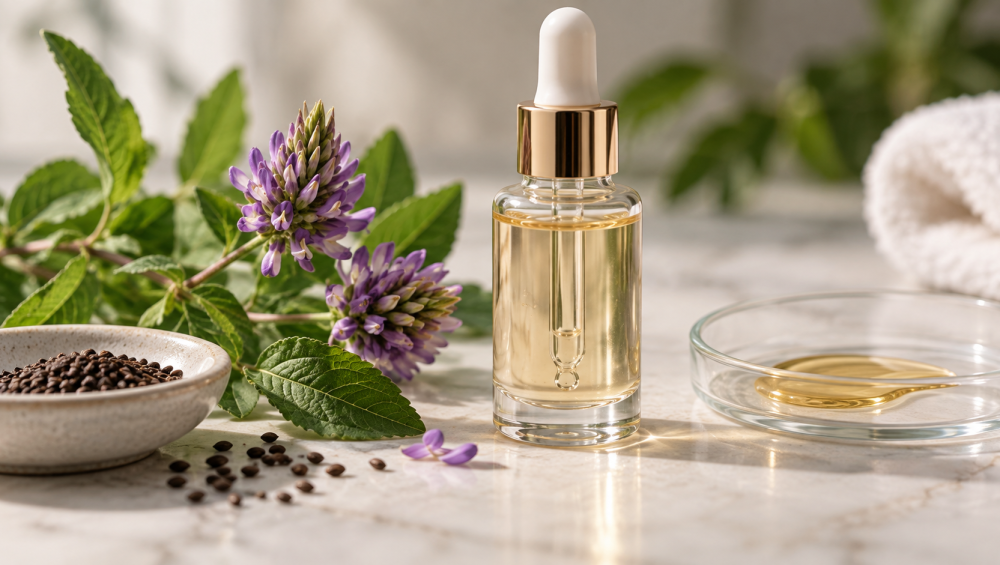
Bakuchiol is extracted from the seeds and leaves of a plant called babchi, which has a long history in traditional medicine in India and China. Chemically it looks nothing like retinol. What caught researchers’ attention is that, in laboratory tests, skin cells exposed to bakuchiol switched on some of the same genes that retinol does. That is why it is described as “retinol-like.”
Retinol is a form of vitamin A. Your skin converts it into retinoic acid, which is the active form and the one prescription products use. How to Choose a Retinol Serum covers that side in more depth.
The study everyone quotes
There is one study that matters, and it is worth knowing exactly what it found.
In 2019, dermatologists at the University of California, Davis ran a randomized, double-blind study of 44 people over twelve weeks. Half used a 0.5% bakuchiol cream twice a day. Half used a 0.5% retinol cream once a day. Photographs were analyzed by a computer system, and a dermatologist who did not know which cream each person was using graded pigmentation and redness.
Both groups improved. Wrinkle surface area went down and dark spots faded, and there was no statistical difference between the two creams. The retinol group reported more scaling and stinging. The authors concluded that bakuchiol was comparable to retinol and better tolerated.
Three things to keep in mind. Forty-four people is a small study. Twelve weeks is a short time. And the bakuchiol group applied their cream twice a day while the retinol group applied theirs once, so the two were not used identically. A promising result, and one study.
Where retinol still has the edge
Evidence. Retinoids have been studied for decades, with prescription-strength versions carrying FDA-approved labels for photoaged skin. Bakuchiol has a handful of studies. When a dermatologist recommends retinol, they are standing on a much deeper pile of paper.
Retinol also comes in a wider range of forms and strengths, so it can be introduced very gently and built up. Bakuchiol products are typically sold at a narrower range of concentrations.
Where bakuchiol has the edge
Comfort. A common reason people give up on retinol is irritation: dryness, flaking, redness, stinging. In the head-to-head study, bakuchiol users reported less of that. For someone whose skin does not tolerate retinol well, or who wants something to use in the morning, bakuchiol is worth a look.
Retinol is generally used at night, with broad-spectrum sunscreen during the day. Bakuchiol is commonly used morning or evening, and you should wear sunscreen every day whichever you choose. Bakuchiol also does not carry the pregnancy warning that retinoids do. That said, “not known to” is not the same as “proven safe,” and anyone pregnant should ask their doctor before using any active ingredient.
What neither of them does
Neither removes wrinkles. Even prescription tretinoin’s own label says it does not eliminate wrinkles, repair sun-damaged skin or reverse photoaging. What both can do, used steadily, is improve the appearance of fine lines, texture and uneven tone. Anything promising more is overselling.
Can you use both?
Yes. Some people use bakuchiol in the morning and retinol at night, or use bakuchiol on nights when their skin needs a break from retinol. There is no known problem combining them, though there is also no study showing the combination is better than either alone.
How to choose
If retinol works for you and your skin is comfortable, stay with it. If you have tried retinol and could not get past the irritation, or you want a daytime option, try bakuchiol. Visible change with either one takes consistent use over time, so do not judge after a week. Apply to clean skin before moisturizer, follow the directions on your product, and wear sunscreen every morning whichever you choose.
Victoria’s approach
Victoria Nash, founder of Esenté Skincare and Younger You Clinique, has been a licensed aesthetician since 2004 and is an experienced skincare educator. She draws on her professional experience at Younger You Clinique when evaluating skincare products and their performance, and Esenté’s approach to any ingredient, new or old, is to judge it on the things you can check rather than on the headline.
Esenté’s retinol offering is the Retinol Progressive 60-Day Renewal System, a staged system with its own directions for gradual introduction. Esenté products are developed collaboratively by our management team and our professional formulation and manufacturing partners, and are manufactured exclusively in the USA.
If you are weighing retinol against an alternative for your own skin, the Ask Victoria page is the place to ask.
Frequently asked questions
In one twelve-week study of 44 people, it performed about as well on the appearance of wrinkles and dark spots, with fewer reports of peeling and stinging. That is one small study against decades of retinol research. Promising, not proven equal.
No. It is a plant extract with a completely different chemical structure. It is called retinol-like because laboratory tests showed it affects some of the same skin genes.
Yes. Bakuchiol is commonly used in the morning or evening, while retinol is generally used at night. Wear broad-spectrum sunscreen every day either way.
Ask your doctor. Bakuchiol does not carry the warning that retinoids do, but that is because it has been studied far less, not because it has been proven safe in pregnancy.
Users in the head-to-head study reported less scaling and stinging than retinol users. Some people still notice mild dryness when starting. Any active can bother sensitive skin.
Yes, at different times of day or on alternating nights. There is no known conflict, and also no evidence the combination beats either alone.
About the author. Victoria Nash, founder of Esenté Skincare and Younger You Clinique, has been a licensed aesthetician since 2004 and is an experienced skincare educator.
Reviewed by Victoria Nash, licensed aesthetician and founder of Esenté Skincare & Younger You Clinique. This article is educational and is not medical advice. Ask your dermatologist or licensed skincare professional about products appropriate for your own skin and medical history.