

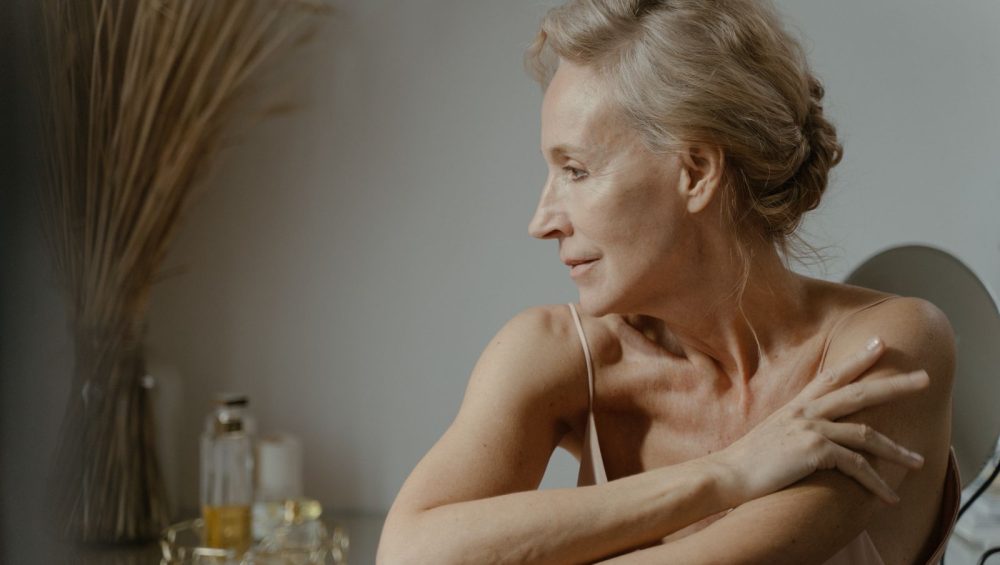
Short answer: Skin changes associated with the menopausal transition emerge gradually, though timing, sequence and severity vary considerably from person to person. Oiliness and reactivity commonly shift first, during perimenopause, while estrogen is still fluctuating — often with adult breakouts and a new intolerance to products you used for years. Increasing dryness follows, and for many women it persists. The steepest structural change is generally placed in roughly the first five years after the final period, which is when firmness and bounce tend to go — an estimate drawn from cross-sectional work rather than a measured trajectory, and one we unpack below. Laxity, crepiness and consolidated pigment follow more slowly over the decade after that. The pattern is worth knowing because each stage responds to something different, and the routine that suits perimenopausal skin is close to the opposite of the one that suits skin five years post-menopause.
Most advice treats menopause as a single event. Your skin experiences it as a timeline.
Why the pattern exists
Estrogen receptors are present throughout human skin — in keratinocytes, fibroblasts, sebaceous glands and hair follicles. That is why a hormonal transition shows up on your face at all, and why it produces a cluster of changes rather than one.
The transition is long. Perimenopause commonly begins in the mid-to-late forties and runs several years. Menopause is defined retrospectively: twelve consecutive months without a period, commonly cited at a US median age of about 51, though SWAN’s longitudinal analysis put the median at 52.5 (Gold et al., American Journal of Epidemiology, 2013). The symptoms do not stop at the finish line — among the SWAN women who reported frequent hot flashes or night sweats, meaning six or more days in the previous fortnight, the median total duration was 7.4 years, and among those with an observable final period it persisted a median of 4.5 years beyond it (Avis et al., JAMA Internal Medicine, 2015). Those figures describe women with frequent symptoms, not every woman.
The window in which skin is being reorganized is closer to a decade than a year.
Stage one: perimenopause, and the confusing years
This is the stage that catches people out, because the complaints do not sound like aging.
Oil behavior becomes erratic. Estrogen and androgens shift relative to one another, and sebaceous glands respond to that ratio rather than to either hormone alone. Skin predictable for twenty years starts producing more oil some weeks and less in others.
Adult breakouts appear or return. Jawline and chin, often cyclical, often in women who had clear skin since their twenties. A common complaint in this age group, and routinely misread as a reaction to a new product.
Reactivity increases. Products tolerated for a decade start to sting. Fragrance that never registered starts to register.
Sleep disruption shows on the face. Night sweats and broken sleep are not a skin problem, but under-eye shadowing, dullness and slower recovery from irritation follow from them.
The mistake at this stage is to escalate. Erratic oil and breakouts push people toward stripping cleansers, acids and scrubs at the moment their barrier is becoming less resilient. The result is skin that is oily, congested and damaged at once.
What actually helps here: stabilize rather than attack. A gentle cleanser at night, a toner or antioxidant spray after every cleanse, niacinamide for barrier support and redness, and a light moisturizer. Esenté’s preferred approach is to cleanse with an aesthetic facial sponge or gauze pad rather than the fingers, and to leave facial scrubbing brushes out altogether. Morning cleanser is generally reserved for genuinely oily skin.
Stage two: the final year and the twelve months after it
This is the compressed one, and it is why women describe their skin as changing overnight.
Circulating estrogen falls substantially across the transition, and for many women the change around the final period feels comparatively rapid — though the endocrine picture differs from woman to woman. Fibroblast activity, structural protein synthesis, skin thickness and water-holding capacity are all influenced by estrogen and tend to decline together. The subjective experience is that skin stops bouncing back — a crease that used to be gone by mid-morning is still there at lunch.
You will see a figure attached to this: roughly 30% of skin collagen lost within five years of menopause, then about 2% a year afterwards. It is worth knowing what that rests on, because it is thinner than its ubiquity suggests.
The primary measurements are Brincat and colleagues’ 1987 work, which found skin collagen content, skin thickness and bone measures declining together at between 1% and 2% per year after menopause (Brincat et al., Obstetrics & Gynecology, 1987;70(6):840–5). Those studies were cross-sectional — different women compared at different distances from menopause, rather than the same women followed over time — and the slope was fitted by regression. The “30% in the first five years” half of the figure does not appear in that paper. It circulates through later review articles, which cite one another rather than reproducing the measurement (see, for example, Duarte et al., Cutis, 2016;97(3):E16–23, and the reviews citing it).
So: the direction is well supported and the mechanism is real. The specific numbers are a re-cited estimate of scale, not a measured trajectory, and no longitudinal study has replaced them.
The other change in this window is sebum. Production tends to fall, and unlike the perimenopausal fluctuation this shift is not usually followed by a swing back. Skin that was oily for decades often becomes noticeably drier and stays that way — which is why a cleanser that was correct in your forties is frequently wrong a year or two later. We cover the structural side in collagen loss after 50.
Stage three: years one to five after your final period
The changes here are consolidation rather than new events.
Dryness tends to become the baseline. For many women it is no longer seasonal. The barrier holds less water and the skin makes less oil to slow its escape.
The barrier becomes the limiting factor. Actives sting, moisturizers absorb unevenly, and the routine that worked in your forties starts producing reactions. Barrier support stops being a supporting step and becomes the foundation everything else sits on.
Wound healing slows. Blemishes, scratches and post-treatment redness take longer to clear. Estrogen’s role in cutaneous wound healing is well described, and the practical effect is that anything irritating your skin now costs more days than it used to.
Facial hair changes. As the androgen-to-estrogen ratio shifts, terminal hairs appear on the chin and upper lip while hair elsewhere thins. Common, rarely discussed, not a sign anything has gone wrong.
What actually helps here: ceramides, hyaluronic acid, and a richer night moisturizer than you think you need. This is also the stage where a retinoid earns its place — introduced gradually according to individual tolerance and the directions for the particular product, because reactive post-menopausal skin rarely takes well to a nightly start. More on the approach in starting retinol without wrecking your barrier.
Stage four: years five to twenty
Slow, cumulative, and dominated by what your skin was exposed to rather than by hormones.
Laxity along the jaw and neck. This is tissue descent, and it is the change topical products address least. A topical cosmetic cannot physically reposition descended tissue or reproduce a surgical lift. It can improve the appearance of firmness, contour and smoothness — a different and more modest promise.
Crepiness on the neck, chest and under the eyes. Fine, closely spaced wrinkling from thinner skin and lost elasticity. It responds to hydration and texture work more than most people expect, and to nothing at all if the area is still getting daily unprotected sun. See crepey skin on the neck and décolleté.
Pigment consolidates. Decades of sun damage surface as fixed lentigines rather than the summer freckling of your thirties.
Skin thins and bruises more easily. Covered in why skin thins after 60.
By this stage the hormonal driver is largely spent and the dominant variable is photodamage. The commonly quoted figure attributes up to 80% of visible facial aging to sun exposure — received wisdom in the dermatology literature more often than a measured result, so read it as an estimate of scale. It points the same way regardless: what you did in the sun before 40 shows up here, and daily protection now changes the next decade.
The three things that get blamed on menopause and are not menopause
Photodamage. Deep wrinkles, mottled pigment, broken capillaries and leathery texture are sun history. The timing coincides with menopause because both surface in your fifties.
Weight change. Facial fat pads shift and shrink with age and with weight loss. That reads as hollowing and sagging, and it is independent of estrogen.
Over-treatment. A familiar version of “my skin got worse at 52” is skin that has had four new actives, an acid and a cleansing device added to it inside three months. Skin in transition tolerates less, not more.
What we are not going to tell you
Systemic hormone therapy affects skin. The same 1987 group reported that the decline in skin collagen was smaller in postmenopausal women receiving estrogen than in untreated women (Brincat et al., British Journal of Obstetrics and Gynaecology, 1987;94(2):126–9). That is an observation about skin, and it is not a reason to start or stop anything. Skin is not an indication for hormone therapy, a skincare brand is not the right source on that question, and this article makes no recommendation on it in either direction. Take it to your physician, who can weigh it against your full medical history.
Second: nothing topical replaces structure that has already gone. Products work on the epidermis and the visible surface, improving texture, hydration, tone and the appearance of fine lines. They do not restore dermal volume, and any brand telling you otherwise is describing a drug it has not registered.
Third: professional treatments performed in a clinic by an appropriately qualified and licensed professional where required — microneedling, laser resurfacing — operate on a different level and are a separate decision from anything you buy on a website.
A routine that matches the stage you are in
Perimenopause. Gentle night cleanser, toner or antioxidant spray after every cleanse, niacinamide, light moisturizer, daily broad-spectrum SPF 30 or higher. Hold off on aggressive actives while oil is fluctuating.
Post-menopause, years 0–5. The same foundation, plus ceramides, hyaluronic acid, a richer night moisturizer, a morning antioxidant, and a retinoid introduced gradually according to individual tolerance and the directions for the particular product.
Post-menopause, five years on. Everything above, with more attention to the neck and chest than the face, and gentle exfoliation kept infrequent.
Esenté’s preferred approach leaves scrubbing brushes out at every stage. For placement within those steps: a gentle cleanser such as Esenté Orchid Reviving Cleanser, then Octet Herbal Toner or Hydro-Mist, a serum suited to your skin, and a hydrating night creme. Esenté formulations are developed collaboratively by Victoria Nash with Esenté’s professional formulation and manufacturing partners, and the Elite line ships in Miron violet glass rather than plastic.
Frequently asked questions
Usually in the mid-to-late forties, during perimenopause, before periods stop. The first signs are erratic oil production, adult breakouts and new sensitivity rather than wrinkles. The structural change concentrates later, around and after the final period — commonly cited at a US median age of about 51, with SWAN’s longitudinal analysis reporting 52.5.
Perimenopausal hormone fluctuation shifts the balance between estrogen and androgens, and sebaceous glands respond to that ratio. Jawline and chin breakouts in the forties are common and are frequently mistaken for a reaction to a new product. Treating them with the stripping routine you would have used at twenty tends to make things worse, because barrier resilience is falling at the same time.
The steepest phase is concentrated in roughly the first five years after your final period. Slower change continues for a decade or more after that, but by then photodamage is the dominant driver rather than hormones. The transition as a whole spans closer to a decade than a year.
No topical product replaces structure that has already been lost. Products work on the epidermis and the visible surface — texture, hydration, tone, the appearance of fine lines — and consistent use produces real, visible improvement in those. Slowing further loss is achievable, and daily sun protection is the most effective way to do it.
That is not a question this article can answer, and not one a skincare brand should be answering. What the research describes is narrower than the question: estrogen receptors are present throughout human skin, and studies of women receiving systemic hormone therapy have reported less structural decline than in women who were not. Those are observations about skin. The decision is a prescription decision that belongs to you and your physician, resting on symptoms, cardiovascular and breast history, age, time since your final period and personal risk tolerance — factors that sit well outside anything skin can inform. Take it to a clinician who knows your history.
No. Timing, sequence, severity and which changes dominate vary considerably with genetics, skin type, Fitzpatrick phototype, accumulated sun exposure, smoking history, sleep and weight change. The stages above are a framework for understanding what is happening, not an order every woman should expect to follow.
Related reading
- What medical-grade skincare actually means
- Collagen loss after 50
- Crepey skin on the neck and décolleté
- Why skin thins after 60
- Do collagen supplements do anything for your face?
- Starting retinol without wrecking your barrier
About the author. Victoria Nash, founder of Esenté Skincare and Younger You Clinique, has been a licensed aesthetician since 2004 and is an experienced skincare educator.
Reviewed by Victoria Nash, licensed aesthetician and founder of Esenté Skincare & Younger You Clinique. This article is educational and is not medical advice. Discuss hormone therapy, menopausal symptoms and any medical treatment with your physician.