

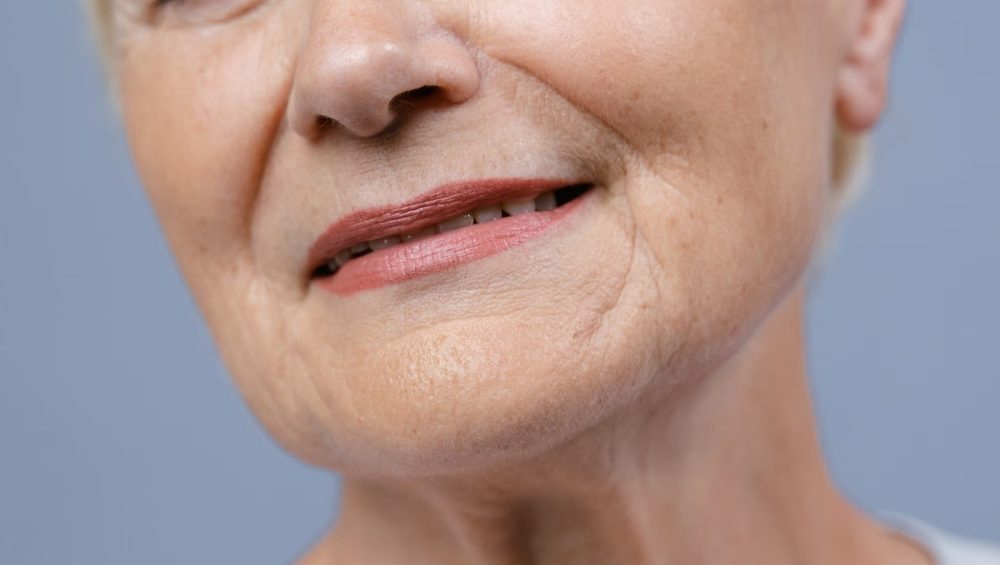
Short answer: Skin after 60 thins on two levels at once. The outer layer renews more slowly and holds less water, and the junction between the outer and deeper layers flattens out, which removes much of the mechanical grip holding the two together. That flattening is why older skin tears, bruises and shears so easily — it is a structural change, not fragility in the abstract. The deeper layer loses volume in parallel. For many people with mature, dry or increasingly fragile skin, supporting the skin barrier is an important foundation before introducing stronger active ingredients: gentler cleansing, restored surface pH, and consistent lipid replacement. Actives come after that, introduced gradually and according to the directions for the particular product, because they tend to be poorly tolerated on a barrier that has not been supported first.
Almost every routine written for this age group has the order backwards.
Two thinnings, not one
The outer layer. The epidermis thins modestly with age while its renewal cycle lengthens — measurably slower in the seventies than in the twenties, though the exact figures vary between studies and measurement methods, so treat any precise number you see with suspicion. Dead cells stay in place longer, which is why older skin can look dull and rough while also being dry.
The junction between the layers. This is the change that explains the symptoms. In young skin the boundary between the epidermis and the layer below is corrugated — interlocking ridges that grip like a dovetail joint. With age that interface flattens: less surface area for exchange, and far less mechanical resistance to shear. Flattening of the dermo-epidermal junction is a standard description of aged skin in the histology literature (Wulf et al., Micron, 2004;35(3):185–91).
That flattening is why an older forearm can tear from a knock that would not have marked it at 40, and why adhesive dressings can lift skin off. Not weakness as a metaphor — a specific, well-described histological change with specific consequences.
The deeper layer. Volume declines, structural protein content falls, and the elastic fiber network degrades, accelerated hard by cumulative UV exposure. Histological work reports declining thickness through later life; the figures vary enough between studies that the direction is more useful than any single percentage.
What else changes, and why it matters more than you would think
Surface pH rises. Healthy skin sits acidic. That acidity is not incidental — the enzymes that build barrier lipids and the skin’s own antimicrobial defenses work within a narrow pH band. Stratum corneum acidification has been shown to be impaired in moderately aged skin, with barrier defects linked to the resulting rise in pH (Choi et al., Journal of Investigative Dermatology, 2007;127(12):2847–56; the mechanistic work in that paper was done in mice). It is a good reason to consider a pH-balancing toner or antioxidant spray after every cleanse, and that step is part of the Esenté skincare regimen — offered as a recommendation rather than as a physiological requirement for everyone.
Sebum production falls further. It has already dropped through menopause. It keeps dropping. Skin has less of its own occlusive layer and loses water faster.
Blood vessels become more fragile. Purple bruising on the forearms and backs of the hands that appears after minimal trauma is common past 60 and is a recognized presentation. It is not a sign of poor skincare and cannot be prevented with a cream. Anticoagulants and antiplatelet drugs make it more pronounced.
Immune surveillance in the skin declines. Langerhans cell numbers fall with age, and the remaining cells have fewer dendrites and reduced antigen-trapping capacity (Wulf et al., 2004). Healing slows, and infections in broken skin are less well contained.
Vitamin D synthesis in the skin declines. Older skin produces less vitamin D from the same sun exposure because the epidermal concentration of the precursor 7-dehydrocholesterol falls; skin from subjects in their late seventies and eighties produced less than half the previtamin D3 of skin from children and adolescents (MacLaughlin and Holick, Journal of Clinical Investigation, 1985;76(4):1536–8). This is a reason to discuss supplementation with a physician, not a reason to skip sunscreen — the trade there is not close.
The causes nobody mentions
Three drivers of thin skin are not aging at all, and they are worth ruling out before spending money on products.
Topical and oral corticosteroids. Long-term corticosteroid use causes dermal atrophy. This is established, dose-dependent and not controversial. Anyone on chronic inhaled, oral or potent topical steroids who has noticed their skin thinning should raise it with their prescriber rather than treat it as inevitable.
Sun exposure. The photodamaged forearm of a 70-year-old and the sun-protected skin of their upper inner arm belong to the same person and the same genetics. Compare them. The difference is exposure.
Smoking and inadequate protein intake. Smoking is well described as an independent contributor to skin aging, and protein adequacy matters to the tissue the skin has to build. Neither is a skincare problem, and neither is fixed by a product.
Barrier first. Actives second. In that order.
The instinct at 60 is to reach for stronger products, on the reasoning that there is more damage to address. It often backfires, producing skin that is simultaneously thin, dry, irritated and over-treated.
Here is the order Esenté recommends.
1. Look at the cleanser before you change anything else
This is the step people are most likely to treat as low-stakes, and where a lot of avoidable damage happens. Harsh or inappropriate cleansing can compromise skin that is already dry or fragile and no longer has the oil production to recover quickly. Price is not a reliable guide either way — what matters is whether the cleanser is gentle and appropriate for the skin using it.
Esenté’s approach is to cleanse at night, reserving a morning cleanser for genuinely oily skin, on the basis that a properly completed evening routine leaves little to remove; warm water suits most people in the morning. We recommend an aesthetic facial sponge or gauze pad rather than the fingers, and leaving facial scrubbing brushes out — on thin skin, abrasion tends to cause the irritation it was bought to correct. Warm water, not hot.
2. Restore surface pH immediately after every cleanse
A toner or antioxidant spray, morning and night, after every cleanse. Given the age-related rise in surface pH described above, we think it is one of the most under-rated steps for this age group.
3. Replace the lipids the skin no longer makes
Ceramides for the barrier lipids. Humectants such as hyaluronic acid and glycerin to hold water. An occlusive layer over the top to slow its loss — humectants alone in dry indoor air can make skin feel worse rather than better.
Applied twice daily. This is not a luxury step. A cluster randomized trial across 14 Western Australian aged-care facilities found twice-daily application of a pH-neutral, perfume-free moisturizer to residents’ extremities cut skin tears from 10.57 to 5.76 per 1,000 occupied bed days over six months — close to half (Carville et al., International Wound Journal, 2014;11(4):446–53). Those were aged-care residents, so the effect size should not be read across to every healthy adult over 60. It does suggest moisturizer is doing more than cosmetic work.
4. Sunscreen, still, at 60 and at 80
Broad-spectrum SPF 30 or higher, every morning. Photoaging is cumulative and ongoing; the damage does not stop accruing because the birthday count is high. Trials of topical retinoids in photodamaged skin have recruited participants well into their seventies and eighties and reported measurable change in that group, so age is not a reason to assume treatment is wasted — and none of it holds against continued unprotected exposure.
5. Then actives, introduced one at a time
There is no single regimen that suits everyone at this age, and this is not the place for one. The general principle is that active ingredients should be introduced gradually, one at a time, according to individual skin tolerance and the directions for the specific product — and that skin which is thin and easily irritated usually does better with a slower introduction than a faster one. If you are under the care of a dermatologist or another provider, their directions come first.
Niacinamide is a reasonable starting point. Barrier support, tone, redness, and better tolerated on thin skin than almost anything else.
A retinoid is the most evidenced category for texture and fine lines, and the one that most rewards patience. Follow the directions supplied with the product you have chosen; slower conversion in over-the-counter retinol is an advantage on thinning skin rather than a compromise. More on the approach in starting retinol without wrecking your barrier.
Peptides are a reasonable option for skin that does not tolerate a retinoid — well tolerated, with a thinner independent evidence base and a published literature that is substantially manufacturer-funded. See what peptides actually do.
Vitamin C in the morning, if tolerated.
6. Exfoliate less than you did
Slower cell turnover is a genuine argument for some exfoliation. Thin, fragile skin is a stronger argument against overdoing it. Keep it infrequent, chemical rather than physical, and stop if the skin reacts.
What honest expectations look like
What improves: hydration, comfort, texture, tone, tolerance of products, resilience to minor damage, and the appearance of fine lines. These are real and visible, though how quickly they appear varies considerably between individuals and formulations.
What does not: the structural volume already lost, the flattened junction between layers, and the degraded elastic network. Topical products act on the epidermis and the visible surface. They do not rebuild anatomical structure below it — and a cosmetic that claims to should be read carefully, because claims about changing the structure of the body are drug claims rather than cosmetic ones.
What is a separate conversation: professional treatments performed in a clinic by an appropriately qualified and licensed professional where required. They act differently and more aggressively than anything sold retail and need a practitioner who has examined your skin — particularly at an age where healing is slower and medications may be relevant.
None of this competes with a filler or a facelift, and none of it is trying to. Injectables add volume. Surgery repositions tissue. Topical care changes the quality of the skin itself, which neither of the other two addresses. The honest version of that promise is better skin, not a different face.
The routine, in order
Morning. Warm water, or a gentle cleanser if your skin is oily. Toner or antioxidant spray. Vitamin C serum if tolerated. Moisturizer with ceramides. Broad-spectrum SPF 30 or higher, extended to the neck and chest.
Evening. Gentle cleanse with a sponge or gauze pad. Toner or antioxidant spray. Retinoid on the nights your product’s directions allow, hydrating serum on the others. A richer night moisturizer.
Weekly. Gentle exfoliation, kept infrequent.
For placement within those steps: a gentle cleanser such as Esenté Orchid Reviving Cleanser, followed by Octet Herbal Toner or Hydro-Mist, then a serum suited to your skin and a hydrating night creme. Esenté formulations are developed collaboratively by Victoria Nash with Esenté’s professional formulation and manufacturing partners. The Elite line ships in Miron violet glass rather than plastic; taking product out with a cosmetic spatula rather than fingers is good hygiene practice.
Frequently asked questions
Two changes together. The outer layer renews more slowly and holds less water, and the junction between the outer and deeper layers flattens, removing much of the mechanical grip that held them together. The deeper layer also loses volume and elasticity. The flattened junction is the reason older skin tears and shears from minor knocks.
Not by a topical product. Products act on the epidermis and the visible surface, where they improve hydration, texture, tone and the appearance of fine lines. They do not restore lost structural volume. Slowing further loss is achievable, and daily sun protection is the most effective way to do it.
Blood vessels become more fragile with age and the supporting tissue around them thins, so minor knocks produce visible bruising on the forearms and hands. Anticoagulants, antiplatelet drugs and long-term corticosteroids make it more pronounced. If it has appeared suddenly or worsened, raise it with your physician rather than a skincare brand.
No. Trials of topical treatment for photodamaged skin have included participants in their seventies and eighties and reported measurable change, and barrier support improves comfort and appearance at any age. The gains are real; they build more slowly.
Often the opposite. Thin, barrier-compromised skin tends to tolerate less, and over-treatment is a common problem in this age group. Look at the cleanser, restore surface pH, replace the barrier lipids, then introduce one active at a time, gradually and according to the directions for that product.
It might be. Long-term topical, inhaled or oral corticosteroids cause dermal atrophy, and the effect is dose-dependent and well documented. Do not stop a prescribed medication over this — raise it with the doctor who prescribed it.
Related reading
- What medical-grade skincare actually means
- Menopause and skin: what changes, and in what order
- Crepey skin on the neck and décolleté
- Do collagen supplements do anything for your face?
- Collagen loss after 50
- The order to apply skincare, and how to store it
About the author. Victoria Nash, founder of Esenté Skincare and Younger You Clinique, has been a licensed aesthetician since 2004 and is an experienced skincare educator.
Reviewed by Victoria Nash, licensed aesthetician and founder of Esenté Skincare & Younger You Clinique. This article is educational and is not medical advice. Discuss medications, bruising, and any change in your skin with your physician.