

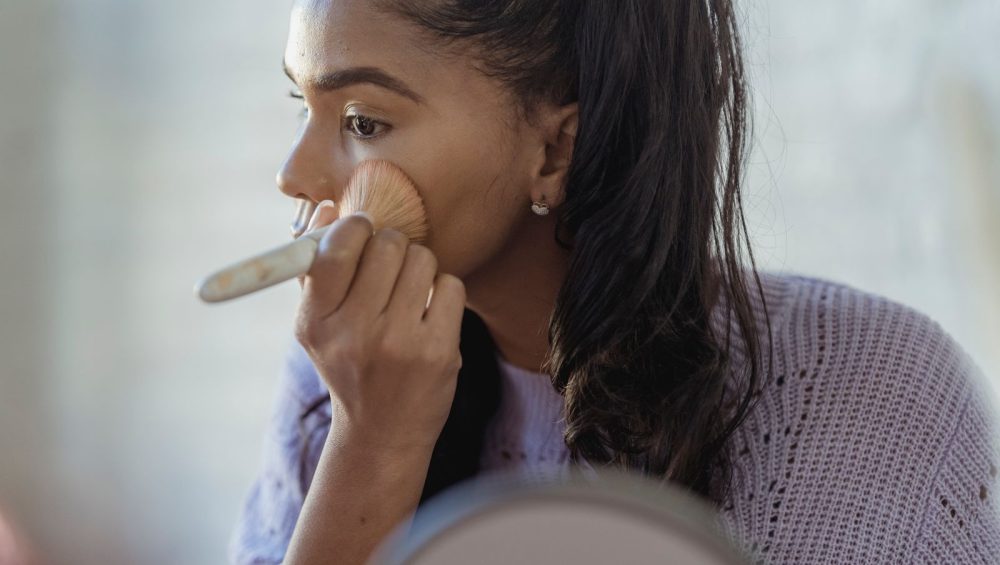
Short answer: It can, but only if the product provides appropriate sun protection and is applied generously and evenly according to its label directions. In practice, foundation, powder and other makeup products are often applied more thinly and unevenly than the amount used for SPF testing, so relying on makeup alone may provide less protection than the SPF number suggests. The dependable approach is a Broad Spectrum sunscreen applied every morning, all year, before your makeup, with hats, clothing and shade adding protection. SPF numbers from layered products do not add together. When you are outdoors, follow the sunscreen label’s reapplication directions.
The SPF on a compact is real. The question is how much of it reaches your skin.
Why the number overstates what you get
Every SPF is measured the same way, in a laboratory test at a set amount that is generous by everyday standards.
Makeup is not applied like that. You put on enough foundation to even out your skin, and perhaps a light layer of powder to set it. Both are usually thinner than the test amount, and applying too little can reduce protection. So a foundation labeled SPF 30 is an SPF 30 product, but worn in a typical thin layer it is unlikely to give you the full SPF 30.
Coverage is uneven
Makeup goes where you want coverage, more heavily on some areas, lightly on others and rarely on the ears or neck.
A 2019 study at the University of Liverpool offers a related example. Eighty-four adults applied an SPF 30 sunscreen on one visit and an SPF 30 moisturizer on another, and UV photography showed which areas they covered. They missed more of the face with the moisturizer, mainly around the eyelids, and were unaware of the gaps. The study tested moisturizer, not makeup, but it shows how easily areas can be missed. Near the eyes, follow the sunscreen label and keep it out of the eyes.
Layered SPF numbers do not add up
Wearing an SPF moisturizer, a sunscreen and an SPF foundation together does not give you the sum of their numbers: SPF 30 plus SPF 15 is not SPF 45. Rely on the sunscreen, applied as its label directs, rather than on the SPF in your makeup.
When an SPF product does count
In the United States, moisturizers and makeup marketed with sun protection claims are regulated as both cosmetics and drugs. That is why they carry a Drug Facts panel.
If a moisturizer or tinted product is labeled Broad Spectrum SPF 30 or higher, and you apply it generously and evenly to all the skin that needs it, as its label directs, it is doing a sunscreen’s job. The difficulty is the amount, since moisturizer often goes on thinly. Day Cream vs Night Cream covers how an SPF day cream fits into the morning.
Sunscreen first, every day
Daily sunscreen belongs in every season. In the morning, cleanse, then use an appropriate toner or mist, serum and moisturizer, each according to the product’s directions. Apply sunscreen generously and evenly as your daytime sun protection, following its label, and take it past where your makeup stops: the ears, neck, chest and backs of the hands. Then apply makeup. How to Prepare Your Skin for Makeup covers the steps in order.
Hats, clothing and shade
A wide-brimmed hat, sunglasses, clothing that covers the skin and time in the shade all reduce the UV reaching you, especially in the middle of the day. Hats and clothing may still leave some areas exposed. These measures work alongside sunscreen and do not replace reapplying it when the label says to.
Reapplying on days outdoors
When you are outdoors, follow the sunscreen label’s reapplication directions: at least every two hours, and as the label states for swimming, sweating and towel drying. If a long stretch outdoors is coming, plan your makeup and sun-protection routine so that you can reapply sunscreen evenly according to its label directions. How Much Sunscreen to Use, and When to Reapply covers the label directions in full.
Before bed
Makeup, sunscreen and oil all come off before bed: eye makeup first, with a dedicated eye makeup remover, then a thorough, gentle facial cleanse. How to Take Your Makeup Off Properly goes through it.

Victoria’s approach
Victoria Nash, founder of Esenté Skincare, has been a licensed aesthetician since 2003. She also owns and operates Younger You Clinique and is an experienced skincare educator. She draws on her professional experience at Younger You Clinique when evaluating skincare products and their performance. Makeup covers the face, and her own sun habits reach further. Victoria applies daily broad-spectrum sunscreen to the backs of her hands, and when driving she wears lightweight white linen gloves to help reduce continued sun exposure. That is her own preventive practice rather than a requirement for everyone. At bedtime her emphasis is a thoroughly clean, makeup-free face. She removes eye makeup first, using small sterile, non-impregnated gauze squares with a dedicated eye makeup remover, then discards them. For facial cleansing she prefers professional facial sponges used gently with an appropriate cleanser, though fingertips are acceptable. Whatever your routine, don’t go to sleep wearing makeup.
For the sunscreen layer under your makeup, Esenté offers Derma-Defense SPF 30 in the Legacy Skincare collection and Derma Defense Z-Cote SPF30 in the Elite Skincare collection. Both are labeled Broad Spectrum SPF 30, and both are untinted. They are examples among many suitable sunscreens, chosen for your skin, preferences and budget; follow the label directions for whichever you use. If you want help fitting sunscreen into your makeup routine, ask through the Ask Victoria page.
Frequently asked questions
It can be, but only if it provides appropriate sun protection and is applied generously and evenly according to its label directions. In practice, foundation is often worn more thinly and unevenly than the amount used for SPF testing, so apply a Broad Spectrum sunscreen first, as its label directs, rather than relying on the foundation’s SPF alone.
Not dependably. A light layer of powder is far from the amount used in SPF testing, and coverage tends to be uneven. Do not rely on it as your only protection; apply a Broad Spectrum sunscreen before makeup.
Before. Apply sunscreen after the rest of your morning skincare, following its label, then apply makeup. That way sun protection, not the look of your makeup, sets the amount.
Follow the sunscreen label’s reapplication directions whenever you are outdoors. If a long outdoor stretch is planned, consider in advance how you will reapply sunscreen evenly with your makeup routine. Hats, clothing and shade help alongside sunscreen, not instead of reapplying.
Yes. Sunscreen, makeup and the day’s oil should all come off before bed. Remove eye makeup first with a dedicated eye makeup remover, then cleanse thoroughly and gently, and go to bed with a completely clean face.
About the author. Victoria Nash, founder of Esenté Skincare, has been a licensed aesthetician since 2003. She also owns and operates Younger You Clinique and is an experienced skincare educator.
Reviewed by Victoria Nash, licensed aesthetician, founder of Esenté Skincare and owner of Younger You Clinique. This article is educational and is not medical advice. Ask your dermatologist or licensed skincare professional about products appropriate for your own skin and medical history.