
Short answer: L-ascorbic acid is the most studied form of topical vitamin C and the least stable ingredient in common use. Pinnell’s 2001 absorption work, carried out on pig skin, established two numbers worth memorizing: L-ascorbic acid requires an appropriately acidic formulation for effective skin penetration, with that research demonstrating optimal penetration at a pH below approximately 3.5, and absorption peaked at 20% with no gain above that in the concentrations tested. Everything else about buying one is a stability problem. Light, oxygen, heat and water all degrade it, which means the packaging, the supply chain and the temperature of the van it arrived in matter as much as the percentage on the front. Buy opaque or light-filtering glass, buy small, and buy from somewhere that does not leave it on a loading dock in July.
The serum you are judging may have stopped being the serum you paid for before you opened it.
The two numbers that decide whether it does anything
Sheldon Pinnell’s group at Duke published percutaneous absorption studies on topical L-ascorbic acid in Dermatologic Surgery in 2001, applying it to pig skin and measuring what reached the tissue. That paper still anchors the field.
Below pH 3.5. L-ascorbic acid requires an appropriately acidic formulation for effective skin penetration, and Pinnell’s work demonstrated optimal penetration at a pH below approximately 3.5. Ascorbic acid is increasingly ionized as pH rises, which is understood to reduce how readily it crosses the skin’s outer layer. This is why a well-made vitamin C serum is genuinely acidic and why it can tingle or sting on skin that reacts easily. Discomfort is not evidence that a product is working, and anyone whose skin objects consistently should stop and consider a derivative instead. It is also why a “gentle, pH-balanced vitamin C serum” is often a contradiction, unless it uses a derivative.
Twenty percent, and not more. Absorption rose with concentration up to 20% and did not improve beyond it in that research. There is no published basis for expecting a 25% or 30% serum to deliver more, and higher concentrations of a low-pH formula are more likely to be uncomfortable on skin that reacts easily.
Two further findings from the same work rarely get quoted and both are useful. Tissue levels saturated after three daily applications, and the half-life of disappearance from tissue was roughly four days. Practically: you cannot force faster results by applying more, and a few missed days do not reset your progress.
One honest caveat about all of this. The foundational absorption and photoprotection work in this field, Pinnell’s included, was carried out on pig skin — standard practice, still the best evidence available, and not the same thing as a trial on human faces. These are also findings about the specific formulations that were tested, not laws of nature that every vitamin C serum inherits. Anyone quoting these numbers at you, including us, should say so.
Why it dies, and how fast
L-ascorbic acid oxidizes on contact with oxygen, light, heat and water. The formula turns yellow, then amber, then brown. That color change is the visible end of a process that started earlier, so by the time you can see it the potency loss has already happened.
We are not going to give you a countdown in weeks. You will find articles that do, quoting a confident number for how long a serum lasts once opened. Those figures trace back to vendor blogs rather than controlled studies, and we removed one from our own published work after checking it. What is defensible: an aqueous L-ascorbic acid serum stored warm, exposed to daylight and opened daily can lose meaningful potency within weeks, and how many weeks depends on the formula, the packaging and the room.
That uncertainty is the point. It is why the container is not a styling decision.
What the packaging is actually for
Three failure modes, in order of how much money they waste.
Light. Clear glass and clear plastic admit the visible wavelengths that degrade photosensitive actives. Light-filtering glass costs more, photographs less well, and does the job. Miron violet glass is one such option. Its manufacturer publishes transmission data reporting that the glass blocks UV-C (200 to 290 nanometers) and UV-B (290 to 320 nanometers) and filters other wavelengths selectively. Those are Miron’s figures rather than ours, which is how a number like that should always be presented.
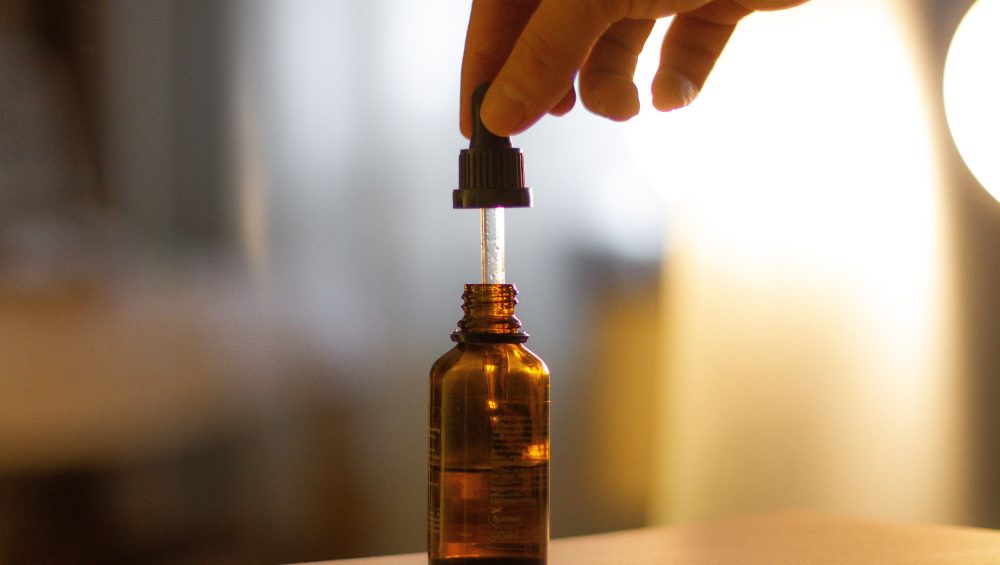
Oxygen. Every time the bottle opens, air enters. A pump limits the exchange. A dropper reintroduces air with every use and returns whatever was on the pipette to the bottle. Smaller sizes finish before degradation becomes the dominant story, which is why buying the value-size vitamin C is usually a false economy.
Heat. This is the one nobody controls for. A serum that spent three days in a delivery van in July has already had a hard life. Buy from sellers with reasonable stock turnover, and if the bottle arrives warm to the touch, that is worth knowing.
Plastic, jars, and the thing people get backwards
The packaging argument in most skincare content is aimed at the wrong target.
Jars are not the problem people assume. Each format has genuine advantages, and which one suits a given product depends on the formulation, the packaging material, light transmission, oxygen exposure and how the product is used. An airless pump excludes air well, and airless pumps have no glass option — they are PET, HDPE or polypropylene. Light-filtering glass performs well on light protection and long-term chemical inertness, and a wide-mouth jar makes a thicker formula usable. For a formula whose main vulnerability is light, that protection carries real weight. Neither format is universally superior.
Good hygiene matters with any open container, because fingers carry bacteria and oil into the product and leave them there. Use a clean spatula for jars, including a violet glass jar. For liquids in bottles the question disappears, since a non-airless pump already prevents finger contact.
Derivatives: the honest trade
If a low-pH serum stings your skin, or you have tried three L-ascorbic acid serums and browned all three, derivatives are a legitimate route. So, for reactive skin, is stepping sideways to niacinamide in the 2% to 5% range, which is far gentler and has its own published support for tone and blotchiness.
Sodium ascorbyl phosphate, magnesium ascorbyl phosphate, ascorbyl glucoside and tetrahexyldecyl ascorbate are all more stable than free ascorbic acid, and several work at a skin-friendly pH. Tetrahexyldecyl ascorbate is oil-soluble, which changes how it behaves in a formula entirely.
The trade should be stated plainly: a derivative has to convert to ascorbic acid in the skin to do the job, and the published data on how efficiently each one converts is thinner and more variable than the data on L-ascorbic acid itself. You are exchanging a known active with a stability problem for a stable ingredient with a conversion question. For sensitive skin that is often the right exchange. It is still an exchange.
The friends it keeps
Lin and colleagues published a finding in the Journal of Investigative Dermatology in 2005 that changed how these serums are built. Adding 0.5% ferulic acid to a solution of 15% L-ascorbic acid and 1% alpha-tocopherol improved the chemical stability of both vitamins and doubled photoprotection against solar-simulated irradiation, from roughly fourfold to roughly eightfold, measured by erythema and sunburn cell formation. That work was done on pig skin, from the same Duke group as the absorption studies.
That is why so many serums now list vitamin C, vitamin E and ferulic acid together. It is one of the few ingredient combinations in cosmetics with a specific published rationale rather than a marketing one. Be precise about what that rationale covers, though: the result belongs to that formulation at those three concentrations, not to the three names appearing anywhere on a label in any amount. Seeing the trio is a reason to look further, not a reason to assume you have bought the study.
None of it replaces sunscreen. Antioxidants reduce damage from radiation that gets through; sunscreen reduces how much gets through. They are different jobs and the second one matters more.
The buying checklist
- Form and percentage, both stated. L-ascorbic acid at 10% to 20%, or a named derivative. Twenty percent is where Pinnell’s absorption curve stopped improving; the ten percent floor is a practical convention rather than a finding. No number on the box means no claim you can check.
- A published pH for an L-ascorbic acid formula. The foundational research points to a pH below approximately 3.5 for effective penetration, so a brand that publishes the number has given you something you can weigh.
- Opaque or light-filtering packaging. Thoughtful packaging can help protect a photosensitive active from unnecessary exposure to light, air and heat.
- A pump or a small opening, and a size you will finish in a season.
- Ingredient-list context, not concentration. Above one percent, ingredients appear in descending order of concentration; at one percent or less they may be listed in any order, so position alone will not tell you how much is present. The full method is here.
- See what the brand publishes about stability. A brand that describes how its formula was tested, and in what packaging, is on firmer ground than one whose evidence is a shelf of awards.
Esenté ships the Elite line in Miron violet glass rather than plastic because, for our formulations, protecting the contents from light and oxygen over the life of the container is the trade we prefer. Esenté products are developed collaboratively by Victoria Nash with Esenté’s professional formulation and manufacturing partners, and Esenté recommends removing product from a jar with a cosmetic spatula rather than fingers. We would rather explain that than sell you a bigger bottle. The rest of what “clinical grade” should mean is on the same principle: judge the checkable things.
Frequently asked questions
There is no single answer, but there is a checkable specification. For most skin, L-ascorbic acid between 10% and 20%, formulated at a low pH — the foundational research points to below approximately 3.5 — in light-filtering or opaque packaging with a pump, in a size you will finish within a few months. For skin that stings at low pH, a named derivative at a higher pH is the better trade.
Pinnell’s 2001 absorption work, done on pig skin, found absorption peaked at 20% with no benefit above it in the concentrations tested. That is where the upper bound comes from; the ten percent floor is a practical convention rather than a published finding. Ten to twenty percent is the sensible range, and we could find no published basis for expecting a higher number to deliver more.
Color is the signal. Clear or pale straw is fine; yellow, amber or brown means oxidation has been underway for some time. Smell can also change. Because you only see the change after it has happened, storage and packaging matter more than inspection does.
It does not require refrigeration. Heat accelerates degradation, so follow the manufacturer’s storage instructions and, in general, keep it in a cool, dry place away from direct light and excessive heat — a dark cupboard is better than a bathroom shelf. Never store it on a sunny windowsill or in a car.
Yes, though many people find alternating them more comfortable: vitamin C in the morning, retinoid at night. That also suits their chemistry, since the antioxidant is most useful during daylight hours. If you are still building retinoid tolerance, separating them reduces the irritation load.
They do different jobs. Sunscreen reduces how much ultraviolet radiation reaches the skin. A topical antioxidant addresses some of the damage from what gets through, and the Lin 2005 work found that adding 0.5% ferulic acid to one particular 15% vitamin C and 1% vitamin E solution roughly doubled its photoprotection on pig skin. That result belongs to that formulation rather than to the ingredient trio in general. Sunscreen first, always. The serum is an addition, not a substitute.
After cleansing and toning, before moisturizer. Serum first, cream over it.
About the author. Victoria Nash, founder of Esenté Skincare and Younger You Clinique, has been a licensed aesthetician since 2004 and is an experienced skincare educator.
Reviewed by Victoria Nash, licensed aesthetician and founder of Esenté Skincare & Younger You Clinique. This article is educational and is not medical advice. Ask your dermatologist or licensed skincare professional about ingredients appropriate for your own skin and medical history.