


Short answer: “pH balanced” suggests a product was formulated with your skin’s pH in mind. On its own, the phrase does not tell you the product’s measured pH or how the brand defines “balanced.” Healthy skin is mildly acidic, generally around pH 4.5 to 5.5, so a neutral pH of 7 is not the target. Cleansing, particularly with alkaline products such as traditional soap, can shift the skin’s surface for a time. Read the phrase as a starting point for questions, and judge a cleanser by how your skin feels after you use it.
The phrase sounds technical, yet it rarely comes with a number attached.
The pH scale in plain words
pH measures how acidic or alkaline a water-based solution is. The scale runs from 0 to 14. Seven is neutral, the point pure water sits at. Below 7 is acidic, and above 7 is alkaline.
The scale is not linear. Each whole step is a tenfold difference, so something at pH 5 is ten times more acidic than something at pH 6, and a hundred times more acidic than pure water.
Your skin’s surface is mildly acidic
Healthy skin is mildly acidic, generally around pH 4.5 to 5.5. A neutral pH of 7 is not the target.
That mildly acidic surface is part of how the outer layer of skin normally works. What Is Your Skin Barrier? explains the layer it belongs to.
What cleansing does to it
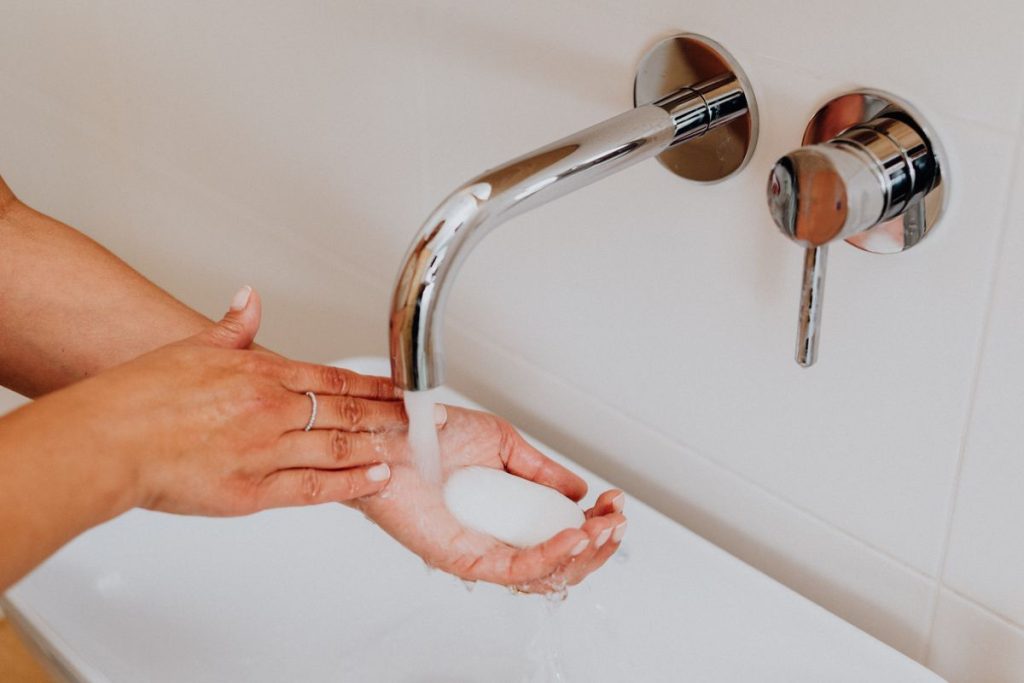
Traditional soap is alkaline. Washing with an alkaline product can shift the skin’s surface away from its mildly acidic state for a time. That does not mean your skin takes on the pH of whatever you wash with. It means the surface moves, and then tends to settle back.
Plenty of cleansers are formulated differently from traditional soap, and format alone will not tell you which is which. Foaming and non-foaming cleansers can both be gentle or harsh, depending on the complete formulation. What you can notice is how your face feels afterward. Skin that feels tight, squeaky or stings can point to the cleanser, the water temperature or how hard you washed, among other common causes. Why Your Cleanser Matters and Why Does Your Skin Feel Tight After Washing? go further.
What “pH balanced” does and does not tell you
The FDA does not define it. The FDA does not keep a list of approved cosmetic claims, and “pH balanced” has no FDA definition. Like any claim on a cosmetic label, it must be truthful and not misleading. Its meaning depends on what the brand intends.
It does not name a number. Balanced to what? Some people read the phrase as “close to the skin’s mildly acidic surface.” Others take it to mean “pH neutral,” which is 7 and less acidic than skin. “pH balanced” alone does not tell you the product’s measured pH or the brand’s definition, so where it matters to you, look for how the brand explains it.
pH is one property among many. A product formulated at a skin-friendly pH can still disagree with your skin if other ingredients do not suit you. Suitability depends on the complete formulation and on your own skin.
Not every product has a pH in the usual sense. pH describes water-based solutions. A waterless balm or powder does not have a pH in the way a water-based gel or lotion does.
Some products are meant to be acidic
Not every product is aiming for the same place. Exfoliating acid products depend partly on pH: the FDA notes that the extent of exfoliation from an alpha hydroxy acid depends on the acid’s type and concentration, its pH and the other ingredients. For those products, pH is part of the design. What Is Glycolic Acid, and Who Is It For? covers one example.
That is another reason “pH balanced” cannot be a universal badge of quality.
Victoria’s approach
Victoria Nash, founder of Esenté Skincare, has been a licensed aesthetician since 2003. She also owns and operates Younger You Clinique and is an experienced skincare educator. She draws on her professional experience at Younger You Clinique when evaluating skincare products and their performance. Esenté regards the cleanser as a vital step, and Victoria prefers gentle cleansing: a professional facial sponge used gently with an appropriate cleanser, lukewarm water and light pressure. In the evening, she emphasizes removing eye makeup with a dedicated eye makeup remover before facial cleansing, and going to bed with a completely clean face. After a thorough evening cleanse, a morning warm-water rinse may be sufficient for some skin. Cleansing and toning are separate but complementary steps. For most skin, she considers a toner or an appropriate antioxidant mist after cleansing an important step. Whether a particular toner or mist helps support the skin’s normal mildly acidic surface depends on its formulation, so that benefit is specific to the product rather than shared by every toner or mist. Which one, and how often, depends on the individual.
Esenté’s range includes the Orchid Reviving Cleanser, a non-foaming cleanser; the Octet Herbal Toner, which is alcohol-free in the usual sense of containing no ethanol, though its full ingredient list includes glycols and phenoxyethanol; and Hydro Mist, an antioxidant spray. They are examples, and other Esenté formulations may suit your regimen. If you have known sensitivities, check each complete ingredient list on the Esenté website, and follow each product’s directions. Esenté works with boutique manufacturers to develop and select formulations that meet the brand’s ingredient, performance and quality criteria. If a label has left you with more questions than answers, the Ask Victoria page is open.
Frequently asked questions
It suggests a product was formulated with the skin’s pH in mind. On its own, it does not tell you the product’s measured pH or how the brand defines it. Look for how the brand explains it.
No. Neutral means pH 7, where pure water sits. Healthy skin is mildly acidic, generally around pH 4.5 to 5.5, so a neutral product is less acidic than your skin. Labels sometimes use these terms loosely, so read beyond the front of the pack.
Traditional soap is alkaline and can shift the skin’s surface away from its mildly acidic state for a time. Whether a particular cleanser suits you depends on its complete formulation and on your skin. If your face regularly feels tight or stings after washing, the cleanser is one thing to look at, along with water temperature and how hard you wash.
Not every toner does. Victoria considers a toner or appropriate antioxidant mist after cleansing an important step for most skin, and whether a particular product helps support the skin’s normal mildly acidic surface depends on its formulation. Which one, and how often, depends on the individual. What Does Toner Do? covers the step in detail.
Usually not. Most labels do not print a pH, and “pH balanced” does not state one. A more useful question is whether the brand explains the formulation, its key ingredients, their intended benefits and how to use the product.
About the author. Victoria Nash, founder of Esenté Skincare, has been a licensed aesthetician since 2003. She also owns and operates Younger You Clinique and is an experienced skincare educator.
Reviewed by Victoria Nash, licensed aesthetician, founder of Esenté Skincare and owner of Younger You Clinique. This article is educational and is not medical advice. Ask your dermatologist or licensed skincare professional about products appropriate for your own skin and medical history.