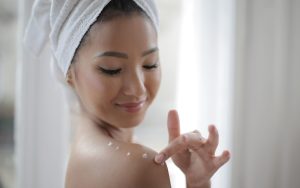


Short answer: Essential oils are concentrated aromatic materials taken from plants, usually by steam distillation or, for citrus peel, by pressing. In skincare they are used for their aroma and, in some formulations, for an intended skincare contribution. Being natural makes an essential oil neither automatically gentle nor automatically irritating; what matters is the specific oil, the amount and the complete formulation. One firm rule holds: undiluted essential oils do not belong on your skin.
Lavender and citrus peel are two familiar sources, and each gives a very different oil.
What an essential oil is
An essential oil is the aromatic part of a plant, separated and concentrated. The international standard for the term describes it as a product obtained from plant material by steam distillation, by mechanical processes from the peel of citrus fruits, or by dry distillation. Lavender oil is typically distilled; orange and bergamot oils are typically pressed from the peel.
“Essential” refers to essence, the plant’s characteristic scent, not to anything your skin needs. And most essential oils are not fatty like olive oil. They are mixtures of small compounds that evaporate readily, which is why you smell them.
In the United States there is no regulatory definition of “essential oil,” and a plant ingredient is held to the same cosmetic requirements as any other.
Why formulators use them
Formulators use essential oils for two different reasons. One is aroma: an essential oil can give a product its scent. The other is an intended skincare contribution, where the oil is there for what it is meant to add to the formulation and the aroma comes with it. A brand that explains its key ingredients can tell you which applies. Either way, an aroma from a botanical source is neither automatically gentle nor automatically irritating. What “Natural” and “Clean” Mean on a Skincare Label goes further.
Why skin responses vary
Each essential oil is a mixture of many compounds, and different oils contain different ones.
The specific compounds matter. Aromatic compounds such as linalool and limonene occur in many essential oils. As they react with air over time, they can form oxidized compounds that may sensitize some people.
Sunlight matters for some citrus oils. Whether a citrus oil can make skin react to ultraviolet light depends on its composition and how it was processed. Cold-pressed oils from the peel of some citrus fruits, bergamot among them, can contain compounds called furocoumarins that react with sunlight. Distilled citrus oils, and oils processed to reduce furocoumarins, do not carry the same concern.
The amount and the formulation matter. An essential oil used at a small amount inside a designed formulation is a different thing from the same oil applied on its own.
Your own skin matters. Reactive skin or a known reaction to a specific compound changes the picture. A Routine for Sensitive Skin covers that side of it.
Undiluted oils do not belong on skin
Pure essential oils are highly concentrated, and applied full-strength they can irritate the skin. Some people also have allergic reactions to certain oils. Adding drops of one to a moisturizer or serum you already own changes a formulation that was designed without it. Leave blending to the people who design formulations, and follow each product’s directions.

Reading essential oils on a label
Essential oils usually appear under their plant names, often in Latin with the common name in brackets, such as Lavandula Angustifolia (Lavender) Oil. Individual compounds such as linalool, limonene or geraniol may also be named, partly because European rules require certain fragrance components to be listed above set levels, and a label written for more than one market may carry them.
In the United States, ingredients used to give a product its scent may also be grouped under the single word “fragrance.” If you have known sensitivities, read the complete ingredient (INCI) list, not only the key ingredients a brand highlights. Key ingredients alone do not show everything in a formulation. For product-specific guidance, ask the brand or your dermatologist. How to Read a Skincare Ingredient List covers the conventions.
Storage, and when you are unsure
Many aromatic compounds change as they react with air, light and heat. Keep products in a cool, dry place away from direct light and excessive heat or humidity, following the manufacturer’s directions. If a product has significantly changed, separated or developed an unusual odor, stop using it or check with the manufacturer.
Informed product selection comes first: know what the product is meant to do, how to use it and what it contains. For particularly reactive skin, a history of sensitivity or concern about a particular formulation, a small test in an area that makes sense for the product’s intended use can be an additional precaution. How to Patch Test a New Product explains how to go about it.
If a product causes persistent redness, itching, burning, swelling or a rash, wash it off, stop using it and speak to a dermatologist if the reaction does not settle.
Victoria’s approach
Victoria Nash, founder of Esenté Skincare, has been a licensed aesthetician since 2003. She also owns and operates Younger You Clinique and is an experienced skincare educator. She draws on her professional experience at Younger You Clinique when evaluating skincare products and their performance. Victoria believes consumers should be able to understand not only what is in a skincare product, but why important ingredients have been included. Esenté’s website gives both the key ingredients and the full INCI list for every product, and explains the intended benefits of key ingredients in straightforward language. Esenté does not add perfume simply to give products a cosmetic fragrance. Some formulations have a natural aroma from botanical ingredients, and certain formulations may use botanical essential oils for their intended skincare contribution, which can also impart aroma. For guidance on a particular Esenté product, or on why an ingredient is in it, use the Ask Victoria page.
Frequently asked questions
Not as a class, and not automatically good either. How skin responds depends on the specific oil, the amount, the complete formulation and your own skin. Undiluted oils applied directly can irritate the skin.
No. Pure essential oils are highly concentrated, and applied full-strength they can irritate the skin or cause an allergic reaction in some people. Use finished products designed for the face and follow their directions.
Not automatically. An aroma from a botanical source is neither automatically gentle nor automatically irritating. What matters is which compounds are present, the amounts, the complete formulation and your own skin.
They are aromatic compounds found in many essential oils. European rules require certain fragrance components to be listed above set levels, so a label written for more than one market may name them.
No. Adding them changes a formulation that was designed without them. Choose a finished product whose ingredients and directions suit your skin.
About the author. Victoria Nash, founder of Esenté Skincare, has been a licensed aesthetician since 2003. She also owns and operates Younger You Clinique and is an experienced skincare educator.
Reviewed by Victoria Nash, licensed aesthetician, founder of Esenté Skincare and owner of Younger You Clinique. This article is educational and is not medical advice. Ask your dermatologist or licensed skincare professional about products appropriate for your own skin and medical history.