
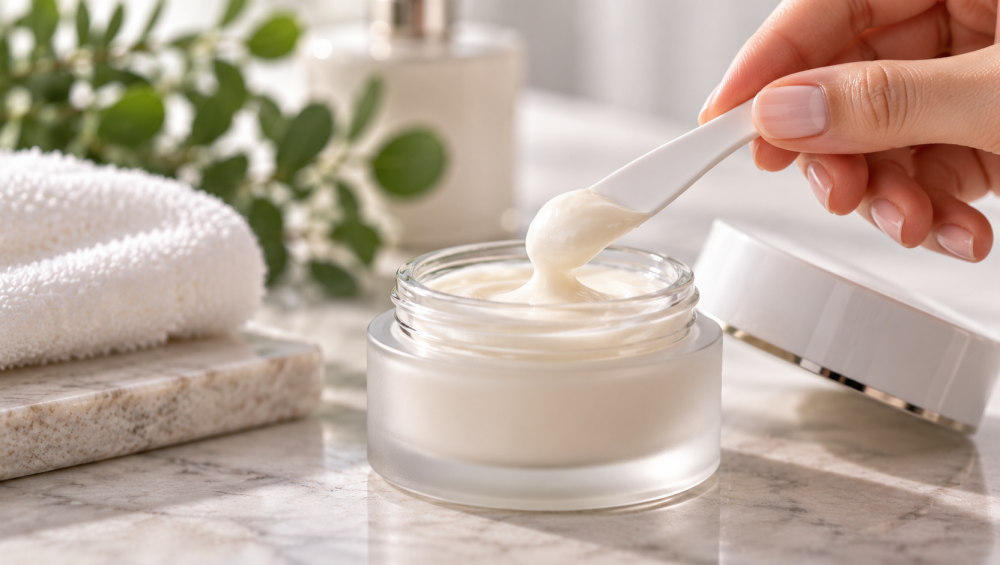
Short answer: Take product out of every jar with a cosmetic spatula, use what you took, and never return the leftover. Your fingers carry skin oils, bacteria and water into the formula, and minimizing that repeated contamination is good hygiene that can reduce the microbial burden on the product. The container is not the main variable here — a well-made glass jar has real advantages of its own, particularly around light and oxygen. What a spatula addresses is the hand going into it, and a stainless spatula that costs a few dollars addresses it permanently.
One tool. One habit. No downside.
What goes into the jar with your finger
Three things, every time, and none of them are visible.
Skin flora. Human skin carries a resident bacterial population that is entirely normal on you and entirely unwelcome in a jar of cream held at room temperature. Fingers also pick up whatever they last touched — a phone, a door handle, a face already mid-routine.
Sebum and residue. Whatever is on your skin transfers into the product. Over the life of a jar you are slowly blending your own oils, dead surface cells and any earlier product back into the formula.
Water. This is the one people underestimate. A wet finger, a damp bathroom, a jar opened straight out of the shower — free water is what microorganisms need to multiply. A formula that is stable dry is a different proposition once you have introduced water into it repeatedly for eight weeks.
None of this makes a product dangerous overnight. It shortens the window in which the product is what the manufacturer filled.
Preservatives are designed for a defined amount of abuse, not an unlimited amount
Cosmetic preservative systems are not decorative. They are formulated, tested and challenged.
The standard approach across the industry is challenge testing — preservative efficacy testing, in the trade — and it is written down. ISO 11930, Cosmetics — Microbiology — Evaluation of the antimicrobial protection of a cosmetic product, is the cosmetic-specific method; USP General Chapter <51>, Antimicrobial Effectiveness Testing, covers the pharmaceutical and topical side. Both work the same way. The finished formula is deliberately inoculated with a defined panel of organisms — in both methods five of them, spanning bacteria, a yeast and a mold — and the preservative system has to reduce those populations by a specified amount within a specified window and then hold them down across a 28-day observation period. A formula that passes is a formula shown to handle a defined contamination event.
Defined. Not unlimited. Every finger dip introduces another contamination load, and minimizing that repeated contamination is good hygiene that can reduce the microbial burden the preservative system has to handle.
A spatula does not sterilize anything. It reduces the load, which is exactly what a preservative system is designed to cope with.
The jar is not the villain
There is a fashionable argument that jars are inherently bad packaging and airless pumps are inherently good. It is half right, and the half it gets wrong matters.
Airless packaging reduces direct consumer contact with the bulk formulation. Product comes out without a finger going in, and that is a real advantage.
The trade-off is material. Airless pump systems are typically plastic — PET, HDPE or PP. Comparative testing of pharmaceutical containers puts glass ahead of both PET and HDPE as an oxygen barrier, with glass treated as effectively absolute and the polymers ranked below it, PET being the better of the two. Plastic also offers no light filtering of its own unless it is pigmented.
Glass gives you the opposite trade. It is inert, it does not breathe, and violet glass filters part of the spectrum: Miron publishes transmission data for its own glass, which blocks the visible band from blue to red and selectively filters other wavelengths. Which format suits a given product depends on the formulation, its sensitivity to light and oxygen, and how the product is used — there is no single hierarchy that holds across every formula. Esenté ships the Elite collection in Miron violet glass because, for our formulations, protecting the contents from light and oxygen over the life of the jar is the trade we prefer.
That leaves the hand as the gap a jar does not close on its own. The spatula closes it. That is the argument, and it is why we recommend the habit rather than a packaging change.
For liquids in bottles the question disappears altogether. A pump or a dropper already keeps fingers out, so there is no gap to close.
Choosing a spatula
Stainless steel is the default and the one worth buying. It is non-porous, it will not stain or hold odor, it takes hot water and soap indefinitely, and it lasts for years. It is also easy to see when it is clean, which matters more than it sounds.
Single-use plastic spatulas are the right answer in a professional setting, where a fresh one per client removes the question entirely. At home they are wasteful for no gain, since you are the only person using the jar.
Silicone is fine, flexible, and good at scraping the last of a thick cream out of a corner. It is slightly more prone to holding residue than steel and needs a proper wash rather than a rinse.
Wood or bamboo looks appealing and is the hardest option to keep clean. Porous surfaces absorb product and water and cannot be sanitized as thoroughly as steel or silicone, which works against the reason for using a spatula at all.
Size to the jar. A spatula too wide for the opening scrapes product onto the rim, which then dries and works its way under the lid seal.
The method, in five seconds
- Wash and dry your hands first. The spatula is not a substitute for clean hands — you still touch the lid, the rim, and your face.
- Scoop what you need, in one pass. Judge the amount before you go in rather than making three trips.
- Set it down on a clean surface — a small dish, a saucer, the back of a clean hand — and close the jar immediately. Every minute a jar stands open is oxygen exposure and a chance for something to land in it.
- Apply. Fingertips to the face are fine at this point; the container is already shut.
- Never return what you did not use. Anything that has left the jar has met air, your skin and the dish. It does not go home. Wipe it into the back of your hand or discard it.
That last one is the rule people break, and it undoes everything the first four achieved.
Cleaning, and one spatula per product
Rinse under warm running water after each use and dry it properly. Once a week, wash with soap and hot water. A stainless spatula can also go through the dishwasher if you have somewhere it will not disappear.
Do not leave it sitting in the jar between uses. It becomes a bridge — a damp object holding residue, in permanent contact with the formula, defeating the purpose.
Keep a separate spatula for each jarred product. Cross-transfer between a cleansing balm, a night cream and an exfoliant is not catastrophic, but it is easily avoided, and mixed residue makes it harder to tell whether a product has changed. Color-code the handles or keep each one beside its jar.
Where you store the spatula matters as much as where you store the product. Both belong out of the bathroom if you can manage it — heat and humidity are hard on formulas and on tools. The storage argument is a physics argument rather than a wellness one, and it applies to the whole shelf.
Where else the rule applies
Mask jars and clay masks. Same rule, plus a brush. Spatula onto a dish, load the brush from the dish, and never dip the brush into the container.
Balms and cleansing balms. These are the most-dipped products in most bathrooms and the ones most often used with wet hands in a steamy room. If you change one habit, change this one.
Scoops that come with the product. Use them, wash them, and do not leave them buried in the jar. A supplied scoop is a spatula with a manufacturer’s logo on it.
Sampling in a shop. Never take a tester with your fingers, and be wary of a tester everybody else has.
Professional treatment rooms. Single-use spatula per client, product decanted into a dish, nothing returned to the back bar container. This is basic infection control rather than a preference.
What a spatula does not fix
Honesty about the ceiling: the spatula controls one variable. Three others still apply.
Light degrades photosensitive actives whatever you use to remove them. Heat and other environmental conditions can affect formulation stability, so follow the product-specific storage and use guidance. And oxygen enters every time the lid comes off, which is an argument for closing jars quickly rather than for opening them less.
A spatula also does not extend a period-after-opening figure. Where one is printed — the open-jar symbol with a number of months, which European rules require on qualifying products and United States law does not require at all — follow it alongside the product’s storage and use guidance, and trust your senses as well. A color shift, separation, or a smell that has changed means the formula has turned regardless of what the label allows. On a US-market product with no such marking, your senses and the purchase date are what you have.
Frequently asked questions
Why should you use a spatula instead of your fingers?
Fingers introduce skin oils, bacteria and water into the container. Preservative systems are formulated and challenge-tested against a defined contamination load under ISO 11930 or USP <51>, not an unlimited one, so repeated dipping shortens the window in which the product is what the manufacturer filled.
Are jars bad for skincare?
No. Glass is inert and an effectively absolute barrier to oxygen, and violet glass filters part of the spectrum — Miron publishes transmission data for its own glass, which blocks the visible band from blue to red and selectively filters other wavelengths. The gap a jar leaves open is the finger going into it, and a spatula closes that gap.
Are airless pumps better than jars?
They reduce direct contact with the bulk formulation, since nothing enters the container. They cost you something in return: airless mechanisms are typically plastic, and comparative container testing ranks glass ahead of PET and HDPE as an oxygen barrier. Plastic also offers no light filtering unless pigmented. Neither format wins universally — it depends on the formulation and how it is used. For Esenté’s formulations, the light and oxygen protection of glass combined with a spatula is the trade we prefer.
What kind of cosmetic spatula is best?
Stainless steel for home use — non-porous, easy to sanitize, lasts for years. Single-use plastic in professional settings. Silicone works well for thick creams. Avoid wood and bamboo, which are porous and cannot be properly cleaned.
Can you put unused product back in the jar?
No. Anything that has left the container has met air, a surface and your skin. Returning it reintroduces exactly what the spatula prevented.
How often should you clean a cosmetic spatula?
Rinse and dry after every use; wash with soap and hot water weekly. Do not store it inside the jar, where it sits damp and in constant contact with the formula.
Does a spatula make skincare last longer?
It protects the formula from one specific failure — microbial contamination — which is a real one. It does not stop degradation from light, heat or oxygen, and it does not extend the period-after-opening on the packaging.
A tool is one of the few parts of a skincare routine you can judge without trusting anyone’s marketing, which is the same test that applies to everything else on the label.
About the author. Victoria Nash, founder of Esenté Skincare and Younger You Clinique, has been a licensed aesthetician since 2004 and is an experienced skincare educator.
Reviewed by Victoria Nash, licensed aesthetician and founder of Esenté Skincare & Younger You Clinique. This article is educational and is not medical advice.