

Short answer: Two clocks run on every product. Unopened, manufacturers typically quote two to three years from manufacture. Opened, the clock is the period-after-opening figure — the small open-jar symbol printed with a number and an M, so 6M means six months. That number is set by the manufacturer from their own stability and preservative-efficacy testing, not by a regulator. Storage conditions can affect stability, and manufacturer-specific storage directions should be followed. One thing to be clear about: that symbol is an EU labeling requirement, not an American one. U.S. law does not require cosmetics to carry an expiry date or a period-after-opening mark at all. Sunscreen is the exception, because sunscreen is a drug.
Most people throw out the wrong things and keep the wrong things.
Two clocks, and only one of them is printed
Clock one: shelf life unopened. Manufacturers commonly quote two to three years for a sealed cosmetic in normal warehouse conditions. That figure comes from their own stability testing, and it is only as good as the storage the product actually got in transit and in a retail stockroom.
Clock two: period after opening. From the moment air, light and your hands first meet the formula. This is the number that matters, and it is far shorter.
The two do not add up neatly, because opening a product changes the chemistry. Oxygen enters. Photosensitive actives are exposed on every use. Microbes get a route in. A serum with two years of unopened shelf life left might have six months of usable life once the cap comes off.
What the PAO symbol means, and what it does not
The open-jar symbol with “6M,” “12M” or “24M” inside it is a European Union requirement, adopted internationally because manufacturers make one carton for all markets. It is not a U.S. requirement, and no U.S. rule obliges a brand to print it — a product sold only in the States may carry nothing at all. Under Article 19(1)(c) of Regulation (EC) No 1223/2009, a product with a minimum durability of more than 30 months carries the open-jar symbol followed by the period in months or years; a product with a shorter durability carries a date of minimum durability, preceded by an hourglass symbol or the words “best used before the end of,” instead.
Three things about the number are worth understanding.
The manufacturer sets it. No agency reviews it. It is derived from the brand’s own stability testing and preservative challenge testing — most often ISO 11930, the standard written for cosmetics, or USP <51>, the pharmacopeial antimicrobial effectiveness chapter also used for topicals. Both work the same way in outline: the formula is deliberately inoculated with a specified panel of bacteria, yeast and mold, and counts are taken at intervals to confirm the preservative system brings them down. They set different acceptance criteria, so “passes challenge testing” is not one fixed bar. The testing is real and meaningful. It is also self-assessed.
Storage conditions can affect stability. Manufacturer-specific storage directions should be followed. Where you store a product changes its shelf life more than almost anything else you control.
It describes preservation, not potency. A 12M product may sit well inside its preservation window at eleven months while its vitamin C has been degraded for months. The symbol addresses the first question, not the second.
Why the U.S. label is often silent
The FDA states it plainly: there are no U.S. laws or regulations requiring cosmetics to have a specific shelf life or to carry an expiration date on the label. Manufacturers are responsible for determining shelf life and for substantiating that a product is safe, but the printed date itself is voluntary. Neither is the open-jar PAO symbol mandated here. If a U.S.-market product carries either one, the brand chose to.
The exception is over-the-counter drug products, and in skincare that means sunscreen. Under 21 CFR 211.137, nonprescription drugs must carry an expiration date unless the manufacturer’s stability testing shows the product remains stable for at least three years. The FDA’s position for consumers follows from that: a sunscreen with no printed expiry date should be considered expired three years after purchase, and discarded if you do not know how old it is. The FDA also states that sunscreen labels must carry the instruction “Protect the product in this container from excessive heat and direct sun,” and recommends keeping containers shaded or wrapped rather than left in the sun. Beyond that, a change in color, smell or consistency is a sensible reason to replace any product, sunscreen included — that judgment is ours, not the agency’s.
Eye products get their own convention. Industry practice, not regulation, puts mascara at around three months from first use, because the wand shuttles between your lash line and a warm, dark tube on every application; the FDA notes separately that shelf life for eye-area cosmetics is more limited than for other products. That is a contamination clock, not a potency clock.
What degrades: some examples
Not everything in a bottle ages at the same rate. Stability depends on the finished formulation, the packaging and the storage conditions, so the ingredients below are examples rather than a ranking.
L-ascorbic acid. The most studied form of topical vitamin C and one of the least stable ingredients in common use. It reacts with oxygen, degrades under UV and accelerates with heat. It is also pH-sensitive: it is typically formulated below about pH 3.5, both because that is the range the percutaneous absorption work points to and because oxidation to dehydroascorbic acid and onward speeds up markedly as pH rises past roughly 4. It can lose meaningful potency within weeks in a warm, frequently opened, light-exposed container. The yellow-to-brown shift is the reaction product — by the time you can see it, the loss has already happened.
Retinoids. Degrade under UV exposure and with heat and air. Stabilized and encapsulated forms are generally understood to hold up better than free retinol, and where a brand publishes which form it uses, that is useful information to have.
Botanical extracts and volatile aromatic compounds. Plant material oxidizes — cut an apple and watch the surface brown. That reaction runs inside a bottle too, and takes active constituents with it. Unsaturated plant lipids go further and turn rancid, which you smell before you see.
Peptides. Generally robust, but sensitive to pH drift.
Niacinamide, glycerin, hyaluronic acid, mineral filters, emollients. Comparatively stable. A niacinamide serum is not the product to worry about.
The practical consequence: the products most worth replacing on schedule tend to be the ones people hold onto longest, because they are usually the expensive ones.
The three things that shorten the clock
Heat. Chemical reaction rates rise with temperature. The long-standing rule of thumb in chemistry is that many reactions roughly double in rate for every 10°C increase — a rough approximation rather than a law, and the reason accelerated stability testing works at all. A product stored warm is running its degradation reactions faster.
Air. Every opening exchanges the air above the formula. Oxidation is cumulative and irreversible.
Contamination. Fingers carry skin flora, and they carry it into the product every single time. This is the failure mode that turns a preserved formula into an unpreserved one before its stated date.
The container question, answered honestly
There is a real trade-off here and most articles pretend there is not.
Airless pump systems are excellent at one thing: they keep fingers out and reduce the headspace air the formula sits under. That is a genuine advantage and we will not pretend otherwise.
They have a constraint that rarely gets stated. Airless pump mechanisms are plastic — PET, HDPE or polypropylene — because the mechanism cannot be made in glass. Plastic is not an absolute barrier: polymers have a measurable oxygen transmission rate, and it rises with temperature. Glass is effectively impermeable. Plastics also offer no light filtering unless pigmented, and pigmented plastic does not filter selectively.
Glass addresses the permeability problem, since it is effectively impermeable to gas, and violet glass adds a light filter on top of that. According to Miron’s published transmission data, the glass blocks UV-C (200 to 290 nanometers) and UV-B (290 to 320 nanometers) and filters other wavelengths selectively.
Neither format is universally right. Which trade-off suits a product depends on the formulation, its sensitivity to light and oxygen, the material and how the product is used. What glass does not address is contamination, because a container needs an opening.
Esenté’s recommendation is clean application appropriate to the package, including a clean spatula for jars where appropriate. A spatula costs almost nothing, it is good hygiene practice, and it narrows the gap between an open container and a sealed one.
Esenté packages its Elite collection in Miron violet glass for this reason: for our formulations, the light-filtering and barrier properties of the glass are the trade we prefer, and the contamination question has a fifty-cent solution.
Date your own products
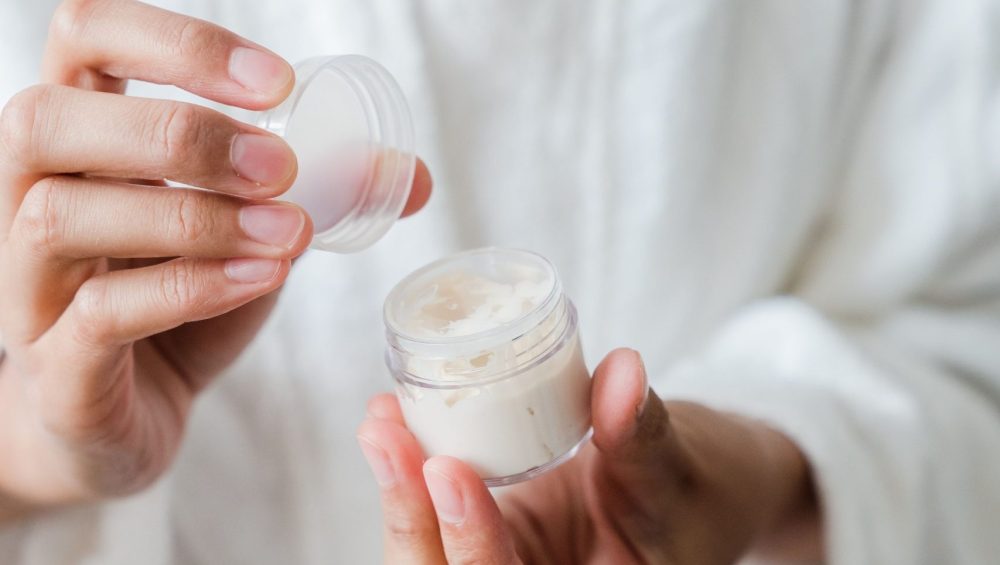
The most useful thing you can do takes ten seconds. When you open something, write the date on the base in permanent marker. Not the purchase date — the opening date.
You now know which clock is running and when it started. No guessing at how long that vitamin C has been on the shelf, no discovering a two-year-old retinol behind the moisturizer.
One more consequence worth naming: a degraded formula also behaves differently on the skin. Products that have thickened or separated spread badly and sit on the surface, which is one of the reasons a serum can feel like it is not absorbing.
When to throw it out, regardless of the date
Four signals override any printed number.
- Color shift. Clear to yellow, yellow to brown, white to cream. The reaction has already run.
- Separation. An emulsion that has split has lost its structure and will not re-form properly.
- Smell change. Rancid, sour, sharply different from new. This is the most reliable single signal.
- Texture change. Thickening, thinning, graininess, a skin forming on the surface.
And the fifth, which is behavioral rather than chemical: if it stings now and did not before, stop using it and do not try to reason your way past it.
There is a familiar version of this — a product described as having “stopped working,” when it in fact finished working some time ago and the bottle is still half full. Packaging that protects a formula is one of the four things worth paying more for, and the one you can check with your eyes before you buy.
Frequently asked questions
Does skincare expire?
Yes, in two ways. The preservative system eventually stops controlling microbial growth, and the active ingredients degrade chemically. The second usually happens first, which is why a product can be perfectly safe and no longer effective.
What does the 12M symbol on skincare mean?
It is the period-after-opening figure: twelve months of usable life from the day you first open the container, as determined by the manufacturer’s own stability and preservative testing. Storage conditions can affect stability, and the manufacturer’s storage directions should be followed. The symbol is an EU labeling requirement under Regulation (EC) No 1223/2009, not a U.S. one — American products carry it by choice.
Is US skincare required to have an expiration date?
No. The FDA states there are no U.S. laws or regulations requiring cosmetics to carry an expiration date, and no U.S. rule requires the period-after-opening symbol either. Over-the-counter drug products including sunscreen are the exception: under 21 CFR 211.137 they must carry a date unless the manufacturer’s stability testing shows the product remains stable for at least three years.
How long does an unopened serum last?
Manufacturers commonly quote two to three years from manufacture for sealed products stored in normal conditions. The date on the carton, where one exists, is the one to go by rather than a general rule.
Which product in my routine goes off fastest?
Often a water-based vitamin C serum. L-ascorbic acid is among the least stable ingredients in common use, and warmth, light and repeated opening all accelerate it.
Does refrigerating skincare make it last longer?
Follow the storage instructions for the particular product first — they are set by the manufacturer for that formula, and they override any general rule. In broad terms, a cool, dry place away from direct light and excessive heat suits most products. Refrigeration is sometimes suggested for aqueous vitamin C formulations, while for emulsions and creams it is less clear-cut, because cold can affect the stability of the emulsion itself. Cool and consistent beats cold and intermittent.
Can I still use a product past its PAO date if it looks fine?
For a body lotion or a simple humectant serum, the risk is modest. For anything used around the eyes, anything with a fragile active, or anything dipped into with fingers, replace it.
About the author. Victoria Nash, founder of Esenté Skincare and Younger You Clinique, has been a licensed aesthetician since 2004 and is an experienced skincare educator.
Reviewed by Victoria Nash, licensed aesthetician and founder of Esenté Skincare & Younger You Clinique. This article is educational and is not medical advice. Ask your dermatologist or licensed skincare professional about your own skin.