
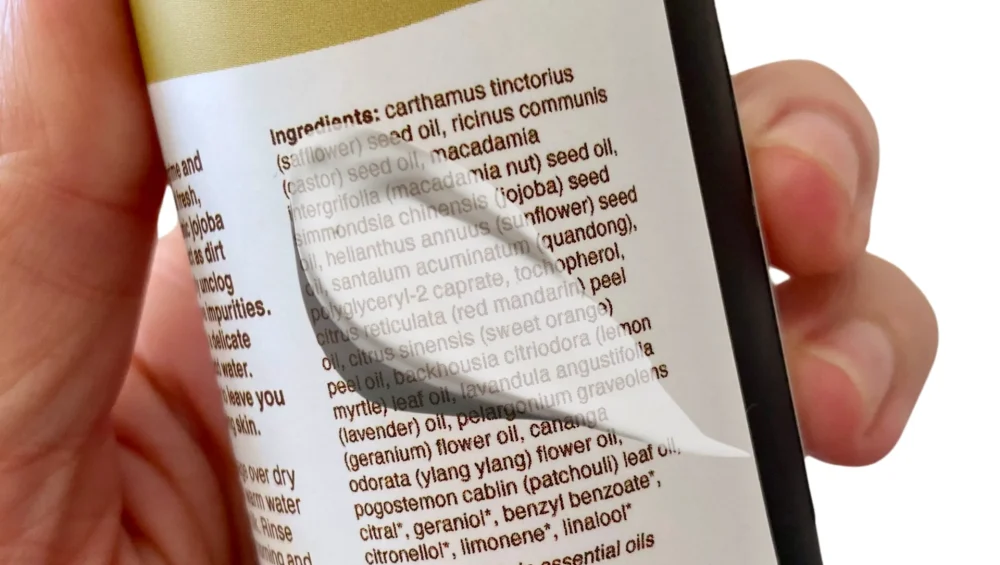
Short answer: Ingredients on a cosmetic sold in the United States are listed in descending order of concentration, but only down to one percent. At or below that threshold the law lets a brand list ingredients without respect to order — and nothing marks where the threshold falls, so a shopper cannot read a dividing line off the label. Understanding that rule is the single most useful thing you can take into a shop. After that, learn what the list cannot tell you: the actual percentage of anything, the purity or grade of the raw material, how fresh it is, and whether an ingredient has been chirally corrected. A label rarely shows any of it, and all of it matters to whether the product works.
The list is a genuine document. It is just a much shorter one than people assume.
What the law actually requires
In the United States, 21 CFR 701.3 governs ingredient declaration on cosmetics. It requires the label to name each ingredient in descending order of predominance, with a specific and consequential alternative in paragraph (f): a brand may instead group them, listing ingredients present at greater than one percent in descending order, then ingredients present at not more than one percent “without respect to order of predominance,” then color additives on the same free-order basis.
Almost everyone uses the alternative, because almost every formula has a long tail under one percent.
Then there is the sentence at the end of that paragraph, which almost no guide mentions: ingredients from the sub-one-percent group may be moved up and listed with the ones above it. The two tiers do not have to be kept apart at all.
Two further provisions sit in the same section. Fragrance and flavor may be declared as “fragrance” or “flavor” without naming the components, which can be dozens of materials behind one word. And where the FDA has accepted a trade secret exemption for an ingredient, the list may end with the phrase “and other ingredients.”
None of this is a scandal. It is the framework, and knowing it changes what you can fairly read into a list.
Worth stating plainly, since it surprises people: cosmetics do not require FDA approval before going on sale, with color additives the exception. The Modernization of Cosmetics Regulation Act, signed on 29 December 2022, added facility registration, product listing, adverse event reporting and safety substantiation requirements, and directed the agency to issue a rule naming fragrance allergens on labels. It did not create pre-market approval.
The one percent rule, and what it cannot tell you
Here is the part most ingredient-list guides get wrong.
The rule is real: above one percent, descending order is genuine information. At one percent or less, the order is free. What does not follow is that a shopper can find the dividing line. The label does not mark it, the regulation does not require it to be marked, the two groups do not even have to be kept separate, and there is no reliable way to work out from an INCI list where the line falls.
Certain ingredients are commonly, though not always, used at low percentages, and seeing one can suggest you are somewhere in the lower part of the list: preservatives such as phenoxyethanol and sodium benzoate, thickeners and gums such as xanthan gum and carbomer, pH adjusters such as citric acid and sodium hydroxide, chelators such as disodium EDTA, and fragrance.
Treat those as possible clues rather than a method. Use levels vary between formulas, several of them can be used above one percent, and spotting a gum tells you nothing precise about what sits above or below it. Anyone who tells you to find the xanthan gum and draw a line has handed you a rule of thumb dressed up as a measurement.
Be fair about the wider point, too. Plenty of ingredients belong below one percent and work perfectly well there: retinol, most peptides, salicylic acid, preservatives. A low position is a question, not a verdict, and the answer is the percentage — which brings us to what the label will not tell you.
The four things the list cannot show you
The actual percentage of anything. Order is not a quantity. A serum whose second ingredient is glycerin might be 20% glycerin or 3% glycerin. The label will not say. Some brands publish the figure; others treat it as proprietary.
Raw material specification and purity. The same molecule can be made to very different specifications: purity parameters, impurity profiles, batch-to-batch consistency, supplier quality systems. All of it sits behind one identical INCI name. Terms such as “pharmaceutical grade” gesture at this, but they are not a standardized cosmetic grading system and the phrase alone establishes nothing.
Freshness. An ingredient list describes what went into the batch, not what survived shipping, warehousing and six weeks on a warm shelf. For photosensitive actives that gap is the whole story, which is why buying vitamin C is mostly a stability problem.
Chirality. This is the one that catches people, and we got it wrong ourselves twice before we went and read the primary source.
Some molecules exist in two mirror-image forms, and the two are not always equivalent in how skin responds. For particular ingredients a formulator may prefer to work with a single isomer; isolating one form costs more than using the mixed material. None of that amounts to a universal rule. The effect of stereochemistry differs by molecule, and chiral correction is not a blanket guarantee that an irritant has been removed.
The label is not a reliable test for it. The published INCI conventions say optical isomers are usually not designated, which is why L-ascorbic acid is normally declared as “Ascorbic Acid.” The word doing the work there is “usually.” Those same conventions record that the committee identifies optical properties where it judges that necessary — d-limonene is their own example — and D-isomer amino acids are named routinely inside peptide names. So the label reads in one direction only. A designator that is present means something; one that is absent means nothing either way, because leaving it out is the default. Scanning for an L- or D- prefix is not a test. What a brand publishes about its formulation approach is the better signal.
INCI, and what the system is for
INCI stands for International Nomenclature of Cosmetic Ingredients. It is a naming standard, maintained so the same ingredient carries the same name in Michigan and in Milan. It is not a quality standard, a safety ranking or a purity specification. It answers one question — what is this substance called — and answers it well. Every other question people put to an ingredient list is one the system was never designed to take.
It also explains why botanical names look alarming and synthetic names look clinical. “Butyrospermum parkii butter” is shea butter. Latin binomials are a requirement of the system, not evidence of anything.
Words on the package with no standardized meaning
All cosmetic labeling is subject to the law, wherever on the package it appears. The difference is narrower: the ingredient declaration has specific requirements attached, while many of the descriptors printed prominently on cartons have no standardized federal definition at all.
- Hypoallergenic. The FDA states plainly that there are no federal standards or definitions governing this term, and that it “means whatever a particular company wants it to mean.”
- Non-comedogenic, dermatologist tested. The FDA has never defined either one or set a testing protocol for it, and it maintains no list of approved cosmetic claims at all. Tested by whom, on how many people, measuring what, with what result? The phrase commits to none of it.
- Clean, natural, chemical-free. No regulatory definition. Water is a chemical.
- Medical grade, clinical grade, pharmaceutical grade, cosmeceutical. None are regulatory categories, and the FDA has said in terms that “cosmeceutical” has no meaning under the Federal Food, Drug and Cosmetic Act. We use “clinical grade” ourselves and say openly that it is positioning. That does not make a product described this way a poor one; it means the word is not doing the work of proving it.
Claim language is constrained in a way those descriptors are not. Whether a product is regulated as a cosmetic or a drug turns on its intended use and the overall context of its claims rather than on any single phrase — but the phrasing illustrates the line well. “Helps reduce the appearance of fine lines” describes an effect on appearance, which is cosmetic territory. Language asserting that a product changes the structure or function of the skin moves toward a drug claim. The hedge you find slightly annoying is doing real work.
Sunscreen has a different label entirely
Sunscreen sold in the United States is an over-the-counter drug, not a cosmetic, and it carries a Drug Facts panel: active ingredients with their proportions attached, alongside standardized uses, warnings and directions. That makes it the most informative label in the category, and it is why sunscreen claims are narrow and fixed in wording. Every compliant sunscreen must state that it helps prevent sunburn. Only a broad spectrum sunscreen of SPF 15 or higher may add the further monograph claim about decreasing the risk of skin cancer and early skin aging from the sun, when used as directed with other sun protection measures — and a product failing either half of that test has to carry a warning saying so.
The five-step method
- Read the whole list, not just the top. The first five ingredients are the bulk of the formula. The rest is where the interesting decisions were made, and where the label stops ranking anything.
- Use the ranking that is real. Above one percent, descending order is genuine information. Below it, order tells you nothing, and you cannot see where the change happens.
- Check where fragrance falls. High on the list, on a product for skin that is reactive or thinning, is a choice made for the shopper’s nose rather than the wearer’s skin.
- Ignore the front of the box for one minute. Then read it again and count how many of its words you now know have no standardized definition.
- Read what the brand publishes beyond the label. Which actives it names, what it says about how the finished formula was made and tested, what it publishes about its formulation approach and packaging. Brands vary enormously in how much of this they put in public, and that variation is itself informative.
Esenté publishes the actives it builds around, uses chirally corrected ingredients where the formulation calls for them, and maintains appropriate substantiation for its claims. Esenté products are developed collaboratively by Victoria Nash with Esenté’s professional formulation and manufacturing partners. The Elite line ships in Miron violet glass rather than plastic, with a cosmetic spatula recommended over fingers. Read what we publish. Read what everyone publishes.
Frequently asked questions
Are skincare ingredients listed in order of concentration?
Down to one percent, yes. United States rules require ingredients present at greater than one percent to be declared in descending order of predominance. Ingredients at not more than one percent may be listed without respect to order, as may color additives — and a brand may move sub-one-percent ingredients up into the ranked group if it wants to. Nothing marks where the threshold falls, which is why an ingredient’s position low on a list tells you very little.
How do I find the one percent line on an ingredient list?
You cannot, reliably. The regulation permits ingredients at one percent or less to be listed in any order, but it does not require the label to mark where that threshold falls, and there is no dependable way to locate it by reading the list. Preservatives, gums, chelators and pH adjusters — phenoxyethanol, xanthan gum, carbomer, disodium EDTA, citric acid — are often used at low percentages, so spotting one is a possible clue about roughly where you are in the formula. It is a clue, not a measurement, and use levels vary between products.
Can I tell if an ingredient is chirally corrected from the label?
Not reliably. INCI convention usually leaves optical isomers undesignated, which is why L-ascorbic acid normally appears as “Ascorbic Acid.” The convention has documented exceptions, so a designator that is present does mean something — but one that is absent means nothing either way, because omitting it is the default. There is no prefix test. What a brand publishes about its formulation approach is the better signal.
What does INCI mean?
International Nomenclature of Cosmetic Ingredients, a naming standard so the same substance carries the same name across markets. It is not a safety rating, a quality mark or a purity specification, and it says nothing about how much is present.
Does “hypoallergenic” mean anything?
Not legally. The FDA states there are no federal standards or definitions governing the term, so each brand sets its own meaning. “Non-comedogenic,” “dermatologist tested,” “clean” and “natural” sit in the same position: the FDA has never defined them and maintains no list of approved cosmetic claims. All are governed only by the general requirement that labeling be truthful and not misleading.
Why is fragrance listed as one word?
Regulations allow fragrance and flavor to be declared under those generic terms rather than by naming each component, on trade secret grounds. A single “fragrance” entry can represent dozens of materials. The Modernization of Cosmetics Regulation Act directed the FDA to issue a rule requiring fragrance allergens to be named on the label. That rule has not been issued yet, so for now the single word still stands.
Why does sunscreen have a different kind of label?
Because sunscreen sold in the United States is regulated as an over-the-counter drug, not a cosmetic. Its Drug Facts panel lists active ingredients with their proportions, plus standardized uses, warnings and directions — the most informative label in the category.
About the author. Victoria Nash, founder of Esenté Skincare and Younger You Clinique, has been a licensed aesthetician since 2004 and is an experienced skincare educator.
Reviewed by Victoria Nash, licensed aesthetician and founder of Esenté Skincare & Younger You Clinique. This article is educational and is not medical advice. Ask your dermatologist or licensed skincare professional about ingredients appropriate for your own skin and medical history.