
Short answer: After 50, higher-performing skincare can be well worth the investment — but not because a label says “clinical-grade,” which is a marketing term rather than a regulated category. It is worth the money when the formulation justifies it: appropriate concentrations of ingredients with real evidence behind them, ingredient quality, stability, packaging that protects what is inside, and tolerability on thinning skin. Price does not establish any of that, in either direction. The formula does.
That distinction matters more after 50 than at any other point in your life.
01 — The biology: what actually changes in your skin after 50
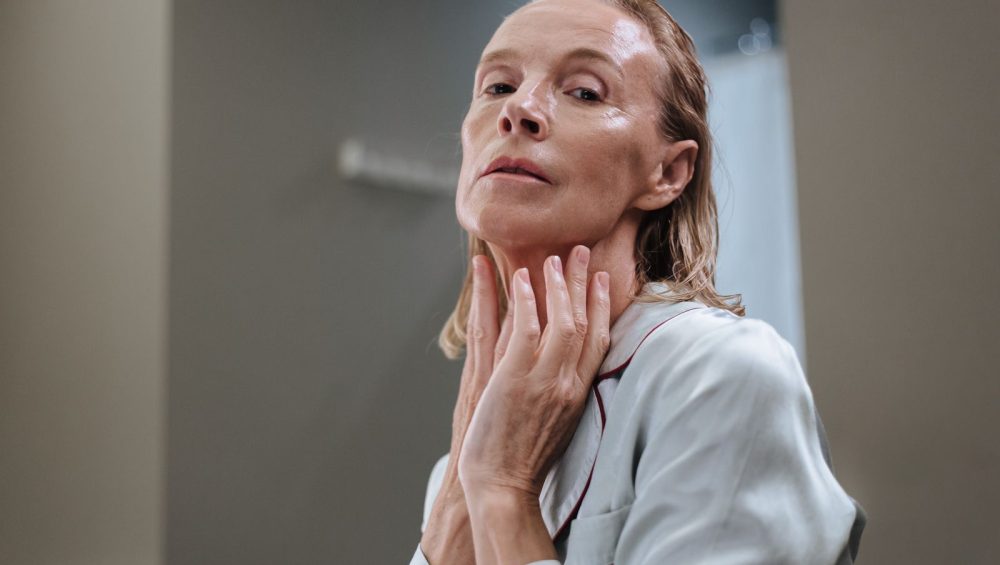
Most of the visible aging women notice in their fifties is not vanity. It is biology, and the timeline is steep.
The dermis, the living layer beneath the surface, is roughly 70 to 80 percent collagen by dry weight, and collagen keeps skin firm, plump and quick to bounce back. As estrogen falls during and after menopause, collagen production falls with it. The most-cited estimate puts the loss at up to 30 percent of dermal collagen in the first five years after menopause, then roughly 2 percent per year after that. It is worth knowing exactly where that number comes from, because it is not quite where everyone says. Brincat’s 1987 study — the reference point nearly forty years later — reports a decline of roughly 1 to 2 percent per year. The “30 percent in five years” formulation entered the literature through later reviews citing one another, and it is now repeated almost everywhere. The underlying study was cross-sectional, comparing different women at different stages rather than following the same women over time, and no longitudinal work has replaced it. Treat the figures as the best available estimate rather than a precise schedule for your own face.
If that estimate is anywhere near right, close to a third of the dermis’s structural support can go inside five years. That is why skin that behaved well in your forties can look thinner, drier and more lined seemingly overnight. Oil production slows, the lipid barrier weakens, and fine lines settle into deeper folds.
You deserve the honest boundary before anyone sells you anything. A topical skincare product cannot simply replace the dermal collagen and volume lost over time, and no cream does what a filler or surgical procedure does. Injectables add volume. Surgery repositions tissue. A well-formulated topical routine changes the quality of the skin at the surface: its hydration, its texture, its tone, the strength of its barrier, and how visible those fine lines become. That is a smaller promise than the industry usually makes, and it is the one that holds up.
02 — The definition: what “clinical-grade” really means, and what it doesn’t
“Clinical-grade” and “medical-grade” are marketing terms. The FDA does not regulate or define them, no agency certifies who may use them, and any brand can print the words on a box. That is not the same as nobody policing them — the moment the words imply a product is clinically proven, that implied claim has to be substantiated, and the FTC, the National Advertising Division and state consumer-protection law all provide routes to challenge one. But there is no standard behind the term itself.
Which means the label guarantees nothing about the four things below. They are not properties that come with the phrase. They are characteristics worth investigating in any product, at any price, whatever it calls itself.
01. Appropriate active concentrations. What matters is whether an ingredient is present at a level that does something — and concentration on its own settles very little. It has to be considered alongside the formulation it sits in, the delivery system carrying it, how stable it is in the bottle, and how well your skin tolerates it. Plenty of drugstore retinols run at 0.5 or 1 percent, so “cheap means underdosed” is lazy and often wrong, and a higher number is not automatically a better product. A well-formulated, stabilized 0.3 percent retinol can serve you better than a 1 percent that oxidized in the warehouse or that your skin cannot tolerate often enough to use.
02. Ingredient quality you can ask about. “Pharmaceutical grade” does not mean a vaguely purer version of the same molecule. It means the material was made and tested against a published monograph: a specific identity test, named impurities with numeric ceilings, limits on residual solvents and trace metals, a microbial specification, and documentation for every batch. The purity figures in those monographs are windows rather than floors, and they differ by ingredient — pharmacopeial niacinamide is specified at 98.5 to 101.5 percent, vitamin E at 96 to 102 percent, and lactic acid at 88 to 92 percent by design. “Cosmetic grade” is not a legal category anywhere; it is a supplier’s assurance that a material is fit for use on skin, which sometimes means testing for things a drug monograph ignores entirely. Ask what standard a brand buys to.
03. Stability, so the active is still active when you use it. Most shoppers never think about this, and it wastes more money than anything else in skincare. Retinol, vitamin C and botanical extracts all degrade on contact with light, air and heat. An oxidized active is not a weaker version of the ingredient you paid for. It is a different molecule that no longer does the job. Serious formulators spend real money on the problem: encapsulation, antioxidant pairings that slow oxidation, and light-filtering packaging. A formula can look flawless on paper and lose ground in the jar if nothing protects it between the lab and your face.
04. Evidence behind the claims. Ingredient-level studies are more readily available and more commonly cited. Evidence on the finished formulation is rarer, and where it exists it tells you more about that particular product — though plenty of well-made cosmetics have never had a finished-product trial, so its absence is not a disqualification. And note what an appearance claim like “helps reduce the appearance of fine lines” actually means. It keeps the product on the cosmetic side of the FDA’s line, but it does not excuse the brand from holding evidence: cosmetic claims cannot be false or misleading, and the FTC expects a company to have a reasonable basis for a performance claim before the advertising runs.
None of this requires a doctor’s office. It does require reading past the label.
03 — The counter: what a prestige price does and does not tell you
Prestige counters sell beautiful products. The textures are gorgeous, the packaging is heavy and elegant, and the experience feels like a reward. Some prestige lines invest in research and have decades of science behind a hero product or two.
The catch is that price is not evidence. A high price can reflect formulation and research, and it can equally reflect the packaging, the retail experience and the marketing, and nothing on the box tells you the ratio. That is not a claim about any particular brand’s economics — it is a reason to evaluate the four things above rather than the price, in either direction.
Three traps worth knowing after 50
Plastic, and the fingers that go into it. Two separate problems get confused here. The first is the container material. Airless pumps solve contamination, but there is no such thing as a glass airless bottle or jar — airless packaging is plastic, whether PET, HDPE or PP. How much light protection a container gives depends on the material, its pigmentation, its opacity and how it is built, and clear plastic gives very little. The second problem is your hands. Fingers introduce bacteria into any open container, glass or plastic, and the fix for that is not the container. It is a cosmetic spatula, used every time, with any jar.
Esenté’s Elite collection uses Miron violet glass, selected for its light-filtering properties and its suitability for protecting sophisticated botanical formulations. For liquids in bottles the contamination question largely disappears, since a standard pump already keeps fingers out of the product.
Not sure what light and air do to a botanical ingredient? Cut an apple in half and leave it on a plate in ordinary daylight. The cut faces brown, and keep browning. The chemistry there is enzymatic and is not the same reaction that degrades a serum, but it makes the general point visible: exposure changes things, and inside a poorly packaged bottle you cannot see it happening.
Added fragrance in a formula built for thinning skin. Two things get blurred here that are not the same. Added fragrance is a compound blended into a formula to give it a scent. It contributes nothing to aging skin, and it is a recognized source of sensitivity for some people — which on a thinning, reactive barrier is a risk without a return. A scent arising from botanical ingredients that earn their place in the formula is a different thing, but it is not automatically gentler: naturally occurring fragrant constituents can provoke a reaction too. Esenté’s position is simply that it adds no perfume, and where a product carries a scent it comes from the botanicals in the formula.
“Inspired by” actives in token amounts. A label can name an impressive ingredient that sits low on the list. On its own that is a question rather than an answer — whether an ingredient does anything depends on concentration, formulation and delivery, and some genuinely effective ingredients belong below one percent.
The opposite trap exists too. Some drugstore brands, developed with dermatologists, deliver excellent hydration and barrier support for a fraction of the price. Price does not equal quality in either direction. The question is never “expensive or cheap.” It is what sits in the bottle, and whether there is enough of it to matter.
04 — The actives: the ingredients that move the needle after 50
Remember this short list. These ingredient classes have real evidence behind them for aging skin, and they are what you are actually looking for when you are deciding whether a product is worth its price.
Retinoids (cell turnover). The most studied topical anti-aging ingredient there is. Two topical retinoids carry FDA-approved anti-aging indications — tretinoin as Renova or Refissa, and tazarotene 0.1 percent cream — both as adjunctive agents for the mitigation of fine facial wrinkles and related signs, in people already using comprehensive skin care and sun avoidance. Each of those labels also states that the drug does not eliminate wrinkles, repair sun-damaged skin, or reverse photoaging. In controlled trials the class speeds cell turnover and raises type I procollagen in photodamaged skin. After 50, this is the workhorse. Tolerance is the whole game: concentration matters, and so does building up to it slowly enough that your barrier keeps pace.
Vitamin C (antioxidant). Defends against daily environmental damage, and is a cofactor in the body’s own collagen chemistry. L-ascorbic acid is the best-documented form and needs an acidic formula, below about pH 3.5, to get through the skin’s surface. The vitamin E and ferulic acid pairing is the best-documented formulation approach rather than a proven winner over every alternative — other derivatives and delivery systems exist, and nobody has run the trial that would settle it. It is also the least stable active on this list: light, air, heat and trace metals all degrade it, and how quickly depends on the formulation, the packaging and where you keep it. Colour is a poor guide, since some formulas start out gold or amber and the first breakdown products are colorless. A deep brown shift in something that started clear is a fair reason to replace it.
Peptides (signaling). Short amino-acid chains, some of which act as messengers in the skin. Palmitoyl pentapeptide-4 has the best evidence of the group: a 12-week, 93-person placebo-controlled split-face trial found modest improvement in the appearance of fine lines, run by the company selling the ingredient. Generally well tolerated, and a reasonable fit for thinning, reactive skin that cannot handle aggressive actives nightly — though tolerability depends on the whole formulation, not the peptide alone.
Niacinamide (barrier, tone). Strengthens the skin barrier, calms redness and improves tone. After 50, barrier support is foundational rather than optional.
Ceramides and hyaluronic acid (barrier, hydration). Not flashy, but essential. They support the barrier and hold water in skin that has lost much of its natural oil, which makes every other active work better and irritate less.
Sunscreen (prevention). The step with the strongest preventive evidence behind it. In a four-and-a-half-year randomized trial in Queensland, Australia, adults assigned to apply broad-spectrum SPF 15+ every day showed 24 percent less measurable skin aging on the back of the hand than adults left to use it at their own discretion, and no detectable increase across the study period. Sun exposure is the largest driver of visible facial aging you can control; the frequently quoted “up to 80 percent” figure is an estimate from the literature rather than a measured allocation, and twin studies suggest genetics account for a substantial share too. Roll up your sleeve and compare the inside of your forearm to your face — that is an illustration rather than an experiment, since facial skin is built differently, but it is a useful thing to look at. No serum outruns unprotected daylight. Look for broad spectrum on the label, not only an SPF number. Broad spectrum means the product has been tested against UVA as well as UVB, and only a broad spectrum sunscreen of SPF 15 or higher may state that it decreases the risk of skin cancer and early skin aging caused by the sun, when used as directed with other sun protection measures. SPF alone tells you about burning. Broad spectrum tells you about aging. Every morning, and reapplied through the day.
05 — The verdict: so, are clinical-grade products worth it?
For most women over 50, spending more can be well worth it, with one condition: you are paying for the formula, not the label.
A well-built product gives you appropriate active concentrations, ingredient quality you can ask about, and packaging that protects those actives long enough for you to use them. That combination has more to offer skin that is losing structure than a surface-level moisturizer does, however luxurious.
You may also use less. Concentrated formulas can go further per drop, and getting the choice right ends the expensive cycle of buying, abandoning and rebuying — though whether that offsets the price depends on the product and how you use it.
What is not worth it: paying more on the strength of the price tag, the packaging, or the words “clinical-grade” on the box.
A simple, effective routine after 50
You do not need fifteen steps. You need a few real actives, used consistently, in the right order.
Morning. Dermatology guidance is to wash your face morning and night. Esenté’s own approach, drawn from Victoria Nash’s experience with skincare clients, is that if the evening routine was done properly there is little left to remove, so many people do well with warm water and an aesthetic facial sponge or gauze pad in the morning, with a full cleanser reserved for oilier skin. Treat that as a preference worth trying rather than a rule — if your skin feels tight after a morning wash, a gentler cleanser is the more sensible fix. Follow with a high-quality antioxidant spray or a toner; Esenté treats this as a standing step rather than an optional one. Then a serum suited to your skin type, a light daytime moisturizer with ceramides or peptides, and always finish with a broad spectrum SPF 30 or higher. The sunscreen is not negotiable.
Evening. Cleanse and tone. If you wore waterproof eye makeup or lipstick, use a quality oil-based makeup remover on those areas only, then cleanse the face, neck and décolleté with a gentle cleanser. Follow with a toner or antioxidant spray. Then a serum for your specific needs, and a hydrating night creme.
How you cleanse, not only what you cleanse with. Esenté’s preference is an aesthetic facial sponge or gauze pad rather than fingers or a facial brush, and the principle behind it is sound: dermatologists generally recommend washing with light pressure, because rubbing irritates skin. Be aware that this is a professional approach rather than a universal finding — independent testing has not shown that a cleansing brush damages the skin barrier more than washing by hand. Take product out of any jar with a cosmetic spatula rather than your hands.
Pace. Add one new active at a time and give it a few weeks before adding another. That is so you know what caused a reaction if one comes, rather than a biological threshold. Thinning, mature skin rewards patience and punishes aggression.
The Esenté difference: what we put the money into
Esenté was built on this philosophy. Botanical, results-driven actives at concentrations that do real work, developed collaboratively by Victoria Nash with our professional formulation and manufacturing partners, rather than to a marketing brief.
Founder Victoria Nash has been a licensed aesthetician since 2004 and is an experienced skincare educator. Esenté formulations are used in the company’s own treatment clinic, Younger You Clinique, where working professionals apply them on real skin.
Four things follow from that:
- No added perfume. Where an Esenté product carries a scent, it comes from the botanical ingredients in the formula rather than from an added fragrance compound.
- Chirally corrected ingredients where appropriate. Some molecules exist in two mirror-image forms, and which one is present is usually what decides whether the ingredient does its job — a relationship specific to each compound rather than a general rule. In Esenté’s experience, sourcing and processing the form that does the work costs more in money and yield. Esenté’s ingredient declarations, supplied through its formulation and manufacturing sources, carry the applicable chiral designators.
- Miron violet glass on the Elite collection. A botanical formula degrading in the bottle is not a bargain at any price.
- Paraben free, which is a factual characteristic of how the line is formulated, and formulated with mature skin that is also reactive in mind rather than trading comfort against results.
The bottom line
After 50, your skin is working against a steep decline, and the products you choose decide how visible that decline becomes. Neither price, nor prestige, nor the phrase “clinical-grade” establishes that a product works. What does the work is the formulation: appropriate concentrations of ingredients with evidence behind them, ingredient quality, stability, protective packaging, tolerability on thinning skin, and whatever the brand can show you about the finished product.
Read the ingredient list, not the label. Spend on formulation quality, effective actives and packaging that protects them—not prestige for prestige’s sake. Wear broad spectrum sunscreen every single day. Do that, and the right routine will do more for your skin in your fifties than anything you tried in your thirties.

About the author. Victoria Nash, founder of Esenté Skincare and Younger You Clinique, has been a licensed aesthetician since 2004 and is an experienced skincare educator.
Reviewed by Victoria Nash, licensed aesthetician and founder of Esenté Skincare & Younger You Clinique. This article is educational and is not medical advice. Ask your dermatologist or licensed skincare professional about your own skin.</em>