
Short answer: Apply thinnest to thickest: cleanser, toner, water-based serums, moisturizer, then sunscreen last in the morning. A thin serum spreads and absorbs better on bare skin than over a layer of cream. Beyond order, storage decides how much active is left by the time you apply anything: light, air, and heat degrade retinoids and vitamin C, and how fast depends on the formulation, the packaging and where you keep it. You can follow a perfect routine with a degraded formula and see nothing.
Two variables, both invisible, both easy to fix.
Esenté formulations use a high percentage of botanical ingredients, which are prone to oxidation and lose efficacy over time. That is the reason for Miron violet glass packaging and its selective light-filtering properties. If you are unsure what oxidation looks like, cut an apple in half and leave it on a plate in daylight. The cut surfaces brown within a short time, and keep browning. The chemistry in an apple is not the chemistry in a serum — enzymatic browning is its own reaction — but it makes the general point visible: exposure to air and light changes things, and it changes them inside a bottle too, where you cannot see it.
Why order matters at all
Skincare products are built around a practical constraint. The outermost layer of your skin exists to keep things out, and different formulas behave differently against it. Some ingredients work at or within that surface layer and never need to go further; others do their job deeper in the epidermis.
Thin, water-based formulas tend to spread and absorb. Thick, occlusive formulas sit on top and seal. Applied over an occlusive layer, a thin serum has a harder time getting where it is going.
That gives you the working rule: thinnest to thickest. It is good practical guidance rather than a law of physics — how much any ingredient penetrates depends on the ingredient, the formulation and what it is layered with.
It also gives you the exception people miss. Sunscreen goes last in the morning regardless of texture, because it is designed to form a continuous film across the surface. Applying moisturizer over it disrupts that film and reduces the protection you measured on the bottle.
The morning routine, in order
1. Cleanser. Dermatology guidance is to wash your face morning and night. Esenté’s own approach, from Victoria Nash’s experience with skincare clients, is that if the evening routine was done properly there is little left to remove, so many people do well with warm water in the morning and a full cleanser reserved for oilier skin. Treat that as a preference worth trying rather than a rule; if your skin feels tight after a morning wash, a gentler cleanser is the more sensible fix. Whenever you cleanse, Esenté’s preference is an aesthetic facial sponge or a gauze pad. Dermatologists generally recommend washing with light pressure rather than scrubbing, because rubbing irritates skin — and independent testing has not shown that a motorized cleansing brush damages the skin barrier more than washing by hand, so treat the sponge-or-gauze recommendation as Esenté’s professional approach to keeping pressure low rather than as a universal finding.
2. Toner or antioxidant spray. Esenté treats this as a standard step rather than an optional one. Today’s hydrating toners and antioxidant sprays can help refresh and condition the skin while preparing it for the products that follow. Esenté Octet Herbal Toner or a high-quality antioxidant spray both work well here.
3. Water-based serum. This is the active step. Vitamin C in the morning, because it works as an antioxidant against daytime environmental exposure. Apply to slightly damp skin.
4. Eye product. Thinner skin, different formulation. Pat, do not rub.
5. Moisturizer. Seals in the layers below and supplies the barrier lipids your skin needs.
6. Sunscreen. Broad-spectrum SPF 30 or higher, every morning, last. Sun exposure is the largest driver of visible facial aging you can control — the commonly repeated “80%” figure comes from a single industry-authored study and should be read as an estimate of scale rather than a measured split — which makes this the step with the strongest preventive evidence behind it, and the one most often skipped in winter.
The evening routine, in order
1. Cleanse and tone. If you wore eye makeup or lipstick, use a quality oil-based makeup remover on those areas — Esenté Eye-Onizer Gentle Makeup Remover is designed for it. Follow with a gentle cleanser, then a toner or antioxidant spray, which is a standing step in Esenté’s routine.
2. Exfoliate, once or twice a week. Chemical rather than physical, using a micro-exfoliation product. Separating it from retinoid nights is sensible conservative practice for most people, particularly on reactive skin — it is not that the two can never appear in the same regimen, and some routines combine them under professional guidance.
3. Treatment serum. Retinoid, peptides, or targeted actives. This is the step where the actives you chose the routine for actually go on.
4. Eye product.
5. Moisturizer or night cream. Richer than the daytime version. Skin loses water faster overnight, and this is where a heavier occlusive earns its place.
The rules that actually change results
Wait between layers, but not long. There is no research behind waiting a specific number of seconds. Wait long enough that products do not pill — that is a texture problem, not a biological one. The commonly repeated advice to wait ten to twenty minutes between steps has little support and mostly guarantees people abandon the routine. The real exception is prescription tretinoin, whose labeling tells you to let skin dry fully after washing before applying.
Damp skin, with a caveat. Applying moisturizer to slightly damp skin to trap water is a reasonable habit. Treating “damp skin” as a way to boost every serum is not supported: wet skin can let some ingredients through more readily, but it depends on the ingredient, more penetration is not automatically better, and water on the face also dilutes whatever goes on top.
Introduce one active at a time. Give each a few weeks before adding another. That is not a biological threshold — no study has established one — it is so that if your skin reacts, you know what caused it.
More layers do not mean more results. Three effective products used consistently beat nine used erratically. Each additional step adds another chance to irritate the barrier.
Esenté does not recommend facial oils. This is Victoria Nash’s professional position rather than a general finding, and the research on oils is genuinely mixed: they are not one category. Olive oil is the one with real evidence against it — a controlled study found four weeks of it measurably weakened the skin barrier — while sunflower seed oil did the opposite in the same study. The comedogenic ratings circulating online descend from decades-old rabbit-ear testing rather than human skin, and a study in the Journal of the American Academy of Dermatology found that finished products made with so-called comedogenic ingredients are not necessarily comedogenic. If you are acne-prone, patch test and judge by what your own skin does.
The part nobody checks: what happens between applications
Here is where a perfectly ordered routine still fails.
Actives are chemicals, and chemicals degrade. Four things drive it: light, oxygen, heat, and water. Every one of them is present in a normal bathroom.
L-ascorbic acid is the most studied form of topical vitamin C and one of the least stable ingredients in common use. Light degrades it. Oxygen oxidizes it. Trace metals catalyse the reaction. Pure vitamin C needs an acidic formula — below about pH 3.5, a figure that comes from a 2001 Duke study performed on pig skin — to get through the skin’s surface, and that acidity is not a trade-off against shelf life, since acidic conditions actually keep the molecule more stable. How long any given serum holds up depends on the complete formulation, the packaging and where you store it, so treat “within weeks” as what can happen to a water-based formula left warm and exposed rather than a schedule that applies to every product. Colour is a poorer guide than most people assume: some formulas start out gold or amber because ferulic acid is a tan powder to begin with, and the first breakdown products are colorless, so a serum can lose potency while still looking fine. A deep brown shift in something that started clear is a fair reason to replace it. Pale yellow is not.
Retinoids degrade under UV exposure. That is why retinoid products belong in opaque or light-filtering packaging, and why a photosensitive active in a clear bottle is worth asking a brand about — the point is the photochemistry, not an inference about anyone’s intentions.
Fingers are the contamination route people forget. For products in open jars, use a cosmetic spatula to remove the amount you need rather than dipping in. Pumps, droppers and airless packaging already solve the problem; the broader principle is clean hands and not introducing anything into the container that does not belong there.
What good packaging actually does
Brands that take stability seriously use three defenses.
Light filtering. This is where amber glass and violet glass are commonly assumed to be interchangeable, and they are not. They solve different problems, and violet glass costs more.
Miron’s own description of its glass is that it acts as a filter rather than a shield: it reduces or blocks the wavelengths that drive degradation while letting a balanced range of light through, with performance depending on the glass’s composition, thickness and structure. That selectivity is the whole design. It is not a blackout across the spectrum, and the manufacturer is explicit that the glass does not stop change entirely.
Amber glass takes the broader approach, blocking light across the ultraviolet range and into the blue, while still passing a significant portion of the visible spectrum above that.
So the two are not solving the same problem, and neither is simply better. Amber blocks more; violet filters more selectively. For a formula built on botanicals, which of those matters depends on what is in the bottle.
Oxygen control. Chelating agents and careful filling both limit how much oxygen the formula meets. Nitrogen purging displaces oxygen before sealing.
Chelating agents in the formula. EDTA and similar molecules bind trace copper and iron, which otherwise catalyze oxidation from inside the bottle.
Esenté packages its Elite collection in Miron violet glass for the first of those reasons. The argument is a photochemical one: light drives the degradation of photosensitive actives, and packaging that filters the wavelengths responsible reduces how much of it reaches the formula.
Storage: five things to change today
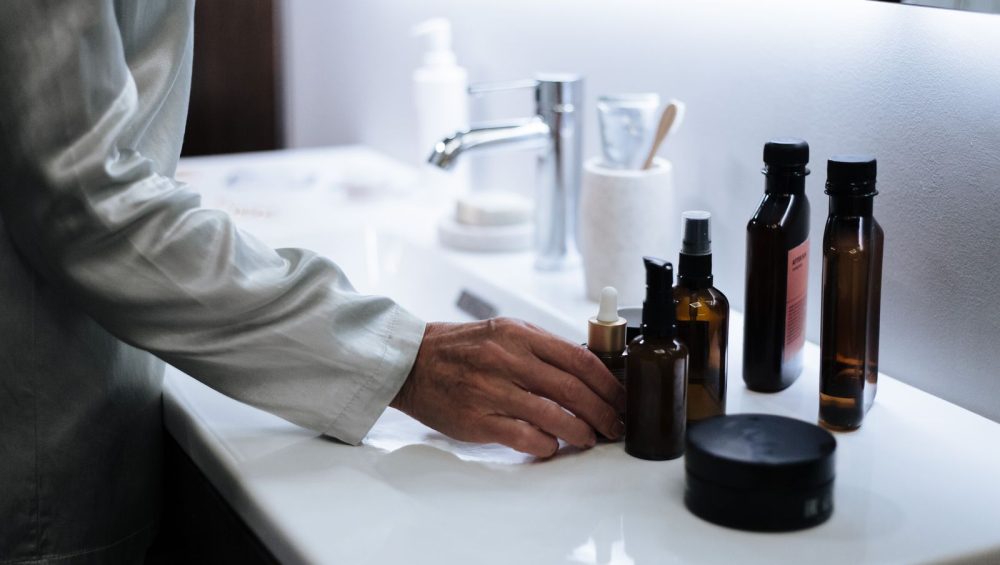
- Keep actives away from excessive heat, humidity and direct light. A cool, dry location away from windows and shower steam is preferable.
- Keep vitamin C cool and dark, and follow the label. Refrigeration is not required and no major brand asks for it, though cold does slow the chemistry a little for water-based pure vitamin C. Light and trace metals matter more than heat: an opaque, air-tight bottle kept out of a sunny bathroom does more than the fridge does. Follow the manufacturer’s own storage directions over any general rule.
- Close things properly and quickly. Every minute a bottle stands open is oxygen exposure.
- Use a spatula for anything in an open jar. Pumps, droppers and airless packaging already keep fingers out.
- Watch for the signals. A marked color shift, separation, or a changed smell are reasons to stop using a product and check with the manufacturer. Not every color or texture change means a formula has expired — but a clear serum that has gone deep brown has told you something.
Frequently asked questions
Do you apply serum before or after moisturizer?
Serum first. Serums are thin and formulated to be absorbed; moisturizers are thicker and formulated to seal. Applied over a moisturizer, a serum has a harder time getting where it is going.
What order should you apply skincare?
Thinnest to thickest: cleanser, toner, water-based serum, eye product, moisturizer, then sunscreen in the morning. Sunscreen always goes last in the daytime routine.
How many serums can you layer?
Two or three is a sensible practical limit for most routines. It is a matter of diminishing returns and rising irritation risk rather than a measured rule about penetration. Rotating actives across days tends to work better than stacking them all at once.
Does retinol expire?
Yes. Retinoids degrade with UV exposure, air, and heat, which is why they are packaged in opaque or light-filtering containers. Check the period-after-opening symbol on the packaging, and treat a marked color or texture change as a reason to stop using it and check with the manufacturer.
How should you store skincare?
Cool, dark, dry, and sealed. Keep photosensitive actives such as vitamin C and retinoids away from windows and out of steamy bathrooms, and follow the storage directions on the product itself. Prefer light-filtering glass over clear bottles, and use a spatula rather than your fingers with anything in an open jar.
Does violet glass really preserve skincare better?
Violet glass filters light selectively, which is how Miron itself describes it: reducing the wavelengths that drive degradation while letting a balanced range through, with performance depending on the glass’s composition, thickness and structure. Be aware of what the evidence base is. There is no independent peer-reviewed study comparing violet glass against amber for preserving cosmetics; what exists is manufacturer-supplied, and Miron states plainly that its glass does not stop change entirely. What is well established in the published literature is the underlying principle — light drives photo-oxidation, and protective glass measurably slows it.
About the author. Victoria Nash, founder of Esenté Skincare and Younger You Clinique, has been a licensed aesthetician since 2004 and is an experienced skincare educator.
Reviewed by Victoria Nash, licensed aesthetician and founder of Esenté Skincare & Younger You Clinique. This article is educational and is not medical advice.